
Spacewar! a free university experiment, ignited the arcade gaming revolution that birthed Atari, Pong, and modern gaming culture. Learn how failed prototypes led to commercial gold, why quarter-jammed machines changed entertainment forever, and how 1970s arcades laid the foundation for today’s $200B gaming industry.
“The secret to creativity is knowing how to hide your sources”, Albert Einstein (attributed)
Let me take you back to a time when video games weren’t just entertainment, they were a revolution.
A revolution that didn’t happen overnight, mind you, but through a fascinating collision of technology, business, and sheer human ingenuity.
It’s a story that begins in the 1960s, tucked away in university labs, with a group of dreamers and innovators who had no idea that their experiments would one day spark a global revolution.
Back then, it wasn’t about making games for profit. It was about pushing boundaries and experimenting with technology. But slowly, and often through trial and error, those early pioneers realised something: people loved these digital games.
And with that realisation, a spark was lit, leading to the rise of arcade games as the cultural force they would become in the 70s.

The exodus from academia
In the beginning, gaming was exclusively the domain of the academic world. At the Massachusetts Institute of Technology (MIT) and other research institutions, students and professors created early computer games as a form of experimentation. These games were collaborative and open-source, shared freely within university circles.
The most famous of these early experiments?
Spacewar!, created in 1962 by Steve Russell and his MIT pals. It was a simple two-player space shooter, but it was revolutionary. And here’s the kicker, it was free.
No copyright, no corporate ownership.
Just a digital gift passed around universities, tweaked and improved by whoever got their hands on it.
But while academics were happy to share, the real world had other plans. The computers needed to run Spacewar! (like the PDP-1) cost over $100,000, more than a house at the time. The idea of turning this into a business seemed ludicrous.
However, the academic world’s fascination with Spacewar! revealed a latent demand for interactive entertainment.
Yet, somewhere in the back of a few clever minds, a thought lingered: What if we could bring this to the masses?
The visionaries & the first (failed) attempts
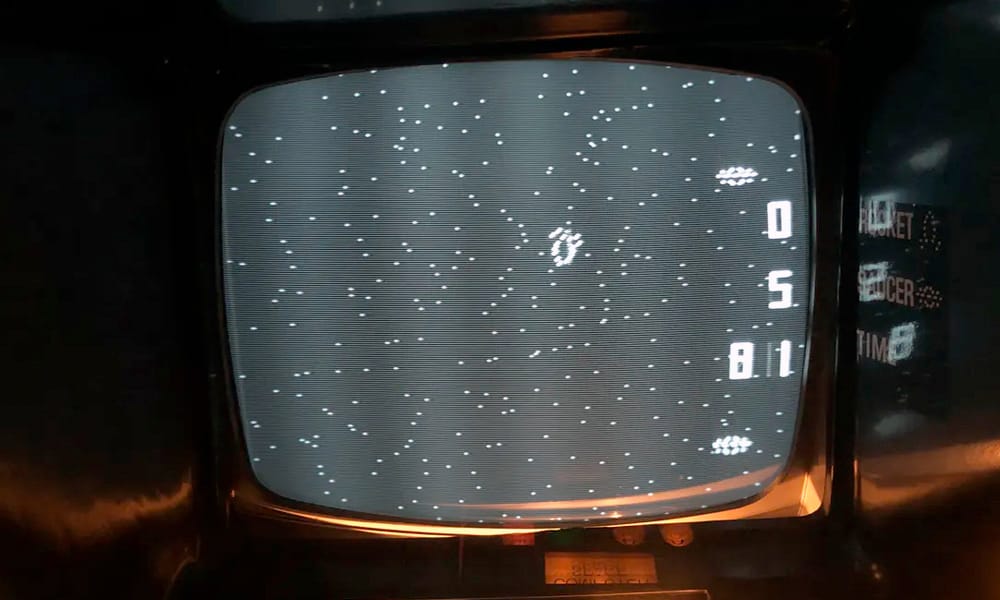
One of the first to recognise the potential for commercial gaming was Nolan Bushnell, a young engineer who had encountered Spacewar! during his time at the University of Utah. Bushnell saw that the appeal of the game extended beyond academic circles and recognised that in order to reach a wider audience, the technology had to be simplified and made affordable.
In 1971, he teamed up with Nutting Associates to create Computer Space, the first commercial arcade video game. It was essentially a stripped-down, single-player version of Spacewar!, housed in a sleek, futuristic fiberglass cabinet.
And yet… it flopped.
Why? Because it was too complicated.
Players had to juggle multiple buttons and joysticks just to steer their ship. The physics were realistic, but the average bar-goer just wanted something fun, not a spaceflight simulator.
As Bushnell later admitted, “It was too complicated for the guy who had just been drinking beer all night.”
The commercial failure of Computer Space demonstrated a key lesson: gaming needed to be accessible and enjoyable for a broad audience, not just those with the technical knowledge to navigate complicated controls.
The breakthrough: Pong & the birth of an industry
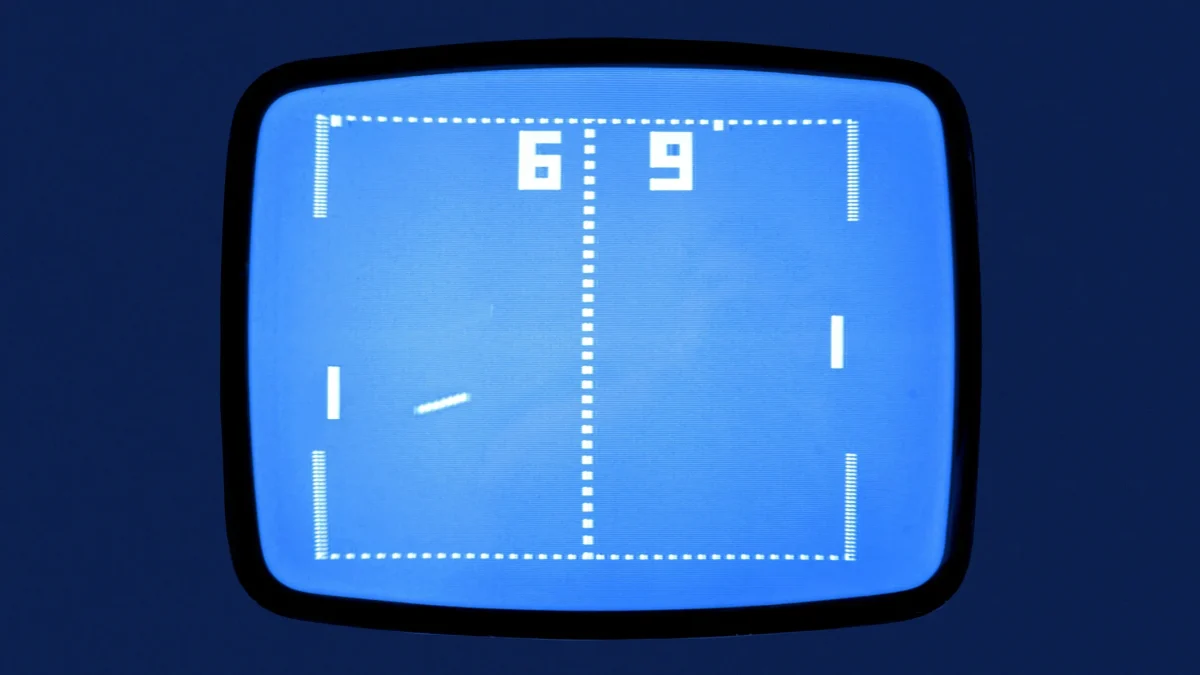
Undeterred by the failure of Computer Space, Bushnell founded Atari in 1972 with the goal of creating simpler, more accessible games. The company’s first major success was Pong, a tennis-like game that simplified the gameplay of early computer games and made it accessible to a broader audience.
Now, Pong wasn’t entirely original, it was inspired by Tennis for Two, an even earlier oscilloscope game.
Two players controlled paddles on opposite sides of the screen, trying to hit a square ball back and forth. The rules were simple, and the game required no previous gaming experience. The objective was clear within seconds of seeing the game played.
Pong was developed by Allan Alcorn, a young engineer who had recently joined Atari. Initially, Bushnell assigned the game to Alcorn as a training exercise, not anticipating its commercial success.
However, Alcorn added several key features that turned Pong into a phenomenon. He programmed the ball to change direction depending on where it hit the paddle, introduced sound effects, and added a gradual increase in speed to raise the excitement as the game progressed.
The first Pong cabinet was installed at Andy Capp’s Tavern in Sunnyvale, California, in September 1972. The game was an instant success, drawing crowds and quickly filling the coin mechanism with quarters.
In fact, the game proved so popular that the mechanism jammed from overuse. This moment marked the true birth of the arcade industry, a successful commercial game that led to the establishment of a new entertainment sector.
The arcade ecosystem emerges
With Pong’s success came a gold rush. Suddenly, everyone wanted a piece of the arcade pie. Companies scrambled to make their own games, leading to a wave of innovation:
- 1973: Space Race (first scrolling graphics)
- 1974: Tank (first game with ROM cartridges)
- 1975: Gun Fight (first microprocessor-based arcade game)
Arcades weren’t just places to play, they were social hubs. Players gathered around cabinets, cheering for high scores, trading tips, and forming rivalries. The high score board became a badge of honour, a way to leave your mark in digital history.
And the business model? Brilliantly simple:
- Manufacturers built the cabinets.
- Arcade owners leased them and took a cut of the profits.
- Players fed in quarters, again and again.
The key to success? “Easy to learn, hard to master.”
Games had to hook players fast but keep them coming back for more.
The technical revolution
As arcade gaming began to grow, so too did the technology behind the games. Early arcade games, such as Pong, used custom-designed circuits built specifically for one game.
But as demand for games surged, developers sought to create hardware that was more flexible and capable of supporting multiple games.
In the mid-1970s, microprocessor-based arcade machines began to emerge, offering greater flexibility, improved graphics, and more complex gameplay.
These microprocessor-based systems could be updated via software instead of requiring physical hardware changes, offering cost-saving benefits and creating the foundation for the future of home gaming consoles.
The graphical capabilities of arcade games also improved rapidly during this period. Games that once featured only simple geometric shapes now began to use sprites, adding depth and complexity to the gameplay experience.
The advancements in sound technology also allowed games to incorporate more realistic sound effects, which further enhanced player engagement.
Major arcade milestones (1962-1975):
- 1971: Computer Space is released as the first commercial video game.
- 1972: Pong is released by Atari, sparking the arcade boom.
- 1973: Space Race introduces scrolling graphics.
- 1974: Tank introduces ROM cartridges.
- 1975: Gun Fight becomes the first microprocessor-based arcade game.
The seeds of future innovation
The arcade boom of the early 1970s set the stage for future gaming innovations. The success of games like Pong demonstrated the importance of multiplayer interaction, which would later influence the rise of esports and competitive gaming.
The arcade business model laid the foundation for the development of gaming centers, internet cafes, and other location-based entertainment hubs.
The technical advancements made during the arcade era also paved the way for home gaming systems. The shift to microprocessor-based systems and the development of sprite graphics would directly influence the design of future video game consoles.
The arcade era planted the seeds for the home gaming revolution, which would explode in the 1980s and 1990s.