
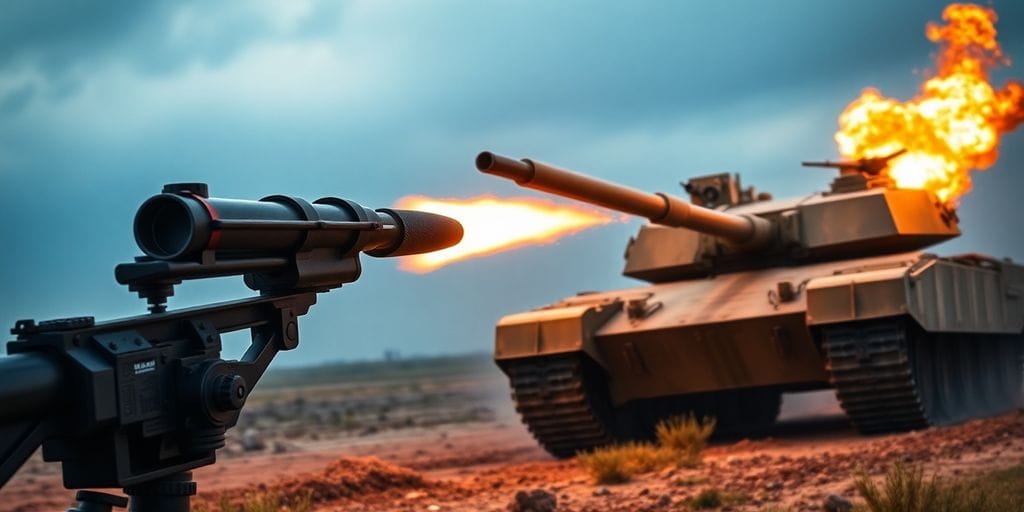
Ever wondered if that shoulder-fired rocket launcher could actually take down a main battle tank? We’re looking at the RPG-29, often called the ‘Vampir,’ and pitting it against the mighty M1 Abrams. It’s a classic matchup: a powerful, modern tank versus a potent anti-tank weapon. Let’s break down what makes each tick and how they might fare against each other. This isn’t just about specs; it’s about how these systems perform in real-world situations.
Key Takeaways
- The RPG-29 ‘Vampir’ is a Soviet-era rocket-propelled grenade launcher known for its tandem HEAT warhead, designed to defeat explosive reactive armor (ERA).
- The M1 Abrams is a highly survivable and mobile main battle tank, featuring advanced composite armor and a powerful 120mm main gun.
- There have been reports of RPG-29s damaging or penetrating Abrams tanks, particularly in engagements where the tank’s weaker rear or side armor was targeted.
- The effectiveness of the RPG-29 against an Abrams depends heavily on factors like the specific Abrams variant, the angle of attack, and the operator’s skill.
- Modern tank defenses, including Active Protection Systems (APS) and improved armor, aim to counter threats like the RPG-29, making direct comparisons complex.
Understanding the RPG-29 ‘Vampir’
Design and Operation
The RPG-29, also known as the ‘Vampir,’ is a Soviet-era rocket-propelled grenade launcher that entered service in 1989. It’s a shoulder-fired weapon, meaning a single soldier can carry and operate it. The system is pretty straightforward: it’s a tube-style launcher that’s loaded from the breech. On top, you’ll find a 2.7x optical sight, which helps the operator aim. Once fired, the rocket deploys eight fins to keep it stable as it flies towards its target. This weapon was the last RPG adopted by the Soviet military before the country dissolved. It’s designed for ease of use and portability in combat situations.
Ammunition Capabilities
The RPG-29 can fire a variety of rounds, giving it some flexibility. The main anti-tank round is the PG-29V HEAT (High-Explosive Anti-Tank) munition. This type of projectile is designed to defeat armor. There are also other types of ammunition available, like the TBG-29V thermobaric round, which is effective against personnel and structures, and the OG-29 HE/Frag round, which is designed to create fragmentation for use against softer targets. The stated penetration capabilities for the PG-29V are quite impressive on paper, with claims of being able to penetrate up to 750 mm of Rolled Homogeneous Armor (RHA). This figure can be reduced when facing advanced armor configurations like Explosive Reactive Armor (ERA).
Service History
The RPG-29 first saw service with the Soviet Army in 1989, making it one of the later developments in Soviet anti-tank weaponry. Since then, it has been used by various forces around the world. It gained some notoriety for its use by irregular forces in the Middle East, particularly during conflicts in Iraq and the 2006 Lebanon War. Reports suggest it was used against coalition forces in Iraq and against Israeli armor during the latter conflict. While it has been supplemented by newer systems like the RPG-30 and RPG-32 in some arsenals, the RPG-29 remains a known quantity in various regional conflicts.
The M1 Abrams: A Proven Main Battle Tank
Core Design Philosophy
The M1 Abrams tank represents a significant evolution in American armored vehicle design, moving away from earlier concepts. Its development focused on crew protection, firepower, and mobility, aiming for a balanced and survivable platform. The Abrams prioritizes keeping its crew safe above all else, a philosophy that has guided its upgrades over the decades. This approach means that while the tank might not always be the lightest or fastest, its ability to withstand damage and continue fighting is a key strength.
Armor and Survivability
Survivability on the M1 Abrams is achieved through a multi-layered approach. Its Chobham armor, a composite material, provides substantial protection against various threats. Additionally, the tank is equipped with an advanced fire suppression system to quickly deal with internal fires, a critical factor in preventing catastrophic ammunition explosions. The crew is also protected by blow-off panels on the ammunition storage, directing any explosion upwards and away from the crew compartment. This design philosophy has proven effective in numerous combat situations.
Firepower and Mobility
For firepower, the Abrams typically mounts a 120mm smoothbore cannon, capable of firing a range of advanced projectiles, including kinetic energy penetrators and multi-purpose rounds. This main gun provides the tank with the ability to engage and destroy enemy armor at considerable distances. Mobility is provided by a powerful gas turbine engine, which, while fuel-hungry, offers excellent acceleration and a high power-to-weight ratio. This allows the Abrams to keep pace with other elements of a modern combined arms force, maneuvering effectively on the battlefield.
Here’s a look at some key specifications:
| Feature | Specification |
|---|---|
| Main Armament | 120mm M256 smoothbore gun |
| Secondary Armament | .50 caliber M2HB machine gun, 7.62mm M240 machine guns (x2) |
| Engine | Honeywell AGT1500 gas turbine |
| Max Speed | ~42 mph (67 km/h) |
| Crew | 4 |
The Abrams’ design has consistently adapted to new threats, incorporating lessons learned from conflicts. This continuous improvement cycle is a major reason for its sustained effectiveness.
Engagement Scenarios: RPG-29 vs. Abrams
Reported Engagements in Iraq
Reports from the early 2000s suggest the RPG-29 saw action against coalition forces during the 2003 invasion of Iraq. While specific details can be hard to pin down, there are accounts of the RPG-29 engaging both American M1 Abrams tanks and British Challenger 2 tanks.
One notable incident, reportedly in August 2006 in Al-Amarah, Iraq, involved an RPG-29 round hitting the underside of a Challenger 2. The tank sustained minor damage and was able to drive away, but crew members were injured. Later, in August and September 2007, there were reports of RPG-29s hitting M1 Abrams tanks in Baghdad. These engagements resulted in crew casualties and damage to the tanks.
Vulnerabilities and Countermeasures
The engagements in Iraq highlighted certain vulnerabilities. The RPG-29, particularly with its tandem-charge warhead, showed it could penetrate the armor of even advanced tanks. In response, tank designs and add-on armor have evolved.
Here’s a look at how tanks have adapted:
- ERA (Explosive Reactive Armor): This is a layer of explosive material sandwiched between metal plates. When a shaped charge round hits, the explosive detonates outwards, disrupting the incoming jet of molten metal.
- Add-on Armor Packages: Tanks can be fitted with extra modular armor, often designed to defeat specific threats like shaped charges.
- Improved Armor Composition: Newer tanks incorporate advanced composite materials that offer better protection against a wider range of threats.
The effectiveness of any anti-tank weapon is a moving target. As tanks get better armor, new weapons are developed to defeat it, and vice versa. It’s a constant back-and-forth.
The Role of Active Protection Systems
Active Protection Systems (APS) represent a more modern approach to tank defense. Instead of just passively absorbing a hit, APS actively tries to intercept or disrupt incoming projectiles before they reach the tank.
- How APS Works: Typically, APS uses radar or other sensors to detect incoming threats like rockets or missiles. Once a threat is identified, the system deploys countermeasures, such as small explosive charges or pellets, to destroy or deflect the projectile.
- Adoption by Other Nations: Countries like Israel have integrated APS (like Trophy) into their Merkava tanks. Russia has also equipped some of its newer tanks with similar systems.
- US Interest: The US military has been testing and evaluating APS for its Abrams tanks and other armored vehicles, recognizing the need to counter evolving threats like advanced RPGs.
Assessing the RPG-29 vs. Abrams Threat
When we look at how the RPG-29 "Vampir" stacks up against the M1 Abrams, it’s really about understanding the specific ways these two systems interact on the battlefield. It’s not just about raw numbers, but how they perform in real situations.
Penetration Potential Against Modern Armor
The RPG-29 fires a tandem-charge warhead, specifically the PG-29V round. This design is meant to defeat explosive reactive armor (ERA) first, and then hit the main armor with a second, more powerful jet. Reports from conflicts suggest this tandem-charge capability can indeed pose a threat to the Abrams.
Here’s a look at the penetration figures for the PG-29V round:
| Ammunition Type | Penetration (RHA) | Penetration (RHA after ERA) |
|---|---|---|
| PG-29V (HEAT) | 750 mm | 650 mm |
This means that while the Abrams’ advanced composite armor is designed to stop many threats, the RPG-29’s tandem warhead is specifically engineered to get past reactive armor layers, which are often used on tanks like the Abrams.
Effective Range and Operator Skill
The RPG-29 has an effective range of about 500 meters. This isn’t a super long distance, especially when compared to the Abrams’ main gun. However, in urban environments or ambushes, this range can be more than sufficient to get a shot off.
- Operator Training: The effectiveness of the RPG-29 heavily relies on the person using it. Proper aiming and understanding of the target’s weak points are key.
- Targeting: Hitting a moving tank, especially a large and well-armored one like the Abrams, requires skill and often a bit of luck.
- Engagement Distance: Most engagements where the RPG-29 has been used against tanks have occurred at relatively close ranges, often within its effective zone.
The success of a shoulder-fired weapon against a main battle tank often comes down to more than just the weapon’s specifications. It’s about the environment, the element of surprise, and the training of the individual soldier.
The Impact of Upgrades on Both Platforms
Both the RPG-29 and the M1 Abrams have seen upgrades over the years. The Abrams has received various armor packages and improved fire control systems. Similarly, newer versions of RPG ammunition might exist, or operators might employ tactics to try and bypass the Abrams’ defenses.
For instance, the Abrams’ survivability has been improved with:
- Advanced Armor: Upgraded composite armor packages.
- Countermeasures: Systems designed to detect and defeat incoming threats.
- Situational Awareness: Better optics and battlefield information for the crew.
On the other hand, the RPG-29’s threat is somewhat mitigated by the Abrams’ design philosophy, which prioritizes crew protection and survivability. While the RPG-29 is a potent weapon, its ability to consistently defeat an Abrams depends on many factors, including the specific variant of the Abrams, the type of ammunition used, and the circumstances of the engagement.
The RPG-29’s Place in Modern Warfare
So, can the RPG-29 really challenge something like an Abrams tank? Well, it’s complicated. We’ve seen reports of the RPG-29 hitting tanks, sometimes causing damage and injuring crews, even against advanced armor. The PG-29V round, with its tandem charge, is designed to get through tough defenses. But tanks like the Abrams are constantly being updated, and they have their own ways of dealing with threats, like active protection systems. It’s not just about the weapon itself, but how it’s used, the crew’s training, and the specific situation on the battlefield. While the RPG-29 is a capable weapon, especially for infantry facing armored threats, it’s just one piece of a much larger military puzzle. Modern tanks are designed with many layers of protection, and a single handheld weapon, even a powerful one, faces a tough fight against a well-protected, technologically advanced main battle tank.
Frequently Asked Questions
What exactly is the RPG-29 ‘Vampir’?
The RPG-29, also called the “Vampir,” is a rocket launcher made in Russia. It was first used by the Soviet army in 1989. It’s designed to be carried and fired by a single soldier and is good at taking out tanks and other armored vehicles.
How does the RPG-29’s rocket work?
The RPG-29 fires special rockets called PG-29V rounds. These rockets are powerful because they have two explosive parts. The first part weakens the armor, and the second, bigger part blasts through it. This design helps it get through tough armor, even ones with extra protective layers.
What makes the M1 Abrams tank special?
The M1 Abrams is a main battle tank from the United States, known for its strong armor and powerful weapons. It’s been used in many conflicts and is considered one of the most advanced tanks in the world. It’s built to survive heavy attacks and fight effectively.
Has the RPG-29 ever damaged an M1 Abrams tank?
Yes, there have been reports of the RPG-29 hitting M1 Abrams tanks. Some incidents in Iraq showed that the RPG-29 could damage the Abrams, especially when hitting weaker spots like the rear or sides. However, the Abrams is designed to withstand many hits.
How far away can the RPG-29 effectively hit a tank?
The RPG-29 has an effective range of about 500 meters (or about 1,600 feet). This means it’s most dangerous at medium distances. Hitting a fast-moving tank like the Abrams at this range requires a skilled shooter.
How do upgrades affect the fight between the RPG-29 and the Abrams?
Both the RPG-29 and the Abrams have been upgraded over time. The Abrams has improved armor and systems to protect itself, while newer versions of the RPG-29 might have more powerful rockets. These upgrades make it harder for either weapon to easily defeat the other.