
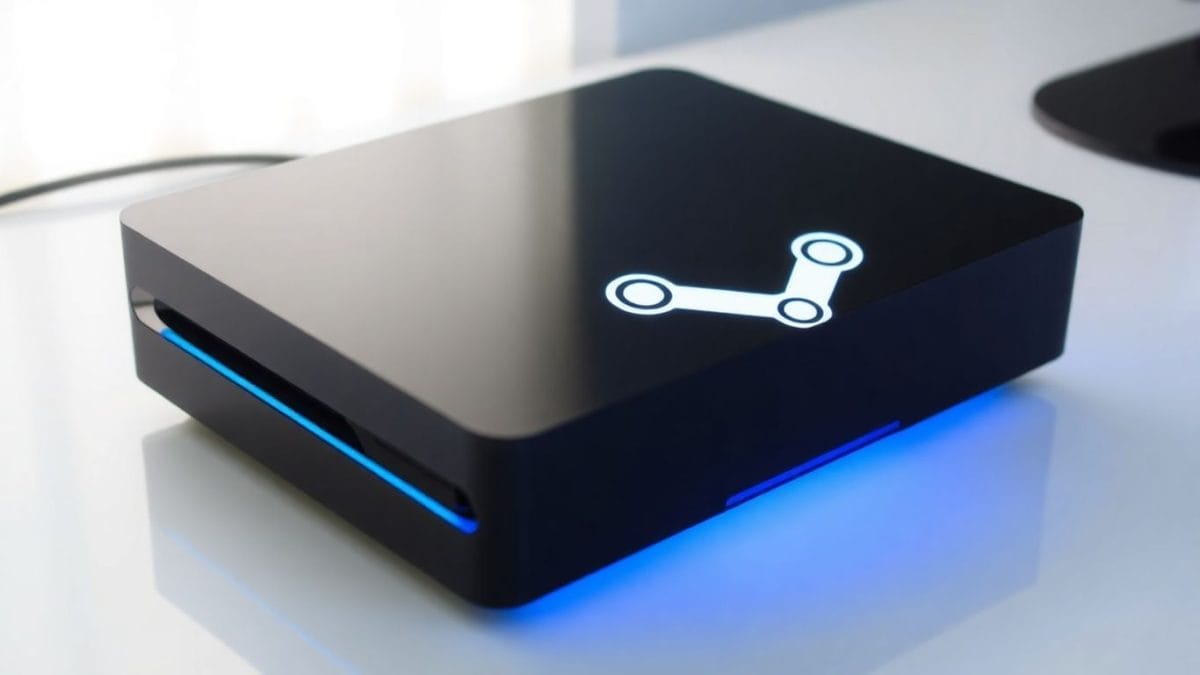
Valve, the powerhouse behind the ubiquitous Steam gaming platform, has unveiled a new iteration of its Steam Machine, aiming to carve out a significant space in the home console market. This ambitious venture seeks to bring the flexibility and power of PC gaming to the living room TV, directly challenging established giants like Xbox and PlayStation. The device, powered by Valve’s Linux-based SteamOS, promises high-fidelity gaming experiences, including 4K resolution at 60 frames per second, and is set to launch in early 2026.
Key Takeaways
- Valve is launching a new Steam Machine console in early 2026.
- The device runs on Linux-based SteamOS and features AMD hardware.
- A major challenge is overcoming Linux’s anti-cheat issues for competitive multiplayer games.
- Valve aims to appeal to both PC enthusiasts and console gamers.
- The company is also introducing a wireless VR headset, the Steam Frame.
A New Contender in the Console Wars
The Steam Machine represents Valve’s renewed effort to bridge the gap between PC and console gaming. Unlike its predecessor, which struggled to gain traction a decade ago, this new iteration boasts more powerful hardware, including a semi-custom AMD Zen 4 processor and RDNA3 graphics. Valve engineers claim the device’s performance can rival or surpass that of approximately 70% of gaming PCs currently in use, particularly when considering thermal management and optimized software.
The Linux Anti-Cheat Conundrum
While the Steam Machine offers a compelling proposition for PC gamers looking to play on their TV, a significant hurdle remains: anti-cheat software. Many popular competitive multiplayer games, such as Fortnite, Valorant, and Apex Legends, have historically been unplayable or have had their support withdrawn on Linux-based systems due to the inherent difficulties in implementing robust anti-cheat measures. Valve’s Proton compatibility layer has made strides, supporting anti-cheat systems like BattlEye and Easy Anti-Cheat, and Valve’s own Counter-Strike 2 and Dota 2 are playable. However, many game developers cite concerns about the ease with which cheating software can be developed for Linux and the relatively smaller player base on the platform, making the investment in securing their games less justifiable.
Targeting Enthusiasts and Newcomers
Valve’s strategy appears to be twofold: attract existing PC gamers who desire a more console-like experience in their living rooms, and potentially draw in console gamers seeking the breadth of PC gaming libraries. The company emphasizes that games will receive a "Steam Machine Verified" rating, assuring compatibility. Industry analysts suggest the device will likely appeal most to a dedicated enthusiast audience, similar to the niche but loyal following of the Steam Deck. The Steam Machine is positioned as a powerful, yet potentially more accessible, alternative to building a high-end gaming PC, offering a streamlined experience akin to traditional consoles.
Beyond the Console: VR Expansion
In addition to the Steam Machine, Valve has also announced the Steam Frame, a wireless virtual reality headset. Described as a "streaming-first" device, it also functions as a standalone PC running SteamOS, aiming to push the boundaries of VR technology with advanced graphical rendering techniques.
Sources
- Valve rivals Xbox and PlayStation with new console, BBC.
- For the Steam Machine to change PC gaming, Valve must solve Linux’s anti-cheat problem, Engadget.
- Valve engineer says Steam Machine is better than most gaming PCs, gHacks Technology News.
- DIY Steam Machine: How I turned my Steam Deck into a gaming console, PCWorld.