

So, you’ve picked up a deck and are ready to tackle the game card spider, huh? It’s a classic for a reason – a good mix of chance and smarts. Maybe you’ve played a few rounds and found yourself a bit stuck, or perhaps you’re just curious about how to get better. This guide is here to break down the game card spider, offering some straightforward tips to help you move from just playing to actually winning. We’ll cover the basics, some tricks for the early game, and how to handle those tricky middle-game situations. Let’s get those cards moving.
Key Takeaways
- Focus on clearing out columns early to get more cards face-up and create empty spaces for easier card movement in game card spider.
- When possible, prioritize building sequences of the same suit. This makes it much simpler to move them later and clear cards from the board.
- Empty columns are super valuable. Try to keep them free for strategic moves, ideally only placing a King or a sequence starting with a King in them.
- Don’t be afraid to use the undo button if a move doesn’t work out. It’s better to backtrack and try a different approach than to get stuck.
- Practice makes perfect. The more you play game card spider, the better you’ll get at spotting patterns and making smarter decisions.
Understanding the Fundamentals of Game Card Spider
Spider Solitaire might seem like just another card game, but it’s got a bit more going on under the hood. Getting a handle on the basics is the first step to actually enjoying it, and maybe even winning a few times. It’s not just about moving cards around; it’s about understanding the game’s structure and what you’re trying to achieve.
The Objective of Spider Solitaire
The main goal in Spider Solitaire is pretty straightforward: you want to arrange all the cards into complete sequences. These sequences need to be in descending order, from King all the way down to Ace, and importantly, they all have to be of the same suit. Once you manage to build one of these full, same-suit sequences, it gets cleared from the playing area. The ultimate aim is to clear the entire board of cards this way. The more sequences you complete, the closer you get to winning.
Setup and Dealing the Cards
Spider Solitaire typically uses two standard decks of cards, meaning you’re working with 104 cards in total. These cards are dealt into 10 columns on the table, which is called the tableau. At the start, only the top card of each column is turned face-up. The rest of the cards are stacked in a reserve pile, known as the stockpile. You’ll draw from this stockpile when you run out of available moves in the tableau.
Here’s a quick look at the initial setup:
- Columns 1-4: Each gets 6 cards, with the top one face-up.
- Columns 5-10: Each gets 5 cards, with the top one face-up.
- Stockpile: The remaining cards are placed here.
Navigating Difficulty Levels
Spider Solitaire isn’t a one-size-fits-all game. You can adjust the challenge based on how many suits you decide to play with. This is where the different difficulty levels come in:
- Easy (One Suit): This is the simplest version, where all cards are of the same suit. It’s a good place to start if you’re new to the game.
- Medium (Two Suits): This level introduces a bit more complexity by using two different suits.
- Hard (Four Suits): This is the classic and most challenging version, using all four suits. It requires more careful planning and strategy.
Choosing the right difficulty level is important. Starting with an easier setting can help you learn the mechanics without getting overwhelmed, allowing you to build confidence before tackling the more complex versions.
Essential Strategies for Early Game Success
Getting off to a good start in Spider Solitaire can make a big difference in how the rest of your game plays out. It’s not just about making any move; it’s about making the right moves that set you up for later.
Prioritizing Hidden Card Exposure
When you first look at the tableau, you’ll see a mix of face-up and face-down cards. Your main goal early on should be to flip over as many of those hidden cards as possible. Why? Because each face-up card gives you more options for making moves and building sequences. Think of it like this: you can’t play a card if you can’t see it. So, look for opportunities to move a card or a sequence off of a face-down card. This is often more important than making a seemingly good move that doesn’t reveal anything new.
- Look for moves that clear a card directly on top of a face-down card.
- Try to build temporary sequences that allow you to move a card and expose what’s underneath.
- Don’t be afraid to move cards around just to get to a hidden one, as long as it doesn’t create a worse situation.
Strategic Use of Empty Columns
Empty columns are like a breath of fresh air in Spider Solitaire. They give you a place to temporarily store cards or sequences, which can be incredibly useful for untangling messy parts of the tableau. However, you need to use them wisely. The best thing to put in an empty column is a King, or a sequence that starts with a King. This is because Kings can only start a new sequence, and an empty column is the perfect place for that. If you fill an empty column with anything less than a King, you’re limiting what you can place on top of it later.
The temptation to just dump cards into an empty column can be strong, but resist it. Think of that empty space as prime real estate – only the most valuable cards (Kings) should occupy it initially.
Avoiding Premature Column Filling
This ties into the previous point. While you want to use empty columns strategically, you also want to avoid filling them up too quickly with cards that aren’t Kings. If you place a 7 in an empty column, you can only place a 6 on top of it. But if you place a Queen there, you can stack several more cards on top of it. So, be mindful of what you’re placing in those empty spots. It’s better to leave a column empty for a while if you don’t have a King or a suitable sequence to place there, rather than filling it with something that restricts your future moves.
Mastering Tableau Management
The tableau, that main playing area with its ten columns of cards, is where most of the action happens in Spider Solitaire. Getting good at managing this space is key to winning. It’s not just about moving cards around; it’s about making smart moves that open up possibilities and set you up for success.
Building Descending Sequences
Spider Solitaire lets you build sequences in descending order, from King down to Ace. This is your primary tool for clearing cards and making space. You can build sequences using cards of any suit, which offers a lot of flexibility, especially early in the game. However, remember that a mixed-suit sequence can sometimes block future moves if you can’t add to it easily. The goal is to create these descending runs to eventually move them off the tableau.
The Role of Suit Matching
While you can build sequences with mixed suits, building sequences of the same suit is much more powerful. When you complete a full suit sequence (King down to Ace of the same suit), you can move that entire block to the foundation. This clears out a whole column, which is a huge advantage. Always look for opportunities to rearrange mixed-suit sequences into same-suit ones. It might take a few extra moves now, but it pays off later by freeing up space and making it easier to complete the game.
Effective Card Movement Techniques
Think about your moves before you make them. Sometimes, moving a card might seem like a good idea because it frees up another card. But does it help you build a longer sequence? Does it reveal a hidden card? Consider the "waterfall effect" – a single move that triggers a chain reaction of other possible moves.
Here are some movement ideas:
- Prioritize revealing face-down cards: Every face-down card you flip over gives you more options. Moves that expose these cards should often take priority.
- Use empty columns strategically: An empty column is a blank canvas. You can use it to temporarily store cards or to start building a new sequence. However, be smart about what you place there. Putting a King in an empty column without a Queen to follow it can essentially waste that valuable empty space.
- Look for moves that clear columns: Getting rid of entire columns gives you maximum flexibility. This allows you to rearrange other cards more freely and uncover more hidden cards.
Managing the tableau isn’t just about reacting to what’s in front of you. It’s about planning several steps ahead. Think about how your current move will affect the cards you can play in the next few turns. Sometimes, the best move isn’t the most obvious one, but the one that sets up a better situation down the line.
Advanced Tactics for Game Card Spider
Strategic Planning and Foresight
Moving beyond basic moves requires you to think several steps ahead. It’s not just about what you can do now, but what opportunities your current move will create or close off for the future. Look at the entire tableau. Can you set up a sequence that will allow you to expose a hidden card on the next turn? Or perhaps you can move a block of cards to free up a column that you’ll need later for a King. Careful observation and planning are what separate a good player from a great one.
Consolidating Sequences
As you build sequences, especially those spanning multiple suits, you’ll want to consolidate them. This means trying to get all the cards of a single suit into one descending sequence. It’s much easier to manage and complete a sequence when all the cards are together. If you have a 7 of Hearts in one column and a 6 of Hearts in another, try to bring them together. This makes it simpler to add the 5, then the 4, and so on, until you can clear the sequence.
Leveraging Empty Columns for Builds
Empty columns are precious. Don’t just fill them with any card. They are ideal for starting new sequences or for temporarily holding cards while you rearrange other columns. Think of them as staging areas. You can move a partial sequence into an empty column to free up space in another column, allowing you to make a critical move there. Remember, you can only place a King or a sequence starting with a King into an empty column, so use this rule to your advantage.
When you have multiple empty columns, you have a lot of flexibility. You can use them to break down complex stacks or to build up new sequences without disrupting your main tableau. Don’t be afraid to shuffle cards around between these empty spaces to find the best arrangement.
Here’s a quick look at how empty columns can be used:
- Starting New Sequences: Place a King in an empty column to begin building a new sequence.
- Temporary Storage: Move a partial sequence to an empty column to free up space elsewhere.
- Rearranging Cards: Use empty columns to shuffle cards and create better-ordered stacks in other columns.
Optimizing Your Game Card Spider Play
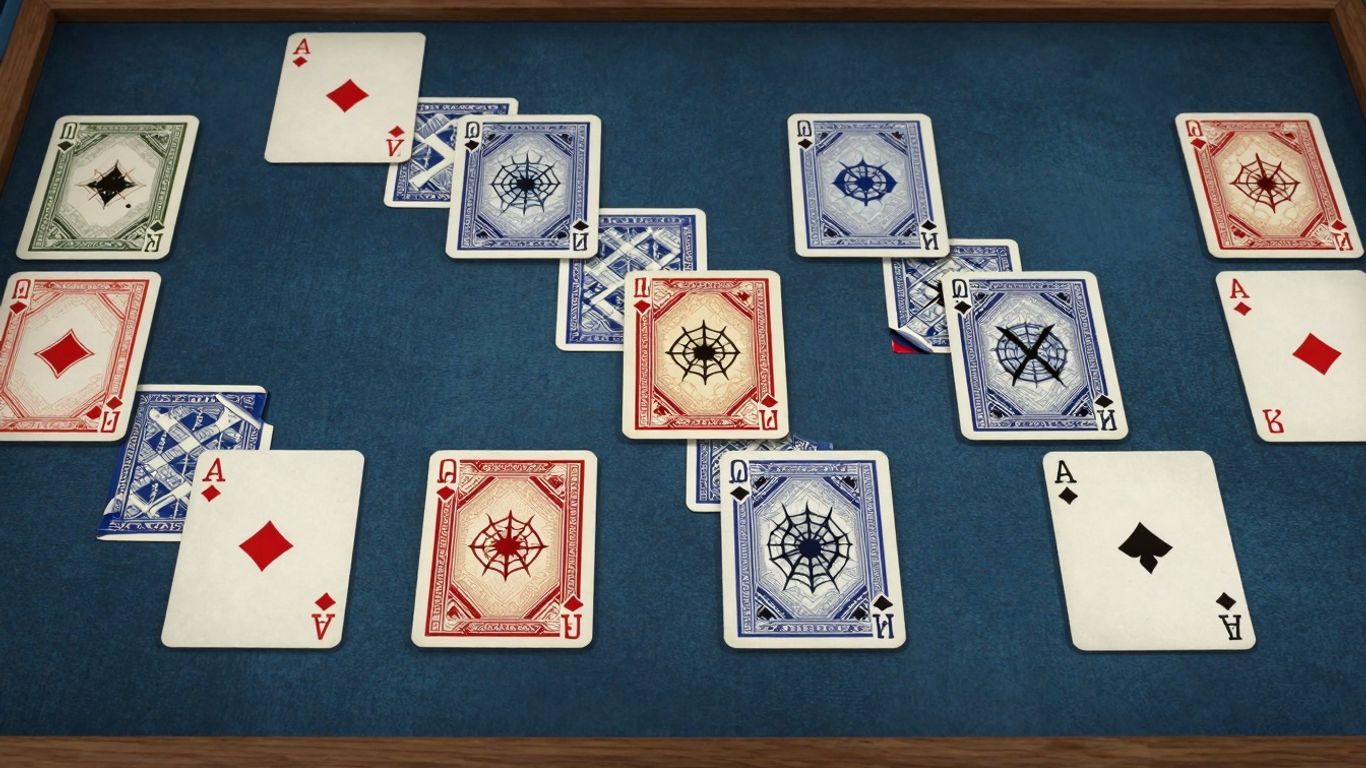
Once you’ve got a handle on the basics and some early-game tactics, it’s time to really refine how you approach each game of Spider Solitaire. This is where you move from just playing to truly mastering the flow and making every move count. It’s about being smart with what you have and planning ahead.
Wise Stockpile Utilization
The stockpile, that stack of face-down cards, is your lifeline when the tableau gets stuck. Don’t just click it whenever you feel like it. Think about when you click it. Ideally, you want to deal from the stockpile when you have as many empty columns as possible, or when you’ve made a move that opens up a lot of new possibilities. Dealing into a full tableau can sometimes just make a mess. Try to deal when you have at least one empty column to give yourself some breathing room.
Prioritizing Low Card Uncovering
In Spider Solitaire, the cards buried deepest are often the most important. While it’s satisfying to build sequences, don’t forget the cards hidden beneath others. Always look for opportunities to flip over face-down cards. Sometimes, a single move to reveal a hidden card can open up a cascade of other moves that were previously impossible. Prioritize moves that expose more cards, especially if those cards are part of a sequence you need.
Thoughtful Sequence Splitting
Sometimes, you’ll have a sequence of cards that are all the same suit, but they’re not in the correct order, or they’re mixed with other suits. You might be tempted to move the whole stack. However, it’s often better to split these sequences strategically. If moving a partial sequence allows you to expose a hidden card or create a more advantageous setup elsewhere, do it. You can always rebuild the sequence later. Think of it like breaking down a big task into smaller, manageable steps.
It’s easy to get caught up in the immediate goal of building a full suit. However, the best players look beyond the current sequence. They consider how a move, even if it temporarily breaks a sequence, might lead to uncovering more cards or creating an empty column, which are often more valuable in the long run. Patience and a broader view of the tableau are key.
Here’s a quick look at how different actions can impact your game:
- Exposing Hidden Cards: Increases available moves and options.
- Creating Empty Columns: Provides crucial space for strategic card placement.
- Dealing from Stockpile: Best done when the tableau has space or potential for new moves.
- Splitting Sequences: Can be beneficial if it leads to greater overall tableau improvement.
Common Pitfalls and How to Avoid Them
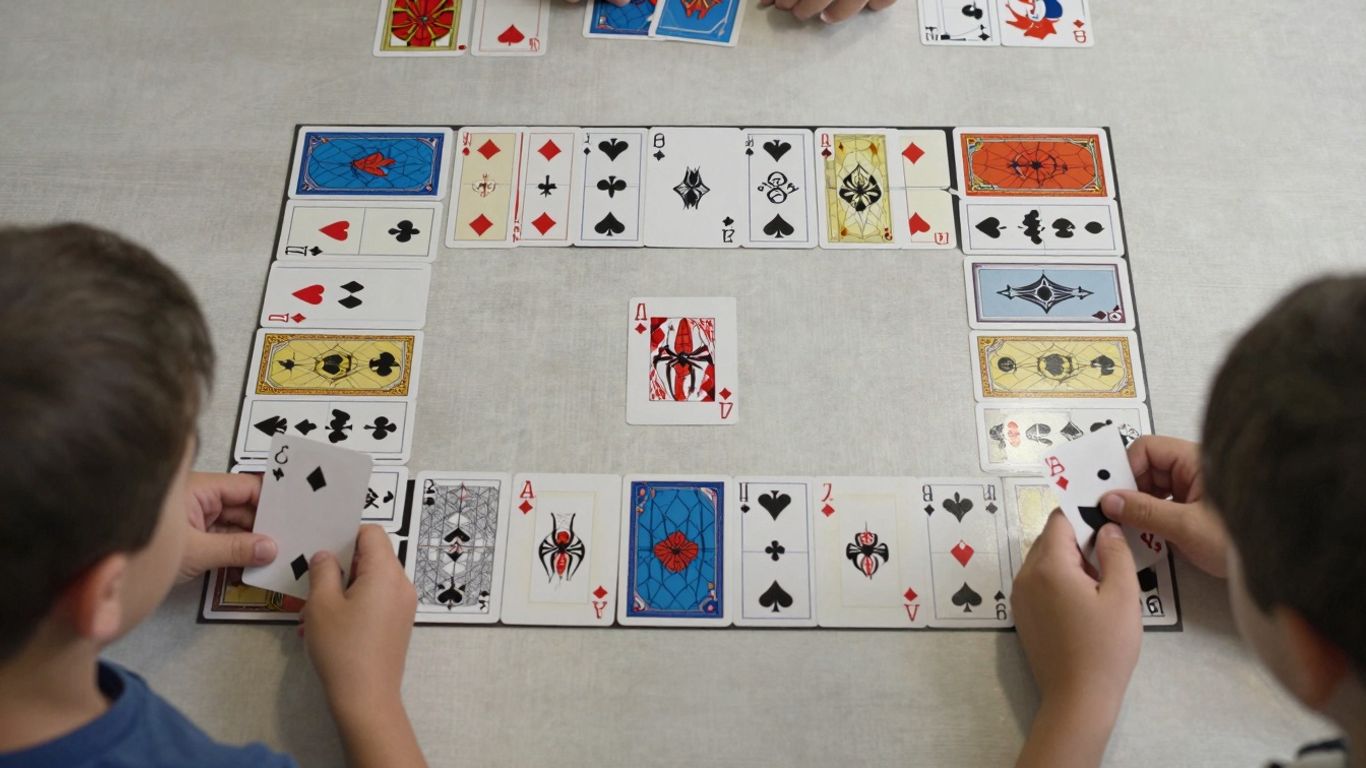
Even experienced players can stumble in Spider Solitaire. Recognizing common mistakes is the first step to fixing them and improving your game. Let’s look at a few traps to watch out for.
Impulsive Card Movements
It’s easy to get excited and just move the first card you see that fits. But every move should have a purpose. Before you shift a card or a sequence, pause for a moment. Ask yourself: What does this move achieve? Does it reveal a hidden card? Does it help build a same-suit sequence? Or is it just clearing space without a clear benefit? Making deliberate choices, rather than reacting, will lead to better outcomes.
Overlooking Buried Cards
Those face-down cards are the heart of the game. You can’t win if you don’t flip them over. Sometimes, a move might seem good because it clears space, but if it leaves a face-down card buried deeper, it might not be the best play. Always scan the tableau to see which moves will reveal new cards. Prioritize plays that uncover hidden cards, as they increase your options and are necessary for completing sequences.
Mismanaging the Stockpile
The stockpile is a lifeline, but it’s not infinite. Drawing from it too early or too often can leave you with a depleted resource when you really need it. Before you hit that draw button, try to make as many moves as possible on the tableau. If your columns are a mess, adding more cards from the stockpile can make things even worse. Think of it as a last resort, not a primary tool for clearing space.
Ignoring Suit Consistency
While you can move cards of different suits onto each other, it’s generally a bad idea. Building sequences with mixed suits can quickly become a tangled mess. It’s much better to focus on creating same-suit sequences. If you have a choice between moving a mixed-suit sequence or a same-suit sequence, almost always go for the same-suit option. This makes it easier to complete sequences and clear cards from the board.
Here’s a quick rundown of what to prioritize:
- Reveal Hidden Cards: Always look for moves that turn over face-down cards.
- Build Same-Suit Sequences: Keep your stacks organized by suit whenever possible.
- Use Stockpile Sparingly: Draw only when you have few other options.
- Empty Columns are Gold: Reserve them for Kings or sequences starting with Kings.
Sometimes, the best move isn’t the most obvious one. Take a breath, look at the whole board, and consider the long-term effects of your actions. Using the ‘undo’ button is not a sign of weakness; it’s a smart way to correct a mistake and explore alternative paths.
Elevating Your Skills Through Practice
So, you’ve got the hang of the basics and maybe even some of those trickier moves. That’s great! But like anything worth doing well, getting really good at Spider Solitaire takes time and, well, practice. It’s not just about playing more games, though. It’s about playing smarter and learning from every hand you’re dealt.
The Importance of Patience
Spider Solitaire can be a real test of your patience. Sometimes you’ll hit a wall, a game that just feels impossible to untangle. Don’t get discouraged. The key is to keep going, to not give up when things get tough. Instead of rushing, take a breath. Look at the board again. Maybe there’s a move you missed, a small sequence you can build that will open things up. Patience allows you to see those opportunities.
Analyzing Past Games for Improvement
Think about it like reviewing footage after a sports game. When you lose, don’t just shrug it off. Take a moment to rewind in your mind. Where did things go wrong? Was there a specific move that boxed you in? Did you draw from the stockpile too early? Identifying these moments helps you avoid making the same mistakes next time. Some versions of the game even let you replay a lost game, which is a fantastic way to try out different strategies without any real-world consequences.
Tracking Performance Metrics
If your game has a stats tracker, use it! Seeing your progress laid out can be really motivating. You can track things like:
- Win Percentage: How often are you coming out on top?
- Average Moves: Are you getting more efficient with your play?
- Time Per Game: Are you finishing faster as you get better?
Setting small goals, like improving your win rate by 5% or reducing your average moves by 10, can give you something concrete to aim for. It turns playing into a more focused learning experience.
Learning to play Spider Solitaire well isn’t just about knowing the rules; it’s about developing a feel for the game. This comes from repeated exposure and thoughtful reflection. Each game, win or lose, is a lesson. Pay attention to those lessons, and you’ll find your skills growing steadily.
Wrapping Up Your Spider Solitaire Journey
So, we’ve gone through the ins and outs of Spider Solitaire, from the basic rules to some smarter ways to play. It’s a game that really makes you think, and honestly, it can be pretty satisfying when you finally clear that board. Remember, the key is to take your time, look at all your options before you move a card, and don’t be afraid to use that undo button if you mess up. Keep practicing, maybe try out different versions of the game, and you’ll find yourself getting better and better. Before you know it, you’ll be a Spider Solitaire pro. Happy gaming!
Frequently Asked Questions
What’s the main goal in Spider Solitaire?
The big idea in Spider Solitaire is to get all the cards sorted into full suits, from King down to Ace. Once you make a complete suit, it disappears from the game. You win when all the cards are gone from the board!
How many decks of cards are used in Spider Solitaire?
Most of the time, Spider Solitaire uses two full decks of cards, which means you’re working with 104 cards. This makes the game a bit more challenging and gives you more cards to sort through.
What’s the difference between the difficulty levels?
The difficulty levels in Spider Solitaire usually depend on how many suits you have to sort. ‘Easy’ often means just one suit, ‘Medium’ uses two suits, and ‘Hard’ throws all four suits at you, making it much trickier to build complete sequences.
Why are empty columns so important?
Empty columns are like secret weapons in Spider Solitaire! They give you a free space to move cards around. It’s best to only put a King or a sequence starting with a King into an empty column. This keeps your options open for later moves.
Should I always try to keep cards of the same suit together?
Yes, absolutely! While you can move cards of different suits on top of each other to make descending piles, it’s much easier to win if you focus on building sequences that are all the same suit. This makes it simpler to complete sets and clear them from the board.
What’s a common mistake beginners make?
A really common mistake is filling up empty columns with cards that aren’t Kings. This traps those columns and limits what you can do. Also, sometimes players move cards too quickly without thinking ahead, which can make it harder to sort suits later on.