
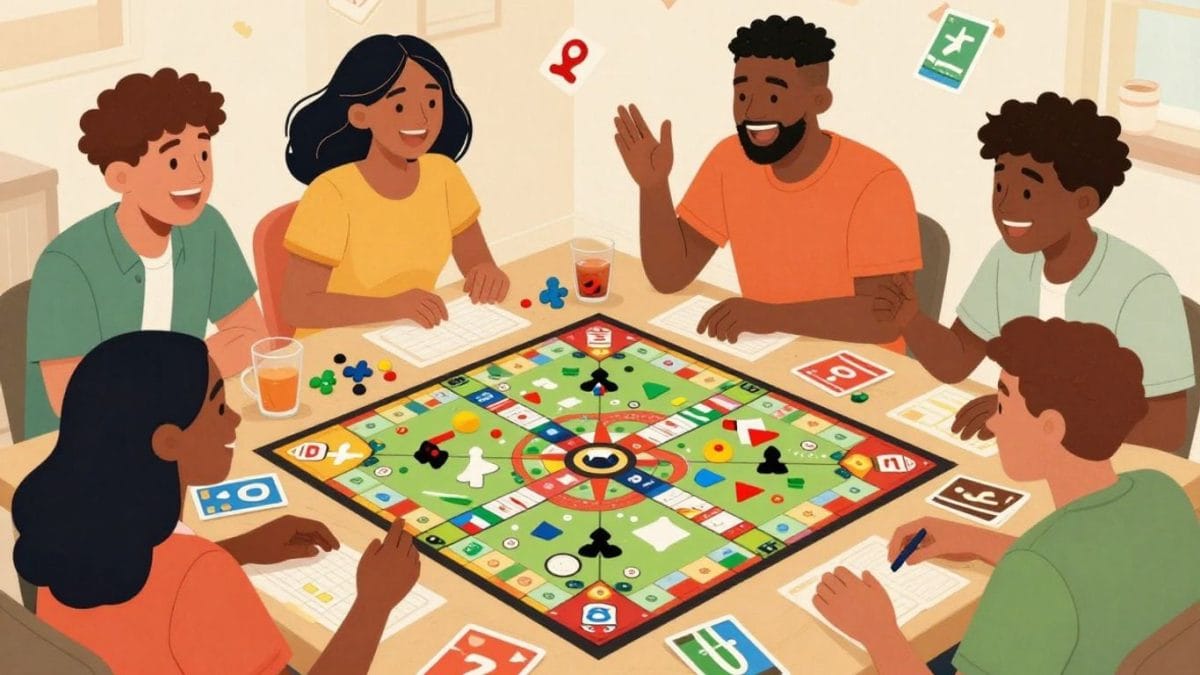
Getting together with friends is awesome, but sometimes you need more than just chatting. Whether you’re looking for something to break the ice or just want to liven up a get-together, having a few go-to games can make all the difference. Forget scrolling through your phones; these are the kinds of games to play with friends in real life that actually get people interacting and laughing. We’ve rounded up some top picks that are easy to set up and guaranteed to bring the fun, no matter the group size or occasion.
Key Takeaways
- Classic games like Charades and Pictionary are always a hit and require minimal supplies, making them easy to organize for any gathering.
- Icebreaker games such as Two Truths and a Lie and Never Have I Ever are great for helping people get to know each other better in a relaxed way.
- App-based games like Heads Up! offer a modern twist and are perfect for quick, energetic fun, even working well for virtual play.
- More involved games like Fishbowl and Mafia encourage sustained engagement and strategic thinking, ideal for groups looking for a deeper challenge.
- Simple, no-prep games are fantastic for spontaneous fun and can be easily adapted for various group sizes and settings.
1. Charades
Charades is a timeless party game that requires no special equipment, just a bit of imagination and a willingness to act silly. It’s a fantastic way to get everyone involved, regardless of age or background. The basic idea is simple: one person acts out a word or phrase without speaking, and their team tries to guess what it is. This game is brilliant for breaking the ice and encouraging non-verbal communication.
To get started, you’ll need some slips of paper and pens. Each person writes down a few words or phrases they think would be fun or challenging to act out. These could be anything from movie titles and book names to common actions or even inside jokes. Fold the papers and place them in a hat or bowl. Players then take turns drawing a slip and acting out the word for their team to guess within a set time limit, usually one to two minutes. The more creative the acting, the funnier the game becomes.
Here’s a quick breakdown of how to play:
- Preparation: Write down words or phrases on slips of paper. Fold them and place them in a container.
- Gameplay: Divide into teams. One player from a team draws a slip and acts out the word without making any noise.
- Guessing: Their team has a limited time to guess the word. If they guess correctly, the team gets a point.
- Rotation: Play continues with players from each team taking turns.
Charades is incredibly adaptable. You can tailor the words to your group’s interests, making it suitable for family gatherings, friend meetups, or even team-building events. It’s a game that consistently generates laughter and memorable moments, proving that sometimes, the simplest games are the most engaging.
2. Pictionary
Pictionary is a classic drawing game that tests your artistic skills and your ability to interpret them. It’s a fantastic way to get a group laughing, especially if you have a mix of artistic talents (or lack thereof!). The basic idea is simple: one person draws a word or phrase, and their team tries to guess what it is before time runs out. This game is all about quick thinking and visual communication.
To play, you’ll need a few supplies:
- A large pad of paper or a whiteboard
- Markers or pens
- A timer (a phone timer works perfectly)
- Slips of paper with words or phrases written on them (you can prepare these beforehand or have players write them as they go)
The game is typically played in teams. One person from a team draws a word from the hat and has a set amount of time, usually 60 seconds, to draw it. Their teammates shout out guesses. If they guess correctly, the team gets a point. If not, the turn passes to the next team. The first team to reach a predetermined score wins.
Pictionary really shines when you embrace the silliness. Don’t worry about creating a masterpiece; the more abstract or rushed the drawing, the funnier it often becomes. It’s the shared struggle and the hilarious interpretations that make the game memorable.
It’s adaptable too. You can tailor the words to your group’s interests, whether that’s pop culture, inside jokes, or even professional terms if you’re playing with colleagues. The key is to keep the energy high and the drawings coming!
3. Heads Up!
Heads Up! is a fantastic mobile game that turns your smartphone into a hilarious guessing machine. It’s perfect for breaking the ice or just injecting some spontaneous fun into any gathering. The basic idea is simple: one player holds the phone to their forehead, displaying a word or phrase. Their friends then act out, describe, or give clues to help the player guess what’s on the screen before time runs out. The game is incredibly easy to pick up, making it accessible for everyone, regardless of their gaming experience.
What makes Heads Up! so engaging is its variety and the sheer silliness that often ensues. The app comes with numerous categories, from animals and movies to accents and impressions, ensuring there’s something for every group’s taste. You can even create your own custom decks, which adds another layer of personalization and inside jokes for your specific circle of friends.
Here’s a quick rundown of how a typical round plays out:
- Player 1 selects a category and holds the phone to their forehead, screen facing outwards.
- Teammates start giving clues, making sounds, or acting out the word displayed.
- Player 1 guesses words. If they guess correctly, they tilt the phone down to move to the next word. If they want to pass on a word, they tilt the phone up.
- The timer runs down, and the goal is to guess as many words as possible before it expires.
This game thrives on quick thinking and creative clue-giving. The pressure of the ticking clock, combined with the often absurd words or phrases, leads to genuine laughter and memorable moments. It’s a low-stakes, high-reward activity for pure entertainment.
While the app is the primary requirement, the best part is that it requires virtually no other setup. You can play it anywhere – at a party, during a casual get-together, or even virtually with friends using video calls. It’s a testament to how simple mechanics can create deeply engaging and fun experiences.
4. Two Truths and a Lie
This is a classic icebreaker that requires no materials, just a willingness to share and a bit of creativity. It’s a fantastic way to learn surprising facts about the people you’re with, whether they’re new acquaintances or old friends.
The core idea is simple: each person states three ‘facts’ about themselves – two that are true and one that is a fabrication. The rest of the group then has to guess which statement is the lie. It’s amazing what people come up with, and the reveal often leads to laughter and further conversation.
Here’s how a typical round might play out:
- Player A: "I’ve met a famous actor, I can speak three languages, and I once swam with sharks."
- Group: Discusses, asks clarifying questions (if allowed by the group’s rules), and then votes on which statement they believe is false.
- Player A: Reveals the lie.
This game is particularly effective because it encourages active listening and critical thinking. You have to pay attention to what others say, not just about their statements, but also about their demeanor when they say them. It also prompts players to think about how they present themselves and what aspects of their lives might be interesting or surprising to others.
While the goal is to guess the lie, the real win is the connection made when truths are revealed and people discover unexpected commonalities or fascinating personal histories. It’s a low-stakes way to build rapport and make everyone feel a little more known.
It’s a game that scales well, working just as effectively with a small group of four as it does with a larger gathering of ten or more. The only real requirement is that players are comfortable sharing a little bit about themselves, even if it’s just a well-crafted fib.
5. Never Have I Ever
Never Have I Ever is a fantastic icebreaker that helps people discover shared experiences and learn surprising things about each other. It’s a simple game that requires no materials, making it perfect for almost any gathering.
The basic premise is to reveal things you haven’t done, and if someone else has done them, they take a point or put a finger down.
Here’s how a typical round plays out:
- Everyone starts with a set number of fingers raised (five is common) or a set number of tokens.
- One person starts by saying, "Never have I ever…" followed by an action they have not performed. For example, "Never have I ever been skydiving."
- Anyone who has performed that action must put one finger down or give up one token.
- The turn then passes to the next person, who says their own "Never have I ever…" statement.
- The game continues until one person has no fingers left, or until a predetermined number of rounds are completed.
It’s a great way to find common ground and spark conversations. You might be surprised to learn how many people in the room have also tried exotic foods or visited far-off places.
While the game can be played with any kind of statement, it’s often best to keep the prompts lighthearted and appropriate for the group. The goal is to foster connection, not discomfort.
This game is particularly effective in larger groups where people might not know each other well. It encourages a bit of vulnerability and humor, helping to break down social barriers quickly and easily.
6. Simon Says
Simon Says is a classic game that relies on careful listening and quick reactions. It’s a fantastic way to get people moving and paying attention, making it a great icebreaker or a fun break during longer gatherings.
The core of the game is simple: follow commands, but only if they are preceded by the phrase "Simon says." If a command is given without this preface, and you follow it, you’re out for that round. The last person remaining becomes the new "Simon."
Here’s how to play:
- Designate a Leader: One person starts as "Simon."
- Give Commands: Simon gives a series of instructions, such as "Simon says touch your nose," or "Simon says jump up and down."
- Listen Carefully: Players must only perform the action if Simon says "Simon says" before the command. For example, if Simon says, "Simon says clap your hands," everyone claps. But if Simon simply says, "Touch your toes," and you do it, you’re out.
- Elimination: Players who incorrectly follow a command or fail to follow a command that was preceded by "Simon says" are eliminated from the current round.
- New Simon: The game continues until only one player is left. That player then becomes the new Simon for the next round.
This game is wonderfully adaptable. You can play it with just a few friends or a large group, indoors or outdoors. It requires no props, just a willingness to participate and a good sense of humor. It’s particularly effective for testing attention spans and can lead to quite a bit of laughter as people try to keep up and avoid making mistakes.
7. 20 Questions
This classic guessing game is a fantastic way to engage your brain and test your deductive skills. One person secretly thinks of a person, place, or thing. The rest of the group then has up to 20 yes-or-no questions to figure out what it is.
It’s a simple concept, but it can lead to surprisingly complex and hilarious rounds of questioning. The key is to ask smart, broad questions first to narrow down the possibilities. For instance, instead of asking "Is it a dog?", you might start with "Is it alive?" or "Is it a physical object?"
Here’s a basic breakdown of how to play:
- Choose a Guesser and a Thinker: One person volunteers to think of the item, and the others form the guessing team.
- The Thinker’s Secret: The thinker selects a person, place, or thing. It could be anything from a historical figure to a type of food to a fictional character.
- The Questioning Phase: The guessing team takes turns asking yes-or-no questions. The thinker can only answer "yes" or "no." If a question can’t be answered with a simple yes or no, the thinker should say "sometimes," "maybe," or "irrelevant."
- Counting the Questions: Keep track of how many questions are asked. The goal is to guess the item within 20 questions.
- The Guess: At any point, a player can try to guess the item. If they guess correctly, the game ends, and they win! If they guess incorrectly, they are out for that round, or the team loses a question, depending on the agreed-upon rules.
This game really shines when the item chosen is a bit obscure or when the group gets creative with their questions. It encourages teamwork and strategic thinking as players try to build on each other’s questions to zero in on the answer.
20 Questions is a great icebreaker or a fun way to fill a few minutes, requiring absolutely no materials. It sharpens critical thinking and is adaptable for various age groups, making it a versatile choice for any gathering.
8. Fishbowl
Fishbowl, also known as Monikers, is a fantastic party game that gets progressively funnier with each round. It’s a game of guessing words or names that everyone in the group has contributed. The real magic happens as you cycle through different ways of giving clues, making it a versatile and engaging activity for a variety of group sizes.
The core of Fishbowl is its multi-round structure, building on the same set of player-generated words. This repetition and variation is what makes the game so hilarious and memorable.
Here’s how a typical game unfolds:
- Preparation: Each player writes down a few names (people, places, things – the more obscure, the better!) on separate slips of paper. These are then folded and placed into a bowl.
- Round 1: Taboo Style: Players take turns drawing a name from the bowl and trying to get their teammates to guess it by describing it. You can’t use any part of the word itself in your description. Once a name is guessed correctly, it’s set aside, and the player draws another. The goal is to get through as many names as possible in a set time.
- Round 2: One-Word Clues: All the names from Round 1 are put back into the bowl. This round is similar, but now you can only give one single word as a clue for each name. This requires a lot of memory and quick thinking from the guessers.
- Round 3: Charades: For the final round, all the names go back in. This time, you can only use actions and gestures – no words at all – to get your team to guess the name.
The beauty of Fishbowl lies in its adaptability. You can adjust the number of names each person writes, the time limits for each round, and even the types of names allowed to tailor the game to your group’s preferences. It’s a game that truly rewards shared knowledge and inside jokes.
Fishbowl is excellent for groups of 8 to 15 people and typically lasts about 10 to 15 minutes per round, though you can easily play for much longer if everyone is having a good time. It requires minimal setup – just paper, pens, and a bowl – making it an easy choice for spontaneous fun.
9. Telephone Pictionary
This game is a fantastic blend of two beloved classics: Telephone and Pictionary. It’s a guaranteed way to generate some serious laughs as you witness how a simple idea can transform through a chain of interpretations. The core idea is to take a written phrase, have someone draw it, then have someone else describe that drawing in writing, and so on, until you see the hilarious evolution (or devolution!) of the original concept.
Here’s how a typical round unfolds:
- The Start: One player writes a sentence or phrase at the top of a piece of paper. This could be anything from "A cat wearing a tiny hat" to "The existential dread of a Monday morning."
- The Drawing: The paper is passed to the next player, who looks only at the written sentence and tries to draw it. They don’t write anything else, just the picture.
- The Description: The drawing is then passed to the third player. This player looks only at the drawing and writes a sentence describing what they think is happening in the picture.
- The Cycle Continues: The paper, now with a new written description, goes to the fourth player, who draws that description. This back-and-forth continues, alternating between drawing and writing, until everyone has had a turn or the paper has made its way around the group.
- The Reveal: At the end, the last player reveals their drawing or description, and then the group goes back through the chain, showing the original sentence, the first drawing, the first description, the second drawing, and so on. The contrast between the initial idea and the final interpretation is usually where the real fun lies.
The beauty of Telephone Pictionary lies in its simplicity and the unpredictable outcomes. It requires no special skills, just a willingness to participate and a good sense of humor. It’s perfect for breaking the ice or just adding a dose of silliness to any gathering. You’ll be amazed at how quickly a straightforward sentence can become a bizarre visual or a nonsensical description.
This game highlights the subjective nature of communication and perception. What one person sees or understands can be vastly different from another’s interpretation, especially when visual and written mediums are involved in a relay.
Supplies needed are minimal: just paper and pens for each participant. It’s an excellent activity for groups of all sizes, though it shines with at least five or six people to allow for more transformations.
10. Mafia
Mafia, also known as Werewolf, is a classic social deduction game that thrives on deception and discussion. It’s a fantastic way to get a larger group interacting and trying to figure out who among them isn’t who they seem.
The core idea is simple: players are secretly assigned roles. Most players are innocent Villagers, but a few are secretly part of the Mafia. The game alternates between ‘day’ and ‘night’ phases.
During the night, the Mafia members secretly choose a Villager to eliminate. When morning comes, the group is informed that someone has been ‘killed,’ and the remaining players must then discuss and debate who they suspect is part of the Mafia. The goal for the Villagers is to identify and vote out all the Mafia members before the Mafia eliminates everyone else.
Here’s a breakdown of the typical roles and flow:
- Villagers: The majority. Their goal is to find and eliminate the Mafia.
- Mafia: A small, hidden group. They aim to eliminate Villagers until their numbers are equal to or greater than the Villagers.
- Special Roles (Optional): Many versions include roles like a Doctor (who can save someone from being killed at night) or a Detective (who can investigate players to learn their role).
Gameplay Flow:
- Setup: Distribute role cards secretly.
- Night Phase: Everyone closes their eyes. The Moderator (or a designated player) signals the Mafia to open their eyes and silently choose a victim. The Moderator then signals them to close their eyes. If special roles are in play, they perform their actions.
- Day Phase: The Moderator announces who was eliminated. The remaining players discuss, accuse, and eventually vote to eliminate someone they suspect is Mafia.
- Repeat: Continue the night and day phases until one faction wins.
This game really tests your ability to read people and to bluff effectively. It’s amazing how quickly a group can turn on each other based on a few suspicious comments or a nervous glance. The tension builds with every round, making the eventual reveal incredibly satisfying, win or lose.
11. Saran Wrap Ball Game
This game is a fantastic way to inject some chaotic fun into any gathering, especially during holidays or when you just need a good laugh. It requires a bit of preparation, but the payoff in entertainment is well worth it. The basic idea is to create a large ball of saran wrap, layering small prizes and treats inside as you go. Think candy, small toys, gift cards, or even funny notes.
Here’s how you can set it up:
- Gather your supplies: You’ll need a generous amount of saran wrap, a collection of small prizes, and a pair of dice.
- Build the ball: Start with a prize in the center and begin wrapping it tightly with saran wrap. Continue adding more prizes and wrapping layers upon layers. The more prizes and layers, the bigger and more exciting the ball becomes.
- Prepare for play: Once the ball is complete, gather your players. One person will hold the saran wrap ball, while another rolls the dice. The goal is to roll doubles.
The first person to roll doubles gets to start unwrapping the ball.
As soon as they roll doubles, they can begin tearing away at the saran wrap to get to the prizes inside. Meanwhile, the dice-roller continues to roll. If the dice-roller manages to get doubles before the person unwrapping finishes their turn, they shout and take over the unwrapping duty. This continues, with players taking turns rolling the dice and unwrapping, until the entire ball is gone and all the prizes have been claimed. It’s a race against the dice and a test of speed and dexterity, leading to plenty of cheers and groans.
This game is a brilliant icebreaker because it gets everyone involved and creates a shared experience of anticipation and excitement. The element of chance with the dice, combined with the physical challenge of unwrapping, makes for a dynamic and memorable activity that guarantees laughter.
12. Wikipedia Race
This game is a fantastic way to test your general knowledge and quick thinking, all while having a good laugh. The goal is simple: get from a starting Wikipedia page to a designated target page using only internal links. It sounds straightforward, but it quickly becomes a strategic challenge.
To play, everyone needs access to a computer or tablet with internet. First, agree on a starting page and a target page. For example, you might start on "Banana" and aim for "The Eiffel Tower." Then, simultaneously, everyone clicks the first link they see on their starting page. The race is on to see who can reach the target page in the fewest clicks or the shortest amount of time.
Here’s how a typical game might unfold:
- Choose your pages: Pick a common starting point and a more obscure or distant target. The more unrelated they seem, the more interesting the race.
- Set the rules: Decide if you’re competing for the fewest clicks or the fastest time. You might also agree on whether certain types of links (like disambiguation pages) are allowed or disallowed.
- Start the race: Everyone opens their starting page and begins clicking links, trying to navigate the vast web of Wikipedia.
- Declare a winner: The first person to reach the target page, or the person with the fewest clicks, wins the round.
This game is surprisingly engaging and can lead to some unexpected discoveries as you bounce from one topic to another. It’s a great way to learn new things without even realizing it.
The Wikipedia Race is a testament to how interconnected knowledge can be. What seems like a random jump can often lead you down a path that reveals surprising connections between seemingly unrelated subjects. It’s a digital scavenger hunt that rewards curiosity and a bit of luck.
13. Virtual Pictionary
When you can’t be in the same room, Virtual Pictionary bridges the gap. This digital twist on the classic drawing game uses online tools to keep the fun going, no matter the distance. It’s a fantastic way to engage teams or friends who are spread out geographically.
The core idea remains the same: one person draws, and others guess the word or phrase. The main difference is the medium. Instead of paper and markers, you’ll be using digital whiteboards or specialized online Pictionary platforms.
Here’s how it generally works:
- Choose Your Platform: You can use the built-in whiteboard feature of video conferencing tools like Zoom or Google Meet. Alternatively, dedicated online Pictionary sites such as Skribbl.io offer a ready-made experience with built-in word lists and scoring.
- Set Up the Game: The host typically sets up a private room or shares their screen. Players might join via a link or by entering a code.
- Drawing and Guessing: One player is given a word to draw. They use the digital drawing tools to sketch their interpretation. The other players type their guesses into a chat or a designated guessing area. The first person to guess correctly earns points.
- Rotating Roles: Players take turns being the drawer, ensuring everyone gets a chance to both create and guess.
This game is particularly good for remote teams looking to maintain a sense of connection and camaraderie. It requires minimal setup if you use an online platform, and the visual nature of drawing and guessing makes it highly interactive and often quite humorous.
The beauty of virtual Pictionary lies in its adaptability. It can be played with just a few friends or a larger group, and the digital format often leads to unexpected and funny interpretations of words, making it a memorable experience for everyone involved.
14. Online Party Game Platforms
When you can’t gather in person, online party game platforms come to the rescue. These services offer a collection of digital games designed for group play, often accessible through a web browser or a dedicated app. They are a fantastic way to keep connections strong, especially for remote or hybrid teams, or just for friends who live far apart.
One of the most popular options is Jackbox Games. This platform provides various "party packs" filled with different games. The setup is straightforward: one person hosts the game on a computer or console, and everyone else joins using their own smartphone or tablet as a controller. This means no one needs a special gaming device, just an internet connection. Games like Quiplash, where players write funny answers to prompts, or Drawful, a Pictionary-style game with a twist, are known for generating a lot of laughs.
Here’s a quick look at what makes these platforms work:
- Accessibility: Players typically only need a web-enabled device (phone, tablet, computer).
- Variety: Platforms offer a range of game types, from trivia and drawing to word games and social deduction.
- Ease of Use: Hosting and joining are usually simple, with minimal technical setup required.
These digital spaces bridge physical distances, allowing for shared experiences and spontaneous fun. They transform screen time into active participation, making virtual gatherings feel more like real get-togethers.
Other platforms and sites offer similar experiences, often focusing on specific game types like virtual trivia or online board games. Many are designed with team building in mind, aiming to improve communication and camaraderie. The key is finding a platform that suits your group’s interests and technical comfort level.
15. Video Game Party Titles

When you want to bring a different kind of energy to your gathering, video games offer a fantastic avenue for interactive fun. These aren’t just for solo play; many titles are specifically designed for group enjoyment, whether you’re all in the same room or connecting online. Console party games can transform a casual get-together into an exciting competition or a cooperative adventure.
For those with a Nintendo Switch, titles like Super Mario Party are a go-to. They often blend classic board game mechanics with a wide array of quick, engaging mini-games that players can jump into. The beauty of these games is their accessibility; they usually have simple controls that even non-gamers can pick up quickly, making them perfect for mixed groups.
Here are a few things to consider when choosing video game party titles:
- Player Count: Ensure the game supports the number of people you’ll have. Some games shine with four players, while others can accommodate larger groups.
- Genre and Style: Think about what your friends enjoy. Are they into competitive racing, cooperative challenges, or quirky mini-game collections?
- Platform Availability: Make sure everyone has access to the necessary console or PC.
While the digital world offers endless entertainment, the real magic happens when shared experiences create lasting memories. Video games, when chosen thoughtfully, can be a powerful tool for connection, laughter, and friendly rivalry.
Beyond dedicated party consoles, many other video games can be adapted for group play. Games that allow for local multiplayer or easy online joining can be just as effective. The key is selecting titles that encourage interaction and shared enjoyment, turning a simple game night into a memorable event.
16. Crosstown Connections
Crosstown Connections is a fantastic icebreaker designed to get people mingling and talking in a low-pressure way. It’s all about forming quick partnerships and sharing something personal, which helps build comfort and energy within a group. The main idea is to pair people up, and then have those pairs share something about themselves, creating a chain of connections.
Here’s how it generally works:
- Form Pairs: Everyone finds a partner. This can be done randomly or by having people find someone they don’t know well.
- Share a Connection: Each pair discusses a prompt or question, like "Share a favorite travel destination" or "What’s a skill you’d like to learn?"
- Share with the Group (Optional): Depending on the group size and time, pairs might briefly share their connection with the larger group.
This activity is great because it’s highly interactive and requires no special materials. It’s especially useful for larger groups where it can be tough for everyone to get acquainted. The real magic happens when these brief interactions lead to more personal sharing, fostering a sense of trust and openness.
This game is a simple yet effective way to break the ice. It encourages interaction and helps people discover common ground quickly, making it ideal for the start of meetings, workshops, or social gatherings. The focus on pairs means that even shy individuals often feel more comfortable participating.
Key Features:
- Group Size: Best for 15-30 people, but adaptable.
- Duration: Typically 10-15 minutes.
- Props: None required.
- Benefits: Encourages interaction, builds comfort, generates energy, and can lead to deeper connections.
17. Ice-Breaker Question Exchange
This activity is a straightforward yet effective way to get people talking and learning about each other. It’s particularly useful when you have a larger group that needs a simple, non-intimidating way to connect.
The core idea is to have participants exchange questions. You can prepare question cards beforehand, or simply ask everyone to think of a question they’d like to ask others. The goal is to encourage sharing and create a more comfortable atmosphere.
Here’s how it generally works:
- Preparation: Create a set of interesting, open-ended questions. These could range from lighthearted topics to more reflective ones, depending on the group and the desired outcome.
- Distribution: Hand out one question card to each participant, or have them write their own question on a slip of paper.
- Interaction: Participants mingle and find a partner. They take turns asking and answering the question they have.
- Exchange: After answering, they swap their question card with their partner. This ensures everyone gets to ask and answer different questions.
- Rotation: Continue this process for a set amount of time, allowing participants to interact with multiple people and learn various facts.
This method is great because it’s highly interactive and gives everyone a clear task. It helps break down initial barriers and can generate a lot of energy and conversation.
The beauty of the Ice-Breaker Question Exchange lies in its simplicity and the inherent structure it provides for interaction. It removes the pressure of initiating conversation from scratch, offering a guided path for participants to discover common ground and unique perspectives.
It’s a method that works well for groups of 30 or more and typically takes about 10 to 15 minutes to complete. It’s a solid choice for team-building events or any gathering where getting acquainted is a priority.
18. One Two Three
This is a straightforward yet effective game that works well for various group sizes and settings. It’s a fantastic icebreaker because it encourages quick thinking and interaction among participants.
The basic premise is simple: players count together, but with a twist. The goal is to get everyone to say a number in sequence, starting from one. However, at any point, a player can choose to say their own number or the number of another player. If two people say the same number at the same time, or if the count gets disrupted, the group has to start over.
Here’s how you can play:
- Everyone stands or sits in a circle.
- The group decides who will start the count (usually with the number ‘one’).
- Players take turns saying the next number in sequence. The catch is that any player can choose to say the next number, or they can point to another player and say that player’s number. For example, if it’s Player A’s turn to say ‘three’, they could say ‘three’ or they could point to Player B and say ‘three’.
- If two people say the same number simultaneously, or if the count is broken (e.g., someone says a number out of sequence or hesitates too long), the group must restart the count from ‘one’.
This game is great because it requires focus and a bit of strategy. You have to anticipate who might say what and try to coordinate without explicit communication. It’s a fun way to build a sense of group cohesion and get people talking.
The beauty of ‘One Two Three’ lies in its adaptability. It can be played with just a few people or a large crowd, and it requires no materials at all. This makes it an ideal choice for spontaneous gatherings or when you need a quick activity to energize a room.
It’s a game that often leads to laughter as people accidentally disrupt the count, but it also encourages a shared sense of accomplishment when the group successfully reaches a higher number together. It’s a good way to get people to pay attention to each other, which is a nice foundation for any group activity, much like managing your digital assets with a secure blockchain wallet app.
19. Making Connections
This is a straightforward yet highly engaging activity that requires no special equipment, just a good opening question. It’s designed to help people find common ground quickly and easily.
The core idea is to build a chain of people based on shared experiences.
Here’s how it works:
- Start with a statement: The facilitator begins by stating something they have done, said, or experienced. For example, "I have visited a national park."
- Find a connection: The first person who has also visited a national park links arms with the facilitator.
- Continue the chain: That newly connected person then makes a similar statement, and someone who shares that experience links arms with them. This continues, forming a growing line or circle.
- The final link: The last person to join the chain has the challenge of finding a connection back to the very first person’s statement, completing the circle.
This game is excellent for breaking the ice, especially in larger groups where people might not know each other well. It encourages active listening and provides a low-pressure way to share personal anecdotes.
This exercise is particularly effective because it moves beyond superficial introductions. By focusing on shared experiences, it naturally creates a sense of camaraderie and shared understanding among participants, making everyone feel a bit more connected.
Group Size: 15-30 people
Duration: 2-5 minutes
Why it’s great: Simple to grasp, fantastic for getting acquainted, works as a circle game, and needs no props.
20. Playing Card Mixers
Sometimes, the simplest tools can lead to the most engaging group activities. Playing cards, a common item found in many households, can be surprisingly versatile for breaking the ice and getting people to interact. These "card mixers" are designed to encourage conversation and connection among participants, especially in larger groups where people might not know each other well.
One popular approach involves using cards to pair people up for quick, fun interactions. You can prepare sets of cards beforehand, perhaps with matching pairs or sets of numbers. When it’s time to start, hand out one card to each person. The goal then becomes finding your "match" – whether it’s someone with the same number, suit, or a specific image. This simple task gets people moving around and talking to others they might not have approached otherwise.
Another method uses cards for a "find your partner" game. Before the event, write a word or phrase on two separate cards for each pair of participants. For example, you might have "salt" on one card and "pepper" on another, or "peanut butter" and "jelly." Distribute the cards randomly, and then have everyone mingle until they find the person holding the matching card. This encourages a bit of detective work and provides an easy conversation starter once pairs are formed.
These card-based activities are excellent for setting a relaxed and social tone. They require minimal preparation and can be adapted for various group sizes and settings, making them a go-to option for facilitators looking for quick, effective ways to build rapport.
Here’s a quick rundown of how you might use cards:
- Matching Pairs: Prepare pairs of cards (e.g., two "A" cards, two "B" cards). Distribute one card to each person and have them find their partner.
- Number/Suit Matching: Use a standard deck of cards. Assign a number or suit to different small groups. Participants find others with the same number or suit.
- Word Association Pairs: Write related words on separate cards (e.g., "sun" and "moon"). Hand out cards and have people find their corresponding word partner.
These mixers are fantastic because they’re low-pressure and provide a clear objective, helping people connect without feeling put on the spot. They’re a great way to kick off an event or transition between different parts of a program.
21. UBUNTU Cards
UBUNTU Cards offer a unique and engaging way to help people find common ground, making them a fantastic addition to any group activity, especially for larger gatherings where individuals might not otherwise interact.
These cards are designed to spark conversation and connection. The core idea is simple: participants draw a card, which presents a prompt or a question. The goal is to find someone else in the group who also drew the same card or has a similar experience related to the prompt. This shared element then becomes the basis for a brief discussion.
Here’s a general idea of how a UBUNTU Cards activity might work:
- Preparation: Ensure you have a deck of UBUNTU Cards. These can be purchased or sometimes created with specific prompts relevant to your group.
- Distribution: Hand out one card to each participant. It’s important that everyone receives a card.
- The Search: Participants mingle, showing their cards to others, looking for a match or a shared theme.
- Connection: Once a match is found, the pair discusses the prompt on their card, sharing their thoughts or experiences.
- Sharing (Optional): Pairs can then share their commonality or a brief insight with the larger group.
The beauty of UBUNTU Cards lies in their ability to facilitate spontaneous interaction and reveal shared experiences among participants, fostering a sense of community and understanding.
This activity is particularly effective for breaking the ice, encouraging networking, or simply adding a layer of interactive fun to an event. Its adaptability means it can be used for quick icebreakers or more extended networking sessions, making it a versatile tool for facilitators.
22. Jump In Jump Out
Jump In Jump Out is a lively energizer designed to quickly get people moving and interacting. It’s particularly effective for breaking the ice and generating a sense of playfulness in a group. The core mechanic involves participants responding to simple verbal cues, either by jumping into a designated space or staying put. This game is excellent for large groups and requires minimal setup.
Here’s how it generally works:
- The Setup: Designate a clear space in the room where participants will gather. This could be a circle on the floor or a specific area. Everyone starts outside this space.
- The Cues: The facilitator calls out statements. If a statement applies to a participant, they ‘jump in’ to the designated space. If it doesn’t apply, they ‘jump out’ (or stay where they are).
- Examples of Cues: Statements can be simple and inclusive, such as "Jump in if you’re wearing blue," "Jump in if you’ve had coffee today," or "Jump in if you enjoy reading." Conversely, "Jump out if you’re a morning person" would mean those who are not morning people stay put.
- The Goal: The aim is to see how many people can jump in for each cue, creating a dynamic visual of shared experiences and differences within the group. It’s a quick way to encourage random mixing and spark conversation.
This activity is fantastic because it’s highly adaptable. You can tailor the statements to the specific group or event. For instance, in a professional setting, you might use cues related to job roles or industry experiences. For a more casual gathering, the prompts can be about hobbies or favorite foods. The rapid nature of the game keeps energy levels high, and the simple instructions make it accessible to everyone, regardless of their comfort level with group activities. It’s a great way to transition into more involved discussions or activities, as it gets everyone physically engaged and mentally alert. You can find many variations of this game online, some even featuring AI chat characters to lead the prompts.
23. Ro Sham Bo
Ro Sham Bo, also widely known as Rock Paper Scissors, is a simple yet surprisingly engaging game that can quickly liven up any gathering. It’s a fantastic icebreaker or a quick energizer that requires absolutely no props, making it incredibly accessible.
The basic premise involves two players facing off, simultaneously forming one of three hand shapes: rock (a closed fist), paper (a flat hand), or scissors (a fist with the index and middle fingers extended).
Here’s how the winner is determined:
- Rock crushes Scissors.
- Paper covers Rock.
- Scissors cut Paper.
When played in a larger group, the game can evolve into a tournament-style bracket or a series of quick one-on-one challenges. It’s a great way to introduce a bit of friendly competition and get people interacting without any pressure. The sheer speed and unpredictability of the outcomes often lead to bursts of laughter and lighthearted banter. It’s a classic for a reason – easy to learn, fun to play, and always a crowd-pleaser.
This game is a testament to how simple mechanics can create significant engagement. It taps into a primal form of decision-making, making it universally understood and enjoyed across different age groups and backgrounds. The quick rounds mean everyone gets a chance to play and potentially win, fostering a sense of shared experience.
24. Around The World
This active group exercise is a fantastic way to get people moving and interacting. It’s adaptable, meaning you can frame it for individuals or teams, depending on what you want to achieve. The core idea involves participants moving through a series of stations or challenges, often in a circular or sequential manner, hence the name "Around the World." It’s designed to be energetic and engaging, making it a great icebreaker or energizer for larger groups.
The primary goal is to encourage participation and create a dynamic atmosphere.
Here’s a general breakdown of how it often works:
- Setup: Designate several distinct areas or ‘stations’ around the space. Each station can have a different simple task or challenge.
- Movement: Participants, either individually or in teams, move from one station to the next in a set order.
- Tasks: The tasks at each station can vary widely. They might involve physical challenges, quick problem-solving activities, or even simple communication games.
- Progression: The aim is usually to complete the task at each station before moving on. Sometimes, there’s a time limit for each station, or the group might be encouraged to complete the entire ‘world tour’ as quickly as possible.
This game is particularly effective because it breaks down any initial awkwardness and gets everyone involved physically. It’s also quite flexible, allowing facilitators to tailor the challenges to the group’s size, available space, and specific objectives, whether that’s team building, problem-solving, or just pure fun.
25. Clumps and more

Sometimes, the best way to get a group interacting is with quick, energetic games that don’t require much setup. "Clumps" is one of those games. The basic idea is to give people a very short amount of time to find others and form small groups. It’s a great way to break the ice and get people talking, especially in larger gatherings.
Here’s how a basic version of Clumps can work:
- The Setup: Designate a space where people can move around. You can use cones or ropes to mark out areas if you have a lot of space, but it’s not strictly necessary.
- The Call: Announce a number, say, "Form groups of four!" or "Find three other people!"
- The Frenzy: Everyone scrambles to find the correct number of people to form a "clump." This usually lasts about 90 seconds, but you can adjust the time.
- The Follow-Up (Optional): Once groups are formed, you can give them a quick question to discuss or a simple task to complete within their clump. This adds another layer of interaction.
This game is fantastic because it’s active, encourages quick thinking, and can be adapted for almost any group size. It’s all about getting people to connect in a fun, sometimes chaotic, way.
Beyond Clumps, there are other similar activities that focus on rapid interaction and getting to know people. Think about games where people have to arrange themselves in a certain order based on criteria you give them, or activities where they have to pass an object around a circle as quickly as possible. These kinds of games are excellent for boosting energy and creating a sense of shared experience.
These types of quick-fire games are perfect for when you need to get a group moving and talking without a lot of fuss. They’re simple to explain and always result in a lot of laughter and interaction.
Bringing People Together Through Play
So, there you have it. We’ve looked at a bunch of different ways to have some fun with friends, whether you’re all in the same room or spread out across the miles. Games are more than just a way to pass the time; they’re a pretty neat way to actually connect with people. They help break the ice, get you talking, and sometimes, you even learn something new about the people you’re playing with. Whether you’re into quick, no-fuss games or something a bit more involved, there’s really something out there for everyone. The main thing is to just get together and play. It’s a simple idea, but it works wonders for building stronger bonds and just making life a little more enjoyable for everyone involved.
Frequently Asked Questions
What are some classic games that don’t need much stuff?
Games like Charades, Pictionary, Two Truths and a Lie, and 20 Questions are super popular and don’t need much more than paper and pens, or sometimes nothing at all! They’re great for getting people talking and laughing without a lot of fuss.
How can we play games if some friends are far away?
No problem! Many games can be played online. You can use video calls for games like Charades or Pictionary (using online whiteboards), or try platforms like Jackbox Games where everyone uses their phones. Even simple guessing games work well over video chat.
What’s a good game for breaking the ice with new people?
Games like ‘Never Have I Ever’ (keep it light and fun!) or ‘Two Truths and a Lie’ are awesome icebreakers. They help people learn surprising things about each other in a relaxed way, making it easier to start conversations.
Are there any games that get everyone moving and energized?
Definitely! Games like ‘Saran Wrap Ball Game’ (with prizes inside) or active guessing games can get people up and moving. Some team-building activities also involve a lot of physical interaction and are great for boosting energy.
What if we have a really big group? What games work best?
For larger groups, simple games that can be explained quickly are best. ‘Mafia’ (or Werewolf) is great for bigger numbers, and games that involve everyone contributing, like a ‘One Word Method’ sentence game, can also work really well.
How do I make sure everyone has fun, even if they’re shy?
The key is to create a welcoming atmosphere. Explain the rules clearly and maybe even show how to play. As the host, your own energy and enthusiasm can make others feel more comfortable joining in. Also, have a few different game options ready in case one doesn’t click with the group.