AI is really changing things up, especially when it comes to making images. It’s pretty wild how we can now create visuals just by typing what we want. This whole area of ai generated imagery is opening up new doors for creators and even for everyday folks. Let’s take a look at what’s out there and how it all works.
Key Takeaways
- AI generated imagery uses machine learning, particularly deep learning and neural networks, to create visuals from text prompts or other inputs.
- Tools like Midjourney, DALL-E, and Stable Diffusion are popular for generating ai generated imagery, each with its own strengths in user experience and flexibility.
- These tools are finding applications across many creative fields, from graphic design to digital art, making advanced visual creation more accessible.
- There’s a noticeable difference in how professional and non-professional users interact with and perceive ai generated imagery tools, especially concerning ease of use and quality expectations.
- The rise of ai generated imagery brings important ethical questions about authenticity, copyright, and fair representation that need careful consideration as the technology evolves.
Understanding AI Generated Imagery
What Constitutes AI Generated Imagery?
AI-generated imagery refers to visual content, such as pictures and graphics, created by artificial intelligence systems. Instead of a human artist or photographer capturing or drawing an image, an AI model produces it. These systems learn from massive amounts of existing visual data to understand patterns, styles, and objects. When given instructions, often in the form of text descriptions, the AI uses this learned knowledge to construct a new image from scratch. The core idea is that the AI synthesizes novel visuals based on its training, rather than simply retrieving or editing existing ones. This process can result in images that are highly realistic, abstract, or anything in between, depending on the AI model and the input provided.
The Role of Machine Learning in Image Creation
Machine learning is the engine behind AI-generated imagery. It’s how these systems learn to create. Think of it like teaching a student by showing them thousands of examples. The AI is fed a huge collection of images and their associated data. Through this process, it starts to recognize relationships – what a ‘cat’ looks like, how light falls on a ‘mountain’, or the typical colors in a ‘sunset’.
Here’s a simplified look at how it works:
- Training: The AI model is exposed to vast datasets of images and text. It learns to associate words with visual elements.
- Pattern Recognition: It identifies recurring patterns, textures, shapes, and color palettes.
- Synthesis: When given a prompt (like "a red apple on a wooden table"), the AI uses its learned patterns to construct a new image that matches the description.
- Refinement: Often, there’s a feedback loop where the AI’s output is evaluated, and the model adjusts to produce better results over time.
The complexity of machine learning allows AI to go beyond simple replication. It can combine concepts, mimic artistic styles, and generate visuals that have never existed before, all based on the statistical relationships it has learned from data.
Generative Adversarial Networks Explained
Generative Adversarial Networks, or GANs, are a specific type of machine learning architecture that has been very effective in creating realistic images. Imagine a game between two players: a ‘Generator’ and a ‘Discriminator’.
- The Generator: This part of the AI tries to create fake images. Its goal is to produce images that look so real they can fool the other player.
- The Discriminator: This part acts like a detective. It’s shown both real images from the training data and the fake images made by the Generator. Its job is to tell which ones are real and which ones are fake.
These two networks work against each other. The Generator gets better at making fakes because the Discriminator keeps pointing out its mistakes. The Discriminator gets better at spotting fakes because the Generator keeps improving its creations. This continuous competition pushes both networks to become highly skilled, resulting in the Generator being able to produce very convincing, novel images.
Key Technologies Powering Image Generation
Generating images with artificial intelligence isn’t magic; it’s the result of sophisticated technologies working together. These systems learn from massive amounts of visual data to create new images that can range from photorealistic to abstract.
Deep Learning and Neural Networks
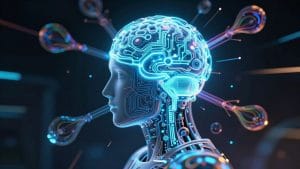
At the core of AI image generation are deep learning models, particularly neural networks. These are complex systems inspired by the structure of the human brain, with many interconnected layers that process information. When trained on vast datasets of images, these networks learn to identify patterns, textures, shapes, and even the relationships between different objects. This learning process allows them to understand what makes an image look the way it does, enabling them to construct entirely new visuals.
Natural Language Processing for Prompts
To interact with these powerful image-generating models, we use text prompts. This is where Natural Language Processing (NLP) comes into play. NLP is a branch of AI that focuses on enabling computers to understand, interpret, and generate human language. When you type a description like "a cat wearing a hat in a park," NLP algorithms break down your request, understand the key elements (cat, hat, park), and translate them into a format the image generation model can use to create the desired picture. The better the NLP understands your prompt, the closer the generated image will be to your vision.
Diffusion Models in Image Synthesis
Diffusion models represent a significant advancement in AI image creation. They work by starting with random noise and gradually refining it, step by step, to form a coherent image. Think of it like a sculptor starting with a block of marble and slowly chipping away until a statue emerges. These models are trained to reverse a process of adding noise to an image. By learning how to remove noise, they can effectively generate high-quality, detailed images from a noisy starting point, often producing results that are remarkably realistic and artistically diverse.
Exploring Popular AI Imagery Tools
The landscape of AI-generated imagery is rapidly evolving, with several powerful tools leading the charge. These platforms offer different approaches and cater to various user needs, from casual creators to seasoned professionals. Understanding their unique strengths can help you choose the right tool for your project.
Midjourney: An Intuitive Platform
Midjourney has quickly become a favorite for many, largely due to its accessible interface. It operates primarily through Discord, a popular chat application, which might seem unusual at first. However, this integration allows for a conversational way to generate images. You simply type a text description, known as a prompt, into a chat channel, and Midjourney’s AI interprets your words to create visuals. Its strength lies in producing artistic and often dreamlike images with relative ease. While it requires some practice to master prompt engineering for specific results, beginners often find it less intimidating than other tools.
DALL-E: Text-to-Image Capabilities
Developed by OpenAI, DALL-E is renowned for its impressive ability to translate complex text descriptions into detailed images. It excels at understanding nuanced prompts and can generate a wide variety of styles, from photorealistic scenes to abstract concepts. DALL-E’s interface is typically web-based, making it straightforward to use. Users input their text prompts, and the AI generates several image options. It’s particularly noted for its capacity to create novel combinations of objects and concepts that might not exist in reality.
Stable Diffusion: Open-Source Flexibility
Stable Diffusion stands out as a powerful open-source model. This means its underlying code is publicly available, allowing for greater customization and integration into other applications. While this flexibility is a major advantage for developers and advanced users, it can also present a steeper learning curve. Stable Diffusion can be run locally on a user’s computer (if hardware permits) or accessed through various online interfaces. Its open nature has fostered a large community that contributes to its development, creating numerous variations and specialized models. This makes it a versatile choice for those who want deep control over the image generation process.
The choice between these tools often comes down to a balance between ease of use, desired artistic style, and the level of control required. Midjourney often wins on simplicity, DALL-E on conceptual interpretation, and Stable Diffusion on flexibility and customization.
Applications Across Creative Fields
AI-generated imagery is not just a novelty; it’s actively reshaping how creative work gets done across various industries. These tools are making complex visual creation accessible to more people and speeding up processes for seasoned professionals.
Transforming Graphic and Advertising Design
For graphic and advertising design, AI image generators are proving to be a game-changer. They lower the barrier to entry, allowing individuals without extensive design training to create visuals for marketing campaigns, social media, or branding. Think about a small business owner who needs a quick graphic for a flyer – instead of hiring a designer or struggling with complicated software, they can now generate suitable images using simple text prompts. Professionals, on the other hand, are using these tools to rapidly prototype ideas, explore different visual styles, or generate background elements, saving significant time.
- Rapid concept visualization: Quickly generate multiple visual ideas for a campaign.
- Asset generation: Create unique icons, patterns, or textures for designs.
- Personalized marketing: Develop tailored visuals for specific audience segments.
The ability to generate diverse visual content on demand is democratizing design, enabling more individuals and businesses to participate in visual communication.
Enhancing Product Visualization
Product visualization is another area seeing a big impact. Companies can use AI to create realistic renderings of products that don’t even exist yet, or to show existing products in various settings and configurations without expensive photoshoots. This is particularly useful for e-commerce, where high-quality product images are vital for sales. Imagine an online furniture store showing a sofa in dozens of different fabric options and room settings – AI can make this process much more efficient.
New Avenues for Digital Art Creation
Digital artists are finding AI tools to be powerful collaborators. While some may use them to generate starting points for their work, others are integrating AI-generated elements directly into their pieces. This opens up entirely new aesthetic possibilities and allows artists to explore styles or concepts that might have been too time-consuming or technically challenging to create manually. It’s a new medium, and artists are experimenting with its unique capabilities to push the boundaries of digital art.
- Exploration of novel aesthetics: Discover visual styles not easily achievable through traditional methods.
- Iterative creation: Rapidly generate variations of an artwork to refine a concept.
- Mixed-media integration: Combine AI-generated elements with traditional digital painting or 3D modeling.
User Experiences and Tool Evolution
When people first started using AI image generators, there was a lot of excitement, but also some confusion. For folks without a background in art or design, tools like Midjourney quickly became popular because they were pretty straightforward to use. You could type in what you wanted, and something cool would pop out. It felt like magic, letting people create visuals for things like social media posts or personal projects without needing to learn complex software.
Professionals, on the other hand, often found the early tools a bit limiting. They needed more control and higher quality for their work. While they appreciated the speed, they also worried about the output looking too generic or not quite matching their specific vision. This led to a push for more advanced features and better fine-tuning options. The open-source nature of tools like Stable Diffusion allowed for more tinkering, but it often meant a steeper learning curve, sometimes requiring a good understanding of the underlying technology or powerful hardware.
The journey of AI image tools is really about finding that sweet spot between making things easy for everyone and giving experts the deep control they need. It’s a balancing act that developers are constantly working on.
Here’s a look at how different users approach these tools:
- Non-Professional Users:
- Often see AI as a collaborator, helping them achieve creative tasks they couldn’t before.
- Prioritize ease of use and quick results for diverse image types (cartoons, characters).
- Frequently use AI for graphic design, web design, and especially advertising.
- Professional Users:
- Tend to view AI more as a tool to assist their existing skills.
- Focus on realistic scenes and abstract art, requiring higher detail.
- Integrate AI into graphic design, product design, and web design workflows.
As these tools get better, the line between a simple tool and a creative partner continues to blur. The goal is to make them accessible enough for anyone to try, while still offering the depth that seasoned artists and designers require for their professional projects. It’s a dynamic space, and how we interact with these AI systems is changing rapidly, with ongoing discussions about how to best distinguish between human and machine-generated visuals AI image detectors. The evolution is geared towards a future where AI image generation is both powerful and approachable.
Ethical Considerations and Future Directions
As AI-generated imagery becomes more common, we’re running into some tricky questions. It’s not just about making cool pictures anymore; it’s about how these tools affect creators, the art world, and even what we consider real.
Authenticity and Misinformation Concerns
One big worry is that AI can be used to create fake images that look real. This could be used to spread false information, create deepfakes, or even just confuse people about what’s genuine. It’s becoming harder to tell what’s real and what’s been made by a machine. This is a problem for news, for evidence, and for trust in general.
Intellectual Property and Copyright Challenges
Then there’s the whole issue of who owns AI-generated art. If an AI creates an image based on millions of existing images, who gets the credit? The AI developer? The person who wrote the prompt? Or the original artists whose work might have been used in training? Current copyright laws weren’t really built for this, so figuring out ownership and usage rights is a big legal puzzle.
Ensuring Inclusivity and Fair Representation
AI models learn from the data they’re trained on. If that data is biased – for example, if it mostly shows certain types of people or cultures – the AI’s output will reflect that bias. This can lead to AI generating images that are not diverse or that reinforce harmful stereotypes. Making sure AI tools are trained on varied and representative data is key to avoiding these problems and making sure everyone is seen fairly.
The rapid advancement of AI imagery tools presents a dual-edged sword. While they democratize creative expression and offer new avenues for innovation, they simultaneously introduce complex ethical dilemmas. Addressing these challenges proactively is not just about regulating technology; it’s about shaping a future where AI serves humanity responsibly and equitably.
Here are some points to consider:
- Transparency: Clearly labeling AI-generated content helps users understand its origin.
- Data Ethics: Ensuring training data is sourced ethically and represents diverse populations.
- Attribution Models: Developing fair ways to acknowledge the sources that inform AI creations.
- Bias Mitigation: Actively working to identify and correct biases in AI outputs.
- User Education: Helping people understand the capabilities and limitations of AI imagery tools.
Looking Ahead
So, we’ve seen how AI image generation is really shaking things up. It’s opening doors for people who might not have had the tools or skills before, making creative work more accessible. Tools like DALL-E and Midjourney are pretty amazing, letting us turn simple words into visuals. But, it’s not all smooth sailing. We’ve got to think about things like who owns the art and making sure the AI isn’t showing unfair biases. As this tech keeps getting better, the big challenge will be finding that sweet spot: making it easy to use, producing great images, and giving people enough control without making it too complicated. It’s an exciting time, and figuring out how we all work with these tools is going to be a big part of the future.
Frequently Asked Questions
What exactly is AI-generated imagery?
AI-generated imagery means pictures or art made by smart computer programs. These programs learn from tons of existing images and then create new ones based on what they’ve learned or what you tell them to make.
How does AI create these images?
It uses special computer brains called neural networks. These networks are trained on huge amounts of pictures. Then, they can make new images that look real or like a specific art style, often by following text descriptions you give them.
What are some popular tools for making AI images?
Some well-known tools include Midjourney, which is easy to use, DALL-E, great for turning words into pictures, and Stable Diffusion, which is free and flexible for those who want to tinker more.
Can anyone use these AI image tools?
Yes! Many tools are designed to be simple enough for people without art skills. You just type what you want to see, and the AI makes it. This makes creating visuals much easier for everyone.
Are there any problems with AI-generated images?
Sometimes. People worry about whether the images are real or fake, and who owns the copyright when AI makes art. Also, AI can sometimes create images that aren’t fair or inclusive because of the data it learned from.
What’s the future of AI in art and design?
AI will likely become even better at making images and will be used in more ways, like for games, movies, and everyday designs. It’s important to keep making these tools fair and easy for everyone to use while thinking about the art itself.