AI art is really changing things. It’s like we’ve opened a new door in creativity, where computers help make amazing pictures and sounds. This isn’t just about fancy tech; it’s about how people and machines can work together to make something totally new. We’re seeing cool stuff come out of this, and it’s making us think about what art even is anymore. Let’s take a peek at some of the awesome ai artworks and the people behind them.
Key Takeaways
- AI art uses computer programs to create images, music, and more, learning from lots of data to make original pieces.
- Tools like Artbreeder, RunwayML, and DALL-E let people turn ideas into visuals using different methods.
- Famous ai artworks like ‘Edmond de Belamy’ show how AI is becoming a part of the art world, even selling for big money.
- The process often involves artists giving text prompts, and AI interpreting them to generate unique visuals, making it a team effort.
- AI is not just for pictures; it’s also used in installations, music, and blending digital with physical art, showing its wide reach.
The Dawn Of AI Artworks
Understanding AI-Generated Art
Artificial intelligence is changing how we think about art. It’s not just about paintbrushes and canvases anymore. AI can now create images, music, and even stories. This technology uses complex computer programs, called algorithms, to learn from huge amounts of existing art. By studying patterns in this data, AI can then generate something completely new. This marks a significant shift, moving AI from a simple tool to a potential creative partner. It’s a bit like teaching a computer to paint by showing it millions of paintings. The results can be surprising, sometimes beautiful, and often make us question what art really is.
The Algorithmic Foundation Of Creative Expression
At its heart, AI art relies on algorithms. Think of algorithms as a set of instructions that computers follow. For art, these instructions are designed to analyze data, find connections, and then produce an output. This output can be an image, a piece of music, or text. The process often involves machine learning, where the AI gets better over time as it processes more information. It’s not magic; it’s math and data working together. The more data an AI has, the more sophisticated its creations can become. This allows for a wide range of styles and forms, from realistic landscapes to abstract designs.
Machine Learning And Neural Networks In Art
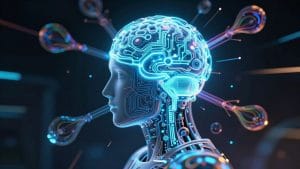
Machine learning is a key part of how AI creates art. It’s a way for computers to learn without being explicitly programmed for every single task. Neural networks, inspired by the human brain, are a type of machine learning that’s particularly good at recognizing patterns. When applied to art, these networks can learn about colors, shapes, textures, and even artistic styles. They can then use this knowledge to generate original works. For example, a neural network might be trained on thousands of portraits to learn what makes a face look realistic. It can then create a portrait that has never existed before, but looks like it could have been painted by a human artist. This ability to learn and adapt is what makes AI art so fascinating and unpredictable.
The development of AI art tools has opened up new avenues for creativity, allowing individuals without traditional artistic training to explore visual expression. This democratization of art creation is a significant aspect of AI’s impact on the creative landscape.
Pioneering Tools Shaping AI Artworks
The landscape of AI art is rapidly evolving, thanks in large part to a suite of innovative tools that are making complex generative processes accessible to a wider audience. These platforms are not just software; they are becoming digital studios for a new generation of creators, offering unique ways to explore and manifest visual ideas.
Artbreeder And Image Morphing
Artbreeder stands out for its intuitive approach to image manipulation. It allows users to blend and modify existing images, effectively ‘breeding’ new visuals by adjusting various genetic traits. This process is powered by Generative Adversarial Networks (GANs), enabling users to experiment with parameters like age, gender, or artistic style to create entirely novel portraits, landscapes, or abstract compositions. The ability to iteratively refine and combine visual elements makes Artbreeder a powerful tool for exploring infinite variations on a theme.
RunwayML’s Dynamic Visuals
RunwayML offers a comprehensive suite of AI-powered tools for video and image generation, editing, and transformation. It utilizes technologies like Variational Autoencoders (VAEs) to produce dynamic and often unpredictable visual outputs. Artists can use RunwayML for tasks ranging from generating animations from text prompts to applying complex style transfers. Its user-friendly interface democratizes access to advanced AI techniques, allowing creators to focus on their artistic vision rather than the underlying technical complexities.
DALL-E’s Text-To-Image Capabilities
OpenAI’s DALL-E has captured significant attention for its remarkable ability to translate natural language descriptions into detailed images. Users can input text prompts, describing anything from a "surrealist painting of a cat playing a saxophone on the moon" to "a photorealistic image of a futuristic city skyline." DALL-E then generates corresponding visuals, showcasing the AI’s capacity to interpret abstract concepts and render them into concrete imagery. This tool has opened up new avenues for conceptual art and rapid visual prototyping.
NVIDIA GauGAN For Realistic Landscapes
NVIDIA GauGAN, now known as Canvas, is designed to transform simple sketches into photorealistic landscape images. By using a segmentation map, where users can draw basic shapes representing elements like mountains, water, or sky, GauGAN applies its AI models to render these elements with incredible detail and realism. It’s particularly adept at creating natural scenes, demonstrating the power of GANs in synthesizing complex textures and lighting conditions to produce believable environments.
These tools represent a significant shift, moving AI from a purely analytical function to a creative partner. They provide frameworks for experimentation, allowing artists to collaborate with algorithms in ways that were previously unimaginable. The ease of use combined with the sophisticated underlying technology is what makes these platforms so transformative for the field of digital art.
Groundbreaking AI Artworks And Their Creators
AI art isn’t just a theoretical concept; it’s already producing works that capture attention and spark conversation. These creations demonstrate the tangible results of algorithms meeting artistic vision, pushing the boundaries of what we consider art. Let’s look at a few examples that have made a significant impact.
The ‘Edmond de Belamy’ Phenomenon
Perhaps one of the most talked-about early AI artworks was "Portrait of Edmond de Belamy." Created by the art collective Obvious, this piece gained notoriety when it was auctioned at Christie’s in 2018, fetching a surprising $432,500. The artwork was generated by a Generative Adversarial Network (GAN) trained on a dataset of historical portraits. This sale marked a significant moment, bringing AI-generated art into the mainstream art market and igniting debates about authorship and value. While some critics dismissed it as a novelty, its auction success undeniably highlighted the growing interest and potential of AI in the creative space.
Reimagining Rembrandt With AI
AI’s ability to learn and replicate artistic styles has been put to the test in ambitious projects aiming to recreate the works of masters. One such endeavor involved a team of data scientists, developers, and art historians who analyzed Rembrandt’s complete collection. They meticulously studied his techniques, brushstrokes, and use of light and shadow. The outcome was an AI-generated portrait that bore a striking resemblance to a genuine Rembrandt, showcasing the AI’s capacity to grasp and reproduce even the most subtle stylistic nuances. This project, among others, demonstrates AI’s potential as a tool for art historical research and stylistic analysis, offering new perspectives on established artists.
Mario Klingemann’s Evolving Portraits
German artist Mario Klingemann has been a pioneer in the AI art scene, known for his work that often explores the intersection of technology and human creativity. His piece "Memories of Passersby I" is a prime example of an evolving AI artwork. This installation features an AI system that continuously generates an endless stream of unique portraits. Klingemann trained his AI on a vast collection of historical portraits, enabling it to understand facial features, expressions, and composition. The interactive nature of the installation, where the AI subtly alters portraits in response to viewers, blurs the lines between creator, artwork, and audience. It emphasizes the dynamic and ever-changing potential of AI in art, moving beyond static images to create living, breathing digital entities. This kind of work challenges our traditional notions of a finished piece, suggesting that art can be a continuous process of generation and transformation, much like the Wisdomia AI Stories that push creative limits.
AI art is rapidly changing our perception of art and creation, presenting new opportunities for artists and enthusiasts alike. It’s not just about the final image; it’s about the process, the algorithms, and the new dialogues they open up.
The Creative Process Behind AI Artworks
Generative Adversarial Networks in Action
At the heart of many stunning AI artworks lies a fascinating technology called Generative Adversarial Networks, or GANs. Think of it like a collaboration between two artificial intelligence systems, each with a specific job. One part, the "generator," tries to create new images. The other part, the "discriminator," acts like an art critic, looking at the generated images and comparing them to a huge collection of real art it has studied. The generator keeps trying to make images that can fool the discriminator, and the discriminator gets better at spotting fakes. This constant back-and-forth pushes the generator to produce increasingly realistic and original visuals. It’s this competitive dance that allows AI to learn styles, textures, and compositions, leading to the unique pieces we see.
Variational Autoencoders for New Variations
Another important technique in the AI artist’s toolkit is the Variational Autoencoder, or VAE. Unlike GANs, VAEs focus on learning the underlying structure of data. Imagine an AI studying thousands of portraits. A VAE learns the essential features that make up a face – the placement of eyes, the curve of a nose, the shape of a mouth – and how these features can vary. Once it understands this "latent space" of possibilities, it can then generate new combinations, creating novel faces or variations on existing themes. This method is particularly useful for exploring subtle differences and creating a range of related artworks from a single concept.
Translating Ideas Through Text Prompts
For many emerging AI artists, the journey from idea to image often starts with words. Text-to-image models, like DALL-E or Midjourney, allow creators to describe their vision in natural language. These text prompts act as the initial spark, guiding the AI’s creative engine. A prompt might be as simple as "a serene forest clearing at dawn with mist" or as complex as "a surreal cityscape in the style of Salvador Dalí, with melting clocks and floating islands." The AI then interprets these words, drawing on its vast training data to generate an image that attempts to match the description. The skill lies in crafting precise and evocative prompts to achieve the desired artistic outcome, turning abstract thoughts into visual realities.
AI Artworks Beyond Traditional Canvases
AI’s influence is stretching far beyond the typical frame or canvas, pushing the boundaries of what we consider art. It’s opening up new avenues for expression that blend technology with imagination, producing pieces that challenge our conventional ideas about artistic practice. This new wave of creativity isn’t just about making pictures; it’s about creating experiences.
Immersive Installations and Data Visualization
Imagine walking into a space where art surrounds you, reacting to your presence or visualizing complex information in beautiful ways. AI is making this a reality. Artists are using AI to process enormous amounts of data – think public image archives or environmental statistics – and transforming them into dynamic, ever-changing visual displays. These aren’t static pieces; they are living artworks that invite viewers to interact and explore. Projects like these can make abstract concepts tangible, offering a new way to understand the world around us. This ability to translate data into sensory experiences is a significant departure from traditional art forms.
AI In Musical Composition
The creative reach of AI isn’t limited to visuals. In music, AI is being used to generate novel melodies, harmonies, and even entire compositions. Some artists are experimenting with AI to create unique vocal arrangements, blurring the lines between human and synthetic sounds. This technology allows for the exploration of musical ideas that might be difficult or impossible for humans to conceive alone, leading to entirely new sonic landscapes. It’s a fascinating area where algorithms meet emotion, creating music that can be both familiar and strikingly new.
Bridging Digital and Physical Art Forms
AI is also playing a role in connecting the digital world with the physical one. For instance, a sculptor might use AI to design and simulate intricate structures digitally before committing to physical materials. This not only speeds up the design process but also allows for experimentation with forms that would be challenging to visualize otherwise. Furthermore, AI can assist in generating patterns for 3D printing or robotic fabrication, bringing complex digital designs into the real world. This integration means that the conceptualization and creation of art can become a more fluid, iterative process, blending the precision of algorithms with the tangible nature of physical objects. It’s a way to make digital concepts real, and real-world ideas digital, all through the power of AI.
The Evolving Role Of The Artist
The way we think about artists and their work is changing, and AI is a big part of that shift. It’s not just about picking up a paintbrush or a chisel anymore. Now, artists are finding new ways to create, and sometimes it feels like we’re not just making art, but also figuring out what art even means in this new landscape.
AI As A Collaborative Partner
Instead of seeing AI as something that replaces artists, many are starting to view it as a new kind of assistant or even a creative partner. Think of it like having a super-powered intern who can generate endless ideas or variations based on your direction. Artists can use AI to explore styles they wouldn’t have tried before, or to speed up parts of the creative process that used to take ages. It’s less about the artist being in complete control of every single detail and more about guiding a powerful tool to achieve a vision.
- Guiding the AI: Artists provide prompts, select outputs, and refine the AI’s creations.
- Exploring new styles: AI can generate visuals or concepts outside an artist’s usual comfort zone.
- Accelerating workflows: Repetitive or time-consuming tasks can be handled by AI, freeing up artists for conceptual work.
Democratizing Art Creation
One of the most talked-about aspects of AI art is how it’s making art creation more accessible. You don’t necessarily need years of technical training to create something visually interesting. This means more people can explore their creative ideas, leading to a wider range of voices and perspectives in the art world. It’s like giving everyone a set of advanced tools, allowing them to experiment and express themselves in ways that were previously out of reach.
The accessibility of AI tools means that the barrier to entry for creating visually striking work is lower than ever. This shift invites a broader spectrum of individuals to engage in artistic expression, potentially uncovering new talents and forms of creativity.
Navigating Authorship And Authenticity
This new era also brings up some tricky questions. When an AI generates an artwork, who is the real artist? Is it the person who wrote the code, the person who provided the prompt, or the AI itself? These are complex issues that the art world is still trying to sort out. It challenges our traditional ideas about originality and who gets credit for a piece of art. The conversation is shifting from ‘who made it?’ to ‘what does it mean and how does it make us feel?’
- Prompt Engineering: The skill of crafting effective text prompts to guide AI generation.
- Curation and Editing: Artists selecting and refining AI-generated outputs to fit their artistic intent.
- Intellectual Property: Ongoing debates about ownership and copyright of AI-assisted artworks.
Future Trajectories For AI Artworks
Hybrid Forms of Artistic Expression
The future of art is looking like a blend of human ideas and machine capabilities. We’re moving beyond just using AI as a tool to create something entirely new. Think of it as a partnership. Artists will work with AI systems, guiding them, refining their outputs, and merging their own creative sparks with what the AI can generate. This could lead to art that’s not just seen, but experienced in ways we haven’t imagined yet, perhaps in interactive installations that change based on who’s viewing them or music that adapts in real-time. This co-evolution of human and artificial creativity is likely to shape the future of art in profound ways.
Expanding Art Markets and Perceptions
AI art is already making waves in traditional art spaces, like galleries and auctions. The sale of AI-generated pieces for significant sums raises questions about value, ownership, and what we consider ‘art.’ As these tools become more common, we might see a shift in how art is valued. Scarcity, a traditional driver of value, could become less important as more people can create art. This means markets might need to adapt, and our own ideas about what makes art special will likely change.
The Symbiotic Relationship Between Human and AI Creativity
Instead of AI replacing artists, it’s more probable that it will become a collaborator. Imagine an artist feeding an AI prompts, tweaking its suggestions, and combining their unique vision with the AI’s output. This partnership can extend beyond visual arts into music, writing, and even performance. It’s about using AI to explore new creative avenues and push artistic boundaries. The key will be learning how to work with these systems, rather than seeing them as competition. This opens up artistic creation to more people, regardless of their traditional artistic background.
The ongoing discussion about AI art highlights the enduring power of human creativity while embracing the new possibilities technology brings to the art world. It’s a conversation about how we define art and the role of the artist in an increasingly digital age.
The Evolving Landscape of Digital Creation
As we’ve seen, AI art is more than just a technological novelty; it’s a rapidly developing field where digital creators are pushing boundaries. Tools like Midjourney and DALL-E are not just making art; they’re opening up new ways for people to express themselves visually. This journey from simple algorithms to complex, stunning artworks shows how technology can work with human imagination. The future likely holds even more exciting collaborations between artists and AI, making art more accessible and diverse than ever before. It’s a space worth watching as these emerging creators continue to shape what digital art can be.
Frequently Asked Questions
What exactly is AI art?
AI art is basically artwork made with the help of computers that can think and learn. Imagine telling a computer what you want to see, and it creates a picture or music for you! It’s like having a super-smart art buddy that uses special programs to make cool new things, sometimes looking like real art, sometimes totally unique.
How do computers learn to make art?
Computers learn to make art by studying tons and tons of existing art, like paintings and photos. They use something called ‘machine learning’ to find patterns and styles. Think of it like a student studying many artists to learn how they paint. Then, they use this knowledge to create their own art, sometimes even mixing styles together.
Are there special tools for making AI art?
Yes, there are! Tools like DALL-E let you type words and it makes an image. Artbreeder lets you mix and change pictures to create new ones. RunwayML helps make moving pictures, and NVIDIA GauGAN can turn simple drawings into realistic scenes. These tools make it easier for people to create art with AI.
Is AI art really ‘creative’ if a computer makes it?
That’s a big question people are still talking about! Some say true creativity comes from human feelings and experiences. Others believe that when AI creates something new and surprising based on what it learned, it’s a form of creativity. It’s more like a team effort between the human who guides the AI and the AI itself.
Can anyone make AI art?
Definitely! Many AI art tools are designed to be easy to use, even if you’re not a professional artist. You can often just type in what you imagine, and the AI will try to create it. This means more people can explore their creative ideas and make art without needing years of training.
What does the future look like for AI art?
The future is super exciting! AI will likely become even better at creating art, and artists will find new ways to work with AI as a partner. We might see completely new kinds of art that blend human ideas with what AI can do. It’s going to keep changing how we think about art and who gets to make it.