
Entertainment, news
Ben Affleck’s $600 Million AI Bet: How Hollywood’s Boldest Director Is Reshaping the Future of Filmmaking
10 Jun 2026

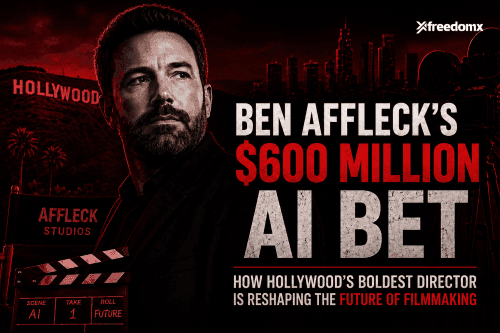
From Oscar-winning director to Silicon Valley disruptor — Ben Affleck’s secret AI company InterPositive has just been acquired by Netflix, and the ripple effects across the global entertainment industry are only beginning to be felt.
When Netflix announced on March 5, 2026, that it had acquired InterPositive, an AI filmmaking startup quietly built by actor and director Ben Affleck, it sent shockwaves through Hollywood, Silicon Valley, and the global creative economy alike. The streaming giant’s acquisition of InterPositive, an AI startup co-founded by Affleck, signals its biggest push yet to bring advanced technology into film and TV production. Few saw it coming. And that, perhaps, was exactly the point.
The Startup Built in Secret
InterPositive was founded in 2022 and operated largely in “stealth mode” under the corporate entity Fin Bone LLC. For nearly four years, one of Hollywood’s most recognisable faces was quietly building an AI company that promised to transform how films are made — not by replacing human creativity, but by augmenting it.
Affleck founded InterPositive in 2022 after realising that existing AI video models weren’t ready to produce Hollywood-grade footage from scratch. “Together with a small team of engineers, researchers and creatives, I began filming a proprietary dataset on a controlled soundstage with all the familiarities of a full production,” he said.
The technology his team built is notably different from the generative AI tools that have sparked labour battles across the industry. InterPositive develops AI tools designed to help filmmakers work more efficiently during post-production. The software can address continuity errors, enhance scenes, and streamline editing workflows. The technology does not generate entirely new content or use footage without permission.
In practical terms, this means the InterPositive system builds an AI model based on an existing production’s dailies, then lets a filmmaker introduce that model into the post-production process to provide the ability to do things like mix and colour, relight shots, and add visual effects.
A $600 Million Deal — and a Turning Point for Streaming
Netflix on March 5 announced the deal to buy Affleck’s InterPositive for undisclosed financial terms. Affleck and InterPositive’s investors will earn as much as $600 million from the Netflix deal if the company meets “certain performance targets,” Bloomberg reported.
The entire 16-person InterPositive team of engineers, researchers and creatives joined Netflix through the acquisition, and Affleck will serve as a senior adviser to provide ongoing guidance.
For Netflix, the acquisition represents a significant strategic pivot. The deal builds on comments from management as AI has exploded onto the scene in the past few years, with executives stressing the ways it can improve quality rather than reducing costs or staffing. “There’s a better business and a bigger business in making content 10% better than it is making it 50% cheaper,” co-CEO Ted Sarandos said in 2024.
Netflix has confirmed it does not plan to sell access to InterPositive’s tools externally. Unlike Disney — which recently opted for a licensing arrangement with OpenAI, providing access to IP from Marvel, Pixar and Star Wars — Netflix is keeping this capability entirely in-house, giving it a potentially decisive competitive advantage.
What the Technology Actually Does
At its core, InterPositive’s innovation is about understanding how a film was made, not generating something entirely new from a text prompt. The patent describes a system that teaches an AI model to watch film footage and understand how the shot was filmed. Most AI vision systems are trained to recognise objects or actions. InterPositive focuses on something different — how the scene was actually shot
The practical applications are wide-ranging. As Affleck explained in Netflix’s announcement video, “You can use your own model to remove the wires on stunts, reframe a shot, get a shot you missed, shape the lighting, enhance the backgrounds.”
“You’re improving your editorial process, your ability to mix colour, finish your film, do visual effects,” Affleck said. “It’s not a way of imposing a new set of reactions or something alien or foreign to the character. It can only understand this and only build this tool because it’s trained on the character that the actor has already built.”
The Cost-Cutting Reality Behind the Creative Vision
While Affleck and Netflix have emphasised InterPositive’s creative benefits, patent documents tell a more complex story. A patent application filed in 2024 and reviewed by Deadline shows that along with those benefits, the company also promised significant cost savings for film and TV producers. The reductions made possible by InterPositive’s technology would be “substantial” on below-the-line production, “conservatively” reaching at least 10% to 20%, according to the application.
The granular projections are striking. Per Deadline’s reading of the filing, the cost of visual effects would drop about 50%. Background actors and stand-ins, 70%. Set dressing, 40%. Art department, 30%. Additional production units outside the main location, 40%. The patent itemises a hypothetical $32.1 million below-the-line budget and claims InterPositive could shave $7 million off it.
These numbers sit uneasily alongside Affleck’s public messaging. With anxiety levels surging across Hollywood about the outlook for industry workers, especially as major unions negotiate new contracts with studios and streamers, the figures are certainly eye-opening.
A Global Disruption: VFX Workers and the Human Cost
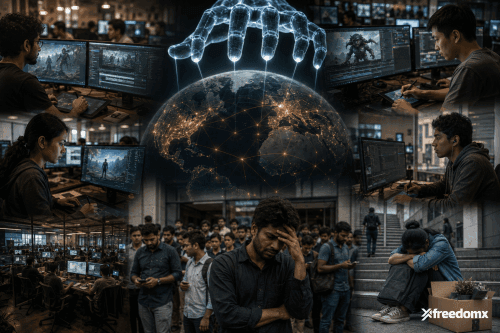
The InterPositive acquisition is not just a Hollywood story, it is a global economic one. InterPositive automates colour grading, relighting, and continuity fixes, work currently done frame by frame by artists in India, South Korea, the Philippines, and Latin America. More than 2 million professionals work in visual effects globally.
The timing could hardly be more fraught. The fragility of the industry that InterPositive now threatens was exposed weeks before the acquisition. Paris-based Technicolor, one of the world’s largest visual effects companies and a key vendor for Disney, Paramount, and Netflix, collapsed under unsustainable debt and abruptly shut down its India operations in February 2025. About 3,000 workers in Bengaluru and Mumbai were left without pay, without notice, and without severance.
While AI had already been eroding visual effects jobs before InterPositive, the Affleck name has turned a quiet industry shift into a global conversation. The impact will be hardest on entry-level workers.
Affleck’s Contradiction and His Conversion
Perhaps no aspect of this story has attracted more scrutiny than Affleck’s own shifting position on AI. Earlier this year, he told podcaster Joe Rogan he did not think AI would have the capacity to “write anything meaningful” or make films “from whole cloth.” However, in a March 6th video announcing the deal, Affleck said he had changed his mind about AI, initially being worried about its potential impact but now viewing it as a “really meaningful innovation.”
“I understand the skepticism because I share it,” Affleck said, adding that he was scared the first time he saw generative AI in action.
His position remains a studied one. Despite his tech interests, Affleck has expressed a desire to keep humans at the centre of the creative process. He is among the hundreds of Hollywood insiders to sign on to the Creators Coalition on AI, a group that describes itself as “a central hub for cross-industry discussions about how AI is impacting the entertainment industry.”
Announcing the acquisition, Netflix said: “We believe new tools should expand creative freedom, not constrain it or replace the work of writers, directors, actors, and crews.”
Hollywood at a Crossroads
The InterPositive acquisition crystallises a tension at the heart of AI’s advance into creative industries: the difference between tools that empower artists and tools that displace them is, in practice, a matter of deployment choices and those choices belong to the companies holding the technology.
The acquisition is sure to be scrutinised as it comes at the same time that above-the-line unions are embarking on a new round of talks with studios and streamers, including Netflix. The aim of the talks is to avoid a repeat of the 2023 strikes, which centred in part on the perceived AI threat.
Above-the-line unions are entering a new round of contract negotiations with studios and streamers, and AI is expected to be a central sticking point again. The 2023 strikes produced landmark language around consent and AI use, but enforcement and scope remain contested.
Whether Affleck’s vision of “human-centred innovation” survives the economic pressures now embedded in InterPositive’s own patent filings will be one of the defining questions for the entertainment industry in the years ahead. The technology has arrived. How it is used — and who bears the cost — remains very much open.
Sources
- Deadline — Netflix Gets Back In The M&A Game, Acquiring Ben Affleck-Founded AI Firm InterPositive — https://deadline.com/2026/03/netflix-ben-affleck-ai-company-acquisition-1236744357/
- Deadline — Before Netflix Deal, Ben Affleck’s AI Firm Set Aggressive Production Cost-Cutting Targets — https://deadline.com/2026/04/netflix-ben-affleck-ai-firm-interpositive-film-production-savings-1236770381/
- Variety — Netflix Could Pay as Much as $600 Million for Ben Affleck’s AI Film Start-Up — https://variety.com/2026/digital/news/netflix-600-million-ben-affleck-ai-film-startup-interpositive-1236685038/
- Inc. — Ben Affleck Just Sold His Stealth AI Startup to Netflix for $600 Million. Here’s What It Actually Does — https://www.inc.com/leila-sheridan/ben-affleck-just-sold-his-stealth-ai-startup-to-netflix-for-600-million-heres-what-it-actually-does/91315812
- NPR — Netflix Strikes Deal with Ben Affleck’s InterPositive AI Company — https://www.npr.org/2026/03/06/nx-s1-5739370/netflix-ben-affleck-ai-interpositive-deal
- Rest of World — What Netflix’s AI Bet on Ben Affleck’s Startup Means for VFX — https://restofworld.org/2026/netflix-interpositive-vfx-ai-automation/
- Fast Company — Netflix Buys Ben Affleck’s AI Startup — https://www.fastcompany.com/91503235/netflix-buys-ben-afflecks-ai-startup
- The Wrap — Can Ben Affleck Lead Hollywood’s Embrace of AI? — https://www.thewrap.com/industry-news/tech/netflix-ben-affleck-ai-interpositive-impact-explained/
- Stephen Follows — What does the patent behind Netflix’s acquisition of Ben Affleck’s AI company actually do? — https://stephenfollows.com/p/netflix-ben-affleck-ai-patent-explained
- CineD — Netflix Acquires Ben Affleck’s InterPositive AI Filmmaking Company — https://www.cined.com/netflix-acquires-ben-afflecks-interpositive-ai-filmmaking-company/
- Moneywise — Ben Affleck says the AI company he just sold to Netflix for $600 million will lead to ‘more human work’ — https://moneywise.com/news/top-stories/ben-affleck-ai-interpositive-netflix-hollywood-jobs
- Beverly Boy Productions — Netflix Acquires Ben Affleck AI Company InterPositive: What It Means for Filmmakers — https://beverlyboy.com/blog/netflix-acquires-ben-affleck-ai-company-interpositive/


