
Entertainment
Hell Grind Created Using Higgsfield AI: The Emergence of AI-Native Filmmaking
05 Jun 2026

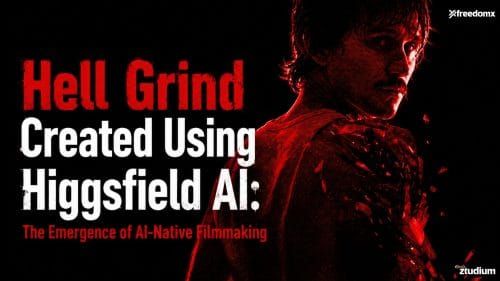
Created using the Higgsfield AI and screened during the Cannes market in May 2026, Hell Grind is the first feature-length film produced end-to-end through an AI-native workflow. What does a 95-minute feature reveal about the new generation of creative production tools?
The film industry has spent the last three years debating what artificial intelligence might eventually do to filmmaking. With Hell Grind, a new question emerges: what can AI filmmaking actually achieve today?
Created using the Higgsfield AI platform and screened during the Cannes market in May 2026, Hell Grind is being positioned as the first feature-length film produced end-to-end through an AI-native workflow. Whether audiences view the result as a breakthrough, an experiment, or something in between, the project represents one of the clearest demonstrations yet of how rapidly AI-powered content creation is evolving.
“By presenting this film, we are showing studios and creators that the infrastructure now exists to execute their most complex visions to life at a fraction the cost of traditional production.“- Alex Mashrabov, Higgsfield AI CEO and Co-Founder
The significance of Hell Grind may ultimately lie less in the film itself than in what it reveals about the changing relationship between creativity, production, and technology.
A Feature Film Built Like Software
Traditional filmmaking is fundamentally a coordination challenge. Scripts move through development, financing, casting, production, post-production, visual effects, and distribution. Even modest independent productions often require dozens or hundreds of people working across months or years.
Hell Grind approached the process differently.
Hell Grind is directed by Aitore Zholdaskali, written by Adilkhan Yerzhanov, and produced with a team of 15 other professional directors, cinematographers, and editors. The team used Higgsfield’s Soul Cinema and Soul Cast, and Dreamina-Seedance 2.0 to make the 95-minute action-fantasy film.
Rather than organising physical shoots, locations, costumes, and visual effects pipelines, the creators relied on AI generation systems, prompt engineering, iterative refinement, and editorial assembly.
“Making a movie today feels like making an album twenty years ago, you need investors and big studios. But then the laptop changed music forever and gave us Billie Eilish. That’s what Higgsfield is doing for filmmakers. The next generation won’t have to wait ten years”. – Aitore Zholdaskali
This shift is important because it reframes production from a logistics problem into a creative systems problem.
The challenge is no longer simply capturing footage. It becomes directing models, managing consistency, refining outputs, and orchestrating thousands of generated assets into a coherent narrative.
In many ways, the workflow resembles software development more than conventional filmmaking.
Higgsfield: An AI video generator for advanced cinematography
Higgsfield is a generative media platform that lets teams create short-form, cinematic videos from a product link, an image, or a simple idea.
The platform offers professional-grade camera control paired with cinematic style presets. Think of it as the intersection between a creative AI platform and a lightweight film production suite — designed from the ground up for short-form video, ads, and branded content. It stands out for its advanced camera motion controls, letting users simulate professional techniques like dolly shots, whip pans, and FPV drone movements — all from text prompts and reference images.
The Higgsfield Soul AI specialises in hyper-realistic image and video generation, mimicking smartphone photography with 50+ style presets ranging from Y2K nostalgia to Tokyo street aesthetics. In March 2025, the company also launched a browser-based product for end-to-end AI video creation.
They also unveiled Product-to-Video, a tool that turns static product shots into polished, ready-to-use ad creatives, letting ecommerce teams go from idea to ad in minutes.
Higgsfield AI resulted in low production cost and time of under $500k USD over 14 days for Hell Grind.
The Rise of the AI Production Stack
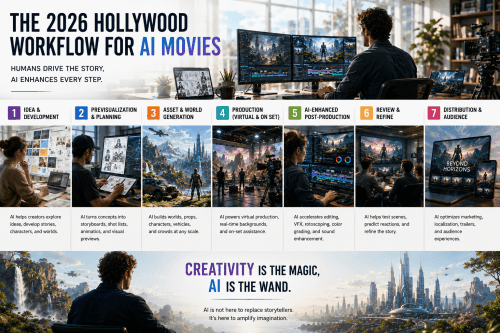
The project also highlights how AI filmmaking is becoming increasingly modular.
Rather than depending on a single model, the creators combined multiple technologies within an integrated workflow. Higgsfield’s tools handled core production and character generation, while additional video generation systems contributed visual outputs.
This reflects a broader trend across creative industries: successful AI content production increasingly depends on the orchestration of multiple specialized systems rather than a single all-purpose model.
Just as modern software is built from layers of infrastructure, APIs, and services, AI-generated media is evolving into a production stack composed of character systems, image models, video generators, editing tools, voice synthesis, and creative control layers.
The companies that successfully integrate these components into usable workflows may prove as important as the underlying models themselves.
Consistency Is Becoming the New Frontier
One of the most revealing aspects of Hell Grind is not the existence of AI-generated imagery. That capability is already well established.
The more significant achievement is maintaining continuity across a feature-length narrative.
According to the filmmakers, prompts often exceeded thousands of words and included detailed instructions covering character appearance, cinematography, physical realism, environmental continuity, and storytelling intent.
This reflects one of the central challenges facing AI video today: consistency.
Generating a compelling 10-second clip is relatively straightforward. Maintaining recognizable characters, coherent environments, visual style, emotional continuity, and narrative progression across an hour and a half of content is considerably more difficult.
Projects like Hell Grind suggest that the industry is beginning to move beyond isolated demonstrations toward solving longer-form storytelling problems.
The technical hurdle is shifting from generation quality to generation reliability.
The Democratisation Question
Every major creative technology wave eventually raises the same question: who gets to create?
Digital cameras lowered barriers to filmmaking. Streaming platforms lowered barriers to distribution. Social media lowered barriers to audience access.
AI production tools may lower barriers to production itself.
The economics surrounding Hell Grind illustrate why this possibility is attracting attention. A production completed in weeks rather than years—and at a fraction of traditional feature budgets—points toward a future where creators can experiment with ambitious concepts without requiring studio-scale resources.
That does not automatically mean every creator becomes a filmmaker.
It does suggest, however, that the gap between imagination and execution may continue to narrow.
Historically, many creative ideas never reached audiences because the cost of realization was too high. AI-native production aims to compress that gap.
Beyond the AI Versus Human Debate
Much of the public conversation around generative AI frames the technology as a replacement for traditional creative processes.
Projects like Hell Grind suggest a more nuanced reality.
The future may not be defined by fully AI-generated productions or purely traditional filmmaking. Instead, the industry appears to be moving toward hybrid models in which human creators direct increasingly sophisticated AI systems.
In that scenario, the role of filmmakers evolves rather than disappears.
Creative professionals become architects of systems, curators of outputs, and directors of machine-assisted workflows.
The question shifts from “Can AI make a movie?” to “How can creators use AI to make better movies?”
A Glimpse of What’s Next
Whether Hell Grind is remembered as a landmark film is ultimately for audiences to decide.
Its broader importance lies elsewhere.
The project demonstrates that feature-length AI-native production is no longer theoretical. The infrastructure, workflows, and creative methodologies now exist to produce long-form visual narratives at a scale that would have been difficult to imagine only a few years ago.
The technology remains imperfect. The artistic results remain contested. The economics, ethics, and long-term implications are still being debated.
Yet the trajectory is increasingly difficult to ignore.
Just as early digital cameras did not immediately replace film and early streaming services did not instantly redefine entertainment, AI-native filmmaking is unlikely to transform the industry overnight.
But projects like Hell Grind suggest that a new chapter in content creation has already begun—one in which the ability to create increasingly cinematic experiences is becoming less dependent on physical production infrastructure and more dependent on creative direction, computational power, and the tools that connect them.
For platforms like Higgsfield, that may be the most important story of all.


