The video game industry was dead in 1985, until Nintendo pulled off the greatest comeback in entertainment history. Nintendo’s risky moves didn’t just save the company – they saved the entire industry. Read on to find the full history.
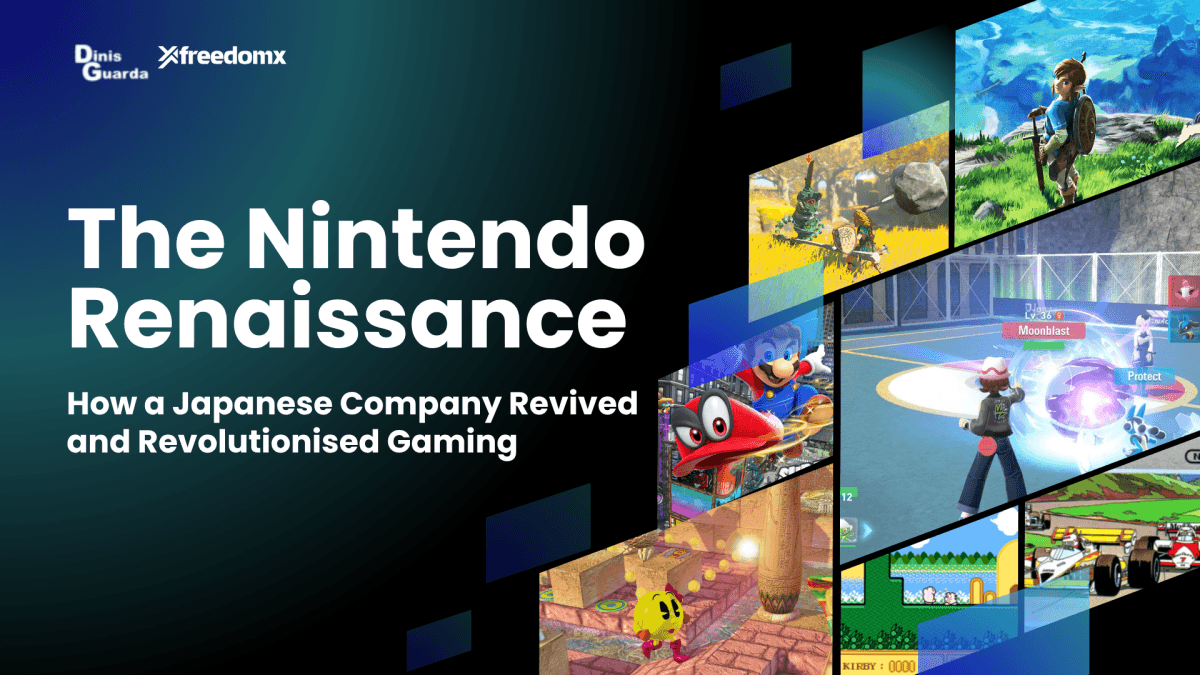
Nintendo Renaissance, Infographic by Dinis Guarda
“A delayed game is eventually good, but a rushed game is forever bad.” – Shigeru Miyamoto, Director of Nintendo and legendary games designer
This quote encapsulates the ethos that not only shaped the iconic company but also transformed the entire video game industry.
Picture this: it’s 1985, and the video game industry is in ruins. After the catastrophic crash of 1983, shops won’t stock consoles, parents think gaming is a waste of money, and the very phrase “video game” has become a joke.
The future looks bleak, until a little-known Japanese company steps in with a bold plan.
Enter Nintendo. While others saw a dying fad, Nintendo saw an opportunity. They didn’t just want to revive gaming, they wanted to reinvent it.
Their secret?
A mix of ruthless quality control, genius marketing, and, most importantly, games so good they made people fall in love with the medium all over again.
From the NES’s clever “Trojan horse” launch to Shigeru Miyamoto’s revolutionary game design, Nintendo didn’t just bring gaming back from the dead, they turned it into a global phenomenon.
The Game Boy proved portability was king, the SNES pushed 16-bit boundaries, and Mario became more recognisable than Mickey Mouse.
This is the story of how Nintendo didn’t just save gaming, they defined it.
So, how did they pull it off?
Resurrection and Revolution: The State of the Gaming Industry in 1985
In 1985, the American video game industry was a complete mess.
After the infamous crash of 1983, retailers were shying away from consoles, parents thought gaming was a waste of money, and the very mention of “video games” had come to represent nothing but disappointment.
The future of gaming was looking pretty grim.
Then, out of nowhere, Nintendo stepped in, but not in the way you might expect. Instead of rushing to capitalise on the chaos, the Japanese company had been quietly observing, taking notes on what went wrong, and getting ready to do something truly different.
Nintendo wasn’t just looking to revive gaming – it was going to completely redefine it.
Their approach was methodical, almost like they were running a scientific experiment. While American companies were churning out low-quality products in a mad rush, Nintendo took its time, carefully crafting their consoles and games.
Where others flooded the market with mediocrity, Nintendo set the bar with strict quality control. And instead of seeing gaming as a passing trend, they treated it like the art form it could be, full of untapped potential.
The release of the Nintendo Entertainment System (NES) wasn’t just about launching a new gaming console, it was a statement. From the toy-like design to the revolutionary pack-in game, every element was designed to rebuild trust and set new standards for the industry.
Rising from the Ashes: The NES Launch
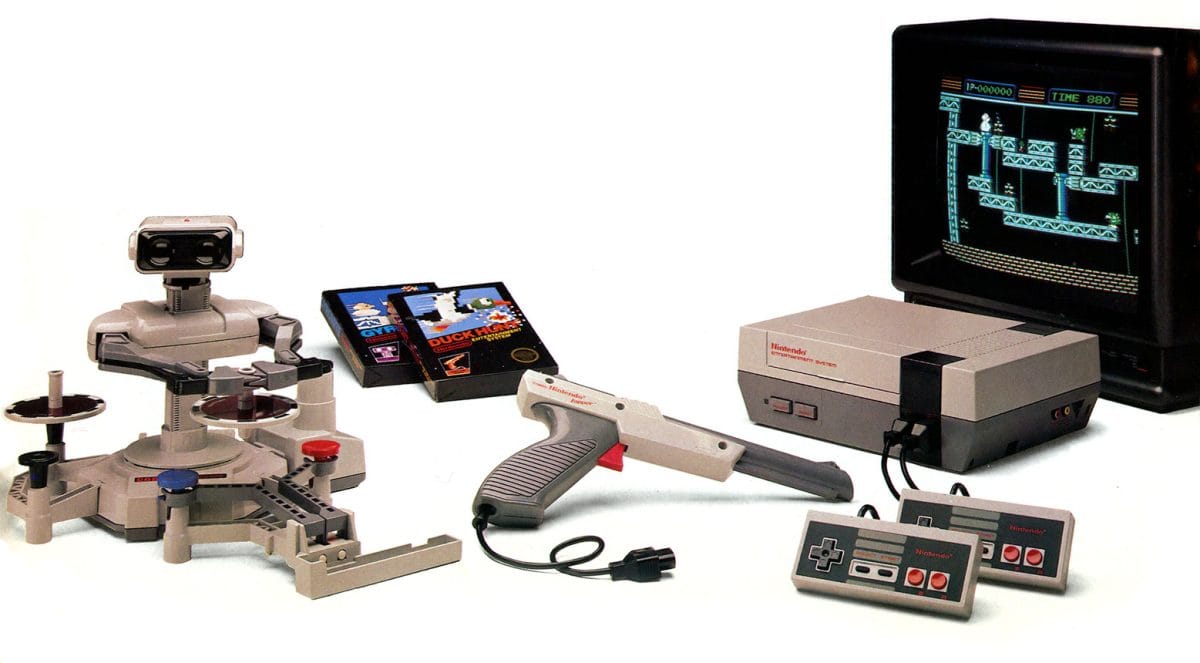
When the Nintendo Entertainment System (NES) hit North America in 1985, it wasn’t just another gaming console being shoved onto the shelves – it was a statement. This wasn’t just about selling a product; it was about reshaping the entire gaming industry.
Nintendo knew that to win back consumer trust and get people excited about interactive entertainment again, they’d need to create more than just a console – they needed to create an experience.
“We didn’t want to make just another video game system. We wanted to make something that would convince American families that interactive entertainment deserved a place in their homes.” – Minoru Arakawa, President of Nintendo of America
And boy, did they succeed.
In a market still recovering from the disastrous video game crash, Nintendo took a very different approach to marketing the NES. They didn’t call it a “video game system” at all.
No, they marketed it as an “Entertainment System,” cleverly distancing it from the negative stigma attached to video games at the time.
The NES’s design was also a stroke of genius. Unlike the bulky, unfriendly designs of previous consoles, the NES looked more like a VCR, making it blend seamlessly into existing home entertainment setups. But perhaps the most clever move of all was the inclusion of R.O.B. (Robotic Operating Buddy), a quirky little robot that could play two simple games.
While R.O.B. didn’t offer much beyond showing off a few tech tricks, his presence was a game-changer. It took the NES from being just a video game system to a “sophisticated electronic toy,” which made it possible for the console to be sold in toy departments, far away from the deserted electronics sections where gaming products had once languished.
It was a genius move that helped Nintendo carve out its space in the homes of millions.
The Gradual Rollout: Testing the Waters
Nintendo didn’t just throw the NES out there and hope for the best. Oh no, they played it smart with a carefully controlled strategy that could have easily been called “testing the waters.”
Instead of launching nationwide from the get-go, Nintendo chose to dip their toes in first. In October 1985, they launched the NES in New York City, releasing just 100,000 units. It wasn’t a full-scale push – it was a trial run.
This gave them the chance to fine-tune their marketing, listen to feedback, and see how the product was received before going all-in.
By February 1986, they expanded to Los Angeles, and then by the end of the year, the NES was ready for the big leagues, hitting a national launch. The response was overwhelming. By Christmas 1986, over 1 million units had sold, and by the same time in 1987, it had tripled to 3 million.
Nintendo’s careful, methodical approach paid off big time.
By 1988, they had a stranglehold on the market. It wasn’t a mad dash to the finish line, it was a smart, steady climb to the top.
Shigeru Miyamoto: The Spielberg of Gaming
A huge part of Nintendo’s rise to dominance can be credited to Shigeru Miyamoto, the man whose creative genius redefined the entire video game industry. Born in 1952 in rural Japan, Miyamoto wasn’t your typical tech-minded programmer or businessman.
Instead, he brought a unique artist’s touch to a medium that was previously ruled by engineers and developers. It was his ability to combine gameplay with emotional depth and stunning design that truly reshaped the gaming world.
“I am not a programmer. I am not a businessman. I am someone who wants to make people smile through play.” – Shigeru Miyamoto
Miyamoto’s approach to game design was all about the player’s experience. He wasn’t bothered with technical specs or making the most money; his focus was on creating immersive worlds that players could get lost in.
He wanted to surprise them, evoke real emotions, and keep them exploring. His design philosophy can be broken down into a few core principles that any gamer would instantly recognise:
- Intuitive controls: Games should be easy to pick up and play without the need for long tutorials. A game that’s fun straight away? That’s Miyamoto’s style.
- Progressive complexity: Start simple, but gradually introduce more layers as the player advances. This keeps things fresh without overwhelming them too soon.
- Emotional engagement: The best games make players form connections with characters or worlds. Miyamoto believed in creating experiences that stayed with players long after they put the controller down.
- Surprise and discovery: Good games are constantly keeping players on their toes, introducing new mechanics and hidden surprises that make each playthrough unique.
- Universal appeal: The best games aren’t just for one group—they reach across cultures and demographics, making them accessible and enjoyable to anyone, anywhere.
It’s no wonder that with these principles, Miyamoto managed to change not just the way games were made, but the very way we interact with them.
Super Mario Bros.: The Game That Changed Everything
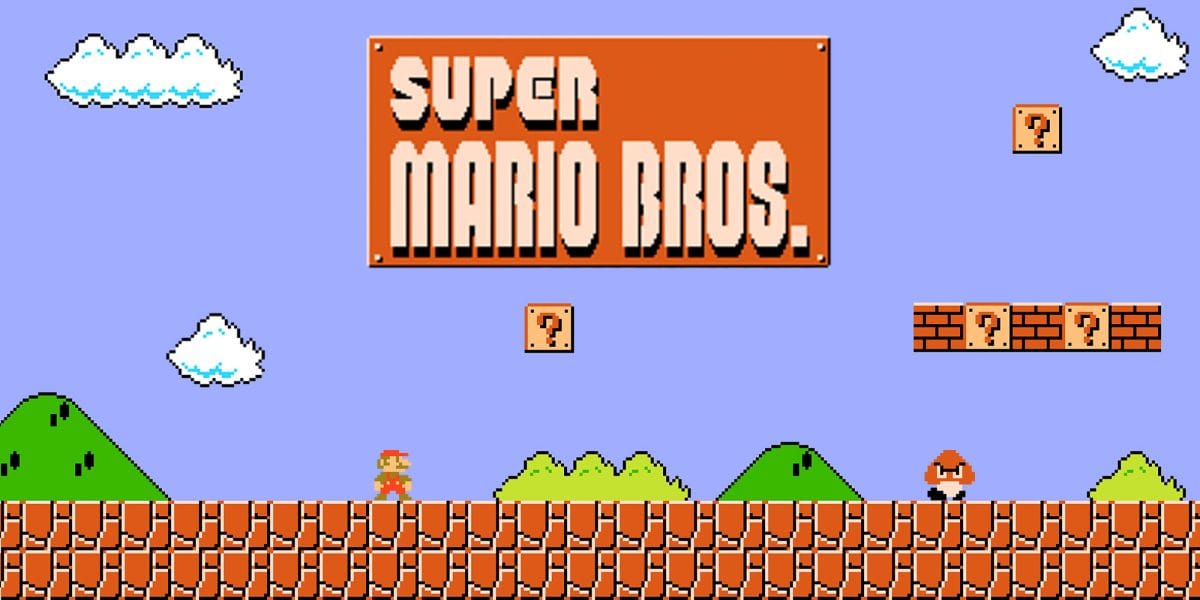
When Super Mario Bros. launched in 1985, it was a game-changer, not just in terms of design, but in how we thought about video games altogether. It wasn’t just a fun way to kill time; it showed that interactive entertainment could have the depth and emotional engagement of movies or TV.
Suddenly, gaming wasn’t just about the pixels, it was about storytelling, character development, and crafting worlds you could lose yourself in.
Mario, the lovable plumber, became an icon almost overnight.
His simple design, born from the technical limitations of the time, went on to define an era. That moustache, that red cap, it was all the product of clever design to work with the technology they had, but it turned into something far bigger.
Mario’s adventures in the Mushroom Kingdom introduced an entirely new kind of gameplay, where levels felt like puzzles and challenges were just as much about thinking as they were about fast reflexes.
“A delayed game is eventually good, but a rushed game is forever bad.” – Shigeru Miyamoto
And the numbers?
Well, Super Mario Bros. went on to become the best-selling video game of all time, holding the crown for over 20 years and shifting more than 40 million copies worldwide. It wasn’t just a commercial triumph; it became a cultural touchstone, pushing video games into the mainstream like never before. Even movies and TV shows had to take notice.
Super Mario Bros. Sales Figures:
| Region | Units Sold | Market Penetration | Cultural Impact Score* |
| Japan | 6.8 million | 85% of Famicom owners | 9.8/10 |
| North America | 29.08 million | 75% of NES owners | 9.9/10 |
| Europe | 8.56 million | 60% of NES owners | 9.2/10 |
| Other Regions | 2.56 million | 45% of system owners | 8.5/10 |
The Game Boy: Portable Gaming Revolution
Then in 1989, Nintendo shook things up again with the Game Boy.
While its tech specs weren’t exactly mind-blowing, the handheld console’s genius lay in Nintendo’s deep understanding of what players wanted. Forget raw power, Nintendo focused on making it affordable, reliable, and, crucially, portable.
The Game Boy gave people the ability to take their gaming on the go, something no other system had truly done before.
And then came Tetris.
Bundling the addictive puzzle game with the Game Boy was an absolute stroke of genius. Tetris appealed to a wide range of players, including adults and women, a market that had been largely ignored up until then.
Due to Tetris, the Game Boy was an instant hit, with 35 million copies sold alongside the console and another 8 million sold separately. It was a game that transcended generations and genders, making handheld gaming a phenomenon.
Sonic vs. Mario: The Console Wars Begin
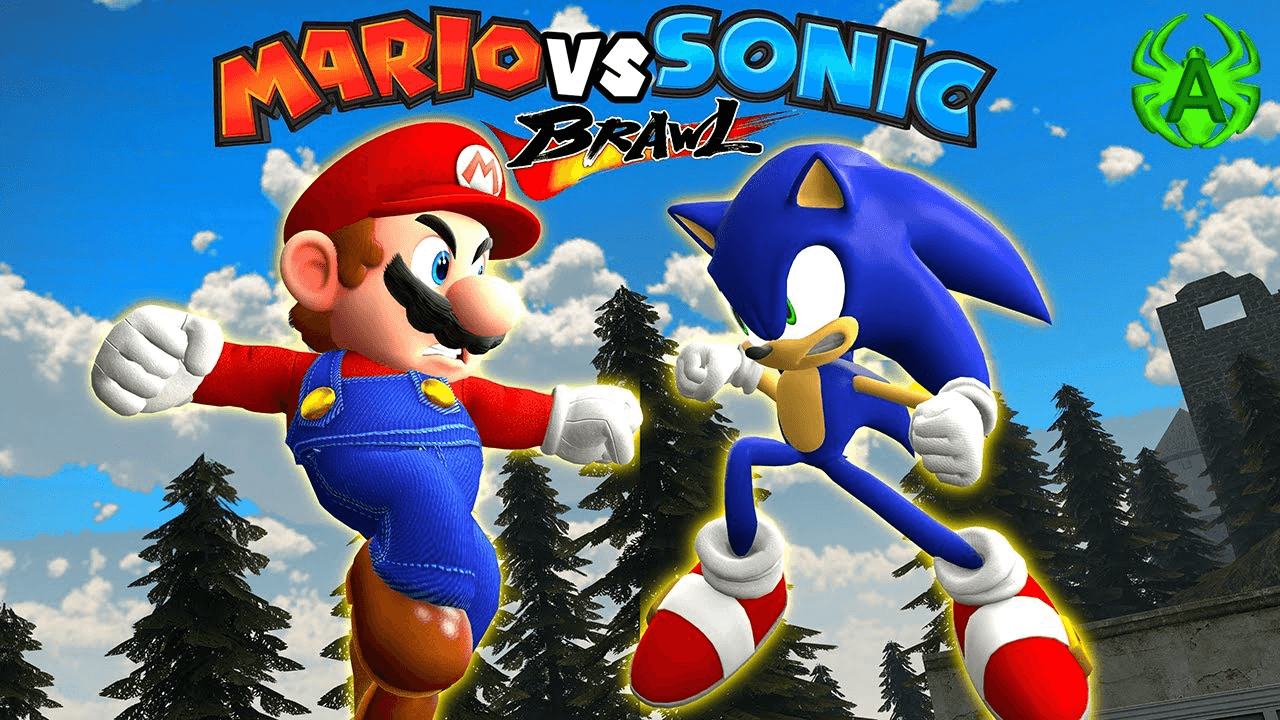
As Nintendo cemented its place at the top, it wasn’t long before it attracted a rival who wasn’t willing to just sit back and let them dominate. Enter Sega and the first major console war.
Their mascot, Sonic, quickly became Mario’s biggest rival, and the battle was on. Sega’s strategy was simple: attack Nintendo’s perceived weaknesses. Their Genesis system was marketed as faster, cooler, and more technically advanced.
The famous “Genesis does what Nintendon’t” campaign was a direct shot across Nintendo’s bow, and it forced both companies to step up their game. It was the beginning of the fierce competition that would define the gaming landscape for years to come.
Console War Statistics (1989-1995):
| System | Global Sales | Market Share | Signature Character Recognition |
| NES/SNES | 111 million | 65% | Mario: 94% recognition |
| Genesis/Mega Drive | 35 million | 20% | Sonic: 67% recognition |
| Other Systems | 26 million | 15% | Various: <30% recognition |
Source: NPD Group, GfK Entertainment, Nintendo/Sega Annual Reports
The Super Nintendo: 16-Bit Excellence
Nintendo wasn’t about to let Sega run away with the lead, though. In 1991, they released the Super Nintendo Entertainment System (SNES), a console that would become legendary. The SNES kept Nintendo’s focus on gameplay at its core but pushed the technical limits of what was possible at the time.
With its 16-bit processor and groundbreaking features like Mode 7 graphics, the SNES gave birth to games that were more intricate, immersive, and complex than anything before it.
Some of the greatest games in history came to life on the SNES, including The Legend of Zelda: A Link to the Past, Super Metroid, and Super Mario World. These weren’t just games, they were works of art, blending storytelling, atmosphere, and gameplay in ways that still influence the industry today.
Nintendo wasn’t just selling consoles; they were creating experiences that left a lasting impact.
Cultural Impact and Legacy
By the mid-1990s, Nintendo had done more than just recover from the gaming crash of the early ’80s, they had transformed the entire industry. What started as a niche hobby grew into a global entertainment force, appealing to all ages and backgrounds.
Nintendo’s commitment to quality control, their focus on building memorable characters, and their bold expansion into global markets were all key to the company’s success.
The Nintendo Renaissance didn’t just change how we looked at video games, it changed how we experienced them. By the time the ’90s were in full swing, video games were an essential part of global entertainment culture, reaching across borders and demographics.
Nintendo’s influence was clear: they hadn’t just revived the industry, they had created an entirely new cultural phenomenon.