
Stuck on Wordle? You’re not alone. Master the puzzle every time with expert strategies that guarantee you will solve it in under 6 guesses. Here is the power opener trick, learn how to decode yellow tiles, and find out the one mistake 90% of players make.

Every morning now seems to start with a little green, grey, and yellow routine. Yes, we are talking about Wordle. It’s a simple word puzzle that has captured millions of players around the world. The rules are clear: guess the five-letter word in six tries.
But let’s be honest, simplicity doesn’t mean it’s easy. Some people can casually find the right answer in three tries, while others end up staring at five grey rows, muttering in frustration, and wondering if their vocabulary is silently laughing at them.
The exciting part of Wordle Hint is figuring out if you’re smart enough, lucky enough, or, most importantly, strategic enough to solve it before you run out of guesses.
And guess what?
With the right approach and some disciplined thinking (plus a few handy shortcuts), you can solve almost any puzzle within six attempts. It’s less about being a walking dictionary and more about creating a way of thinking that narrows your options wisely with each guess.
Why Wordle Hint took over the world
Before diving into strategy, let’s take a moment to recognise what made Wordle such a hit. It’s not flashy. There are no ads. You don’t need to download an app or spend any money. It’s just you, a five-letter word, and six guesses. Its magic comes from its simplicity and daily routine.
Wordle Hint satisfies the same need as a crossword or Sudoku. It’s a brain teaser, but with a modern, social touch. Since everyone plays the same puzzle each day, it sparks conversation. Friends compare results, families share their colored boxes in group chats, and social media fills up with Wordle grids.
However, underneath the friendly conversation is a competitive urge. Nobody wants to admit they couldn’t solve it. That’s where strategy comes in.
Why Wordle feels so addictive
Before diving into the strategies, let’s take a quick stop at the psychology junction. Ever wondered why Wordle Hint scratches such a satisfying itch?
- Instant feedback: Each guess gives you a colourful reminder of reality. Green means success, yellow hints at possibilities, and grey brings disappointment.
- Daily rationing: There’s only one puzzle each day, leaving you wanting more. You can’t binge, which makes it feel like limited chocolate.
- Social element: Who hasn’t seen those cryptic grids shared on Twitter or WhatsApp? Rows of colourful squares saying “I solved it in 3!” without revealing the word. It’s competitive but laid-back at the same time.
- Simplicity rules: It’s simple enough that even your uncle who thinks Facebook is a “new idea” can give it a try.
IGN India
Wordle Hint: Solve Puzzle in Under 6 Guesses
Step 1: The Importance of Your Opening Word
Think of the opening word as your first move in chess. It doesn’t guarantee victory, but it definitely gives you an advantage.
What Makes a Great Starter Word?
- Vowel Spread: English words depend a lot on vowels. If you use multiple vowels early, you’re already narrowing your options.
- Common Consonants: Letters like R, S, T, L, and N appear frequently. Starting with these helps you secure the building blocks.
- Balance: Don’t be greedy. Using five vowels, like in the word “audio,” provides information, but it skips important consonants. Conversely, using all consonants can leave you short on vowels.
Popular Power Starts
- Trace
- Crane
- Slate
- Audio
- Soare (a Wordle nerd favourite)
Keep in mind that the game doesn’t reward you for playing the same word every day. Some players enjoy choosing a different starter each time to mix things up. However, sticking with a strong opener can give you more consistent statistics.
Step 2: Decoding the Feedback Like a Detective
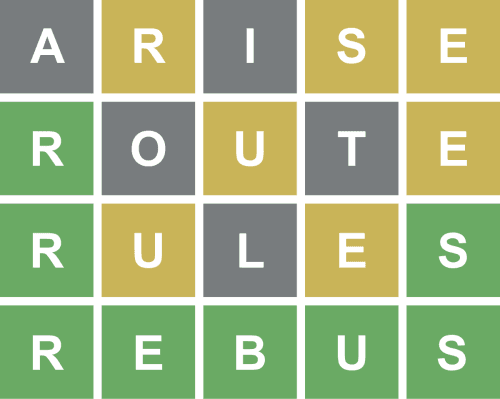
The beauty of Wordle Hint lies in its visual feedback system. However, many people treat it too casually. You are essentially playing detective at a crime scene where every colour is a clue.
- Green (Correct letter, correct place): Jackpot. Lock it down.
- Yellow (Correct letter, wrong place): Gold dust. It’s shouting, “I belong somewhere else; work it out!”
- Grey (Letter not in the word): Eliminate ruthlessly. Cross it out mentally and never waste another guess on it.
The mistake beginners make is ignoring yellows. They’ll put the letter back in the same spots or, worse, use words that don’t focus on moving them correctly. Treat every yellow as a must-move puzzle piece.
Step 3: Covering More Ground in the Early Guesses
Here’s where real strategy comes in. Your second and third guesses should aim to maximise information, not chase wins too quickly.
Suppose your opening word is TRACE and you get only a yellow ‘A’. Instead of sticking with something like GRAPE, be smarter. Try words like BOUND or SLIMY to test new letters. The goal is to dramatically reduce the pool of viable options by your third try.
Think of each guess not as a random stab, but like a game of Battleships. You’re not trying to sink the ship immediately; you’re narrowing the possibilities until only one ship is left standing.
Step 4: Recognising Letter Frequency
If you’re stuck, keep in mind that English letter frequency is not random. Letters like E, A, R, O, T, and L appear frequently, while others like J, Q, X, and Z hardly ever show up in Wordle Hint solutions.
Sometimes tricky words hide double letters, like silly, level, or allow. Don’t forget to consider the possibility of repeats if you’re nearing the end of your guesses. It’s easy to miss that last gap if you don’t think about double O’s or double L’s.
Step 5: Tactical Guessing vs Blind Hopping
Many players panic by guessing four and start typing random words just to see what happens. That often leads to more greys and wasted chances. This is where you need to be strategic:
- Cross-check everything: Before confirming a guess, ask yourself, “Does this use my known greens correctly? Does this change my yellows?”
- Avoid repeats: Don’t use grey letters again unless you think they might appear double (like sassy after eliminating a single ‘S’ but not a double).
- Commit to the puzzle: Stop trying meaningless words just to test more letters. By guess four or five, you should be focusing in.
Step 6: Endgame Tightening
By guess five, you should ideally have narrowed it down to two or three possible words. This is where intuition meets probability.
If your choices are between CLOTH and CLOCK, remember that common endings like -CK or -TH have different likelihoods based on previous clues. At this stage, picking the more common structure gives you the best chance.
However, Wordle Hint is also meant to be fun. If you want to take a risk and choose the rarer word just for enjoyment, go ahead.
Advanced Hacks (For When You’re Stuck)
- Recognise traps: Words with unusual consonant clusters like glyph can surprise people. Also, words with repeated odd letters like sissy can be tricky.
- Keep word lists in mind: Some dedicated players memorise the Wordle Hint solution pool, which is limited. If you’re not that committed, just being aware of rare structures, such as -ING endings or -IGHT patterns, can help.
- Diversify second guesses: If your first guess had many vowels, like audio, follow up with a guess focused on consonants, like stern. If your first guess was heavy on consonants, change your approach.
Mistakes People Commonly Make
- Using their favourite word every time without thinking it through. A great opener helps, but you still need discipline.
- Forgetting double letters. You’ll regret it when you miss “silly” for three guesses in a row.
- Overusing yellows. If ‘R’ is yellow, don’t keep placing it in the same three spots just because it’s a habit.
- Emotional panic. When you feel like you’re failing, you play worse. Stay calm; the game rewards focus.
Why Wordle Hint isn’t just a game
Many teachers have started using Wordle in classrooms to build vocabulary and improve logical thinking. Businesses have even quietly incorporated it into warm-up team meetings. The game exercises both your language memory and your ability to build strategies. When you think about it, isn’t that the real appeal? It’s not just about getting five green boxes. It’s about training yourself to think systematically, to embrace limits, and to solve problems under pressure while still having fun.
Nothing feels as satisfying as that sense of pride when you guess the daily word in under six tries. With these strategies, you’ll be ready for that win every day.