
Tired of robotic game characters repeating the same boring lines? Non-Player Characters (NPCs) can now think, learn, and feel like real characters, turning static worlds into dynamic, living adventures.
Have you ever been playing an open-world role-playing video game (RPG)? You’re completely lost in its amazing views and great story. Then, you talk to a character in the game, like a farmer, and the magic suddenly breaks.
You know the type. He stands in exactly the same place every day. He says the same one line, over and over again. It might be something like, “I’m stuck carrying your things,” or “Do you go to the fancy part of town? No, I didn’t think so.”
Sounds familiar?
For a very long time, these game characters (called NPCs) have been really important. They fill the world and give you quests. But they are also the biggest problem. You can easily see how they are programmed. They are like puppets, and you can see the strings controlling them. They are stuck repeating the same actions forever.
But what if that could change?
Imagine if that same farmer could remember that you saved his sheep last week. He could notice the new scar you got from a monster fight. He could even ask you if you’ve dealt with those bandits yet. And he could do all this in a brand new, natural conversation that wasn’t written by a programmer beforehand.
This isn’t just a dream anymore. Welcome to a new age for video games. A technology called Generative AI is changing everything. It’s coming out from behind the scenes and is starting to act on its own. It’s turning our robotic game characters into believable, living people inside the worlds we explore.
What Are NPCs?
Let’s start with the basics.
NPC stands for Non-Player Character. In essence, it’s any character in a game not controlled by a human player. They are the shopkeepers who sell you healing potions, the quest-givers who send you on epic journeys, the allies who fight by your side, and the villains who monologue before a boss battle.
They are the bustling crowds of a cyberpunk city, the cheering spectators in a football stadium, and the humble chickens you probably shouldn’t have kicked.
Their traditional roles are vital but rigid:
- Quest Dispensers: The primary source of objectives and plot advancement.
- Lore Dumps: Walking, talking encyclopedias for the game’s history and world-building.
- Ambience Creators: Populating towns and cities to make them feel alive (even if their behaviour is anything but).
- Mechanical Functions: Providing services like crafting, trading, or upgrading skills.
The problem has always been their lack of, well, character. They operate from a finite set of pre-written lines and pre-determined paths. They have no memory, no ability to adapt, and no capacity for surprise. They are, in the most literal sense, programmed. This fundamental limitation is the wall that Generative AI is now tearing down.
The evolution from scripts to intelligence
To appreciate the revolution, it’s worth taking a quick stroll down memory lane to see how we got here.
The Early Days
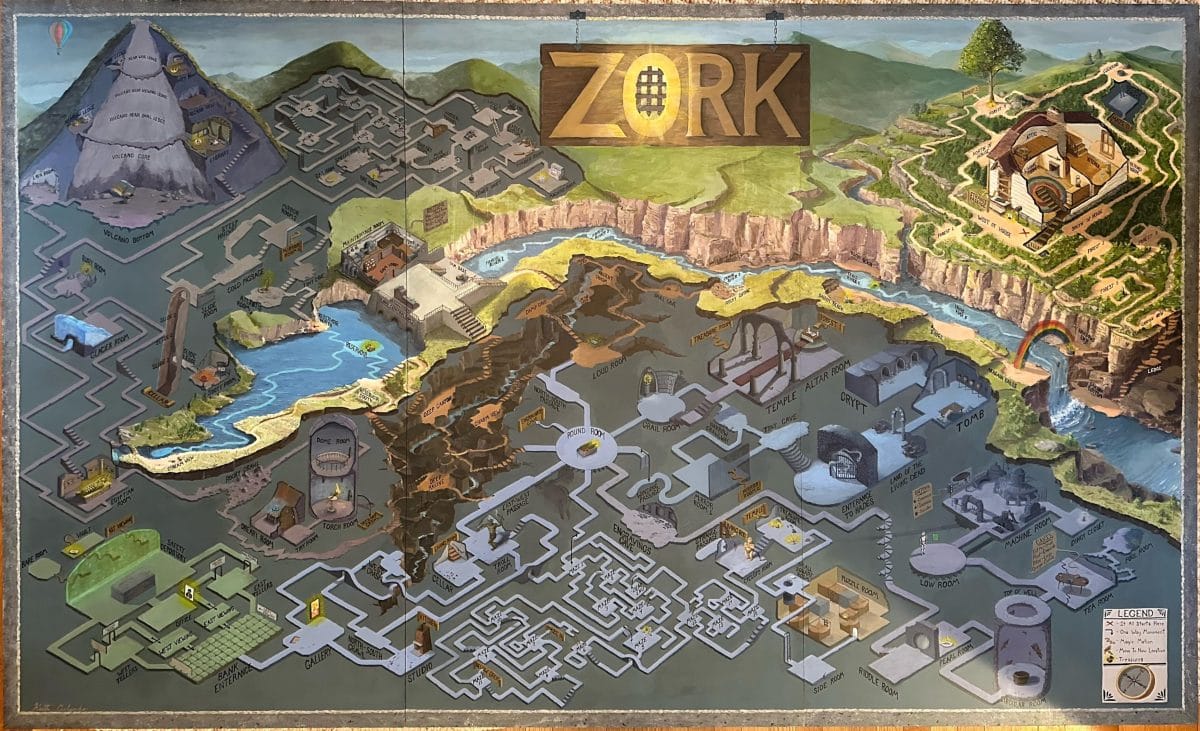
In the days of text-based adventures like Zork, NPCs were purely descriptive. You’d type “talk to guard”, and the game would simply print out his scripted response. Early graphical adventures, like those from Sierra or LucasArts, added voice and animation but the principle was the same: a giant branching tree of dialogue.
The player could choose from a list of options, and the NPC would respond with the corresponding pre-recorded line. It was clever, but the boundaries were always visible.
The 3D Era:
With 3D worlds like The Elder Scrolls or Grand Theft Auto, NPCs became more numerous. They’d wander on schedules, have simple routines, and react to the player’s actions with a limited set of responses (usually running away or attacking).
Games like The Sims added another layer, giving NPCs (or Sims) desires and needs that influenced their behaviour. Yet, their dialogue remained a closed loop of recorded audio. The writing was often brilliant, but it was finite. You could eventually exhaust every conversation topic, revealing the puppet strings.
The “Choice and Consequence” Model
Modern masterpieces like The Witcher 3 or the Mass Effect series pushed scripted narratives to their absolute peak. They featured incredibly deep characters with complex, branching dialogue trees where your choices felt like they mattered.
However, this complexity came at a colossal cost: thousands of hours of writing, voice recording, and motion capture for every possible permutation. It was a staggering achievement, but ultimately, it was still just a bigger, more elaborate script. The NPCs couldn’t deviate from it.
This entire history has been about developers trying to simulate intelligence by painstakingly hand-crafting every possible interaction. Generative AI flips this model on its head. Instead of simulating intelligence, it’s about creating it.

The technology behind the NPCs
So, how does it actually work?
When we talk about Generative AI for NPCs, we’re usually talking about a combination of several powerful technologies.
- Large Language Models (LLMs): This is the engine room. You’ll have heard of ChatGPT and its cousins. These AI models are trained on a colossal amount of text data, allowing them to understand language, context, and even style. For a game, an LLM isn’t connected to the entire internet; it’s fine-tuned on a specific dataset: the game’s own lore, character biographies, historical context, and the desired tone of voice. This creates a specialised AI that knows everything about the game world and can generate appropriate, in-universe dialogue on the fly.
- Procedural animation and voice synthesis: What good is a dynamically generated line of dialogue if the character just stands there, mouth agape, in silence? This is where other AI tools come in. Technologies like text-to-speech (TTS) have become incredibly sophisticated, able to generate natural, emotive voice audio in real-time that matches the generated text. Pair this with procedural animation systems that can automatically generate appropriate gestures, facial expressions, and body language based on the emotional content of the dialogue, and you have a character that can truly perform its AI-generated lines.
- Memory and context windows: This is the secret sauce for believability. Advanced AI systems can now maintain a “memory” of past interactions with a player. This could be a local memory (e.g., “this player gave me a gift yesterday”) or a global memory (e.g., “the player is the renowned hero who defeated the dragon of Darkwood”). This context is fed back into the LLM every time you initiate a conversation, allowing the NPC to reference past events and make the relationship feel continuous and evolving.
It’s a symphony of different AI systems working in concert: the LLM generates the thought, the TTS gives it a voice, and the animation system gives it a body. The result is a character that can converse freely, not just from a list.
Industry leaders and AI NPCs
This isn’t just theoretical. Several major players are already putting this tech into our hands.
NVIDIA:

A giant in the graphics world, NVIDIA is also a huge force in AI. Their Avatar Cloud Engine (ACE) is a suite of technologies designed specifically for this purpose. They demoed a stunning tech preview called Covert Protocol, featuring an NPC in a cyberpunk hotel bar who could hold unique, natural conversations with players using both voice and text, complete with perfectly synced facial animation. It was a landmark moment that showed the tech working in real-time.
Ubisoft:
The creators of vast open worlds like Assassin’s Creed and Watch Dogs have developed Ubisoft Neo NPCs. This is a full R&D project creating NPCs that players can talk to naturally, who can remember those conversations, and who have their own personalities and motivations. They’re designed not just for chat, but to be meaningful companions who can reason, strategise, and react to a dynamic world.
Inworld AI:
This company is focused purely on creating the “brains” for AI characters. Their platform allows developers to design an NPC’s personality, motivations, and knowledge base, and then plug that “brain” into their game engine. They’re powering everything from indie projects to experiments by giants like Microsoft.
Modders and Indies:
The revolution is also happening from the ground up. Clever modders have already used LLM APIs to create mods for games like Skyrim and Mount & Blade II: Bannerlord that replace scripted dialogue with AI-generated conversations. It’s a bit rough and ready, but it powerfully demonstrates the hunger for this technology and its transformative potential.
How Generative AI is Enhancing NPCs in Video Games
Okay, so the tech is cool. But what does it actually do for our gaming experience? The benefits are profound.
- Unlimited, Dynamic Dialogue: The most obvious win. NPCs will no longer have just five things to say. You could theoretically talk to any character for hours, learning about their life, their opinions on the world, and their thoughts on current events—all in a way that feels unique to your playthrough. That random city guard might have a fascinating backstory about why he joined the watch, if you just bother to ask.
- True Emergent Storytelling: This is the holy grail. Imagine an NPC who witnesses you commit a crime in a town. In a old game, they might run to a specific spot to trigger a scripted “wanted” level. An AI NPC might instead recognise you, remember you helped them previously, and decide to quietly warn you to leave town before they report you, creating a completely unscripted narrative moment that is yours alone.
- Deeply Personalised Relationships: Your relationship with an AI companion will be built on a history of unique interactions. They’ll remember your failures and celebrate your successes. If you’re consistently rude to them, they might become cold and uncooperative. If you’re kind and supportive, they might become a fiercely loyal friend. Your allies and enemies will be forged by your actions, not just by ticking boxes in a script.
- Living, Reactive Worlds: The world will react to you in meaningful ways beyond a simple “reputation” score. Your deeds will be discussed and exaggerated in taverns. An NPC you wronged might hold a grudge and seek revenge later in a way you never expected. The world won’t feel like a static backdrop waiting for you to interact with it; it will feel like a living ecosystem that you are a part of.
- Accessibility and Immersion: For players who find reading large amounts of text challenging, the ability to have natural voice conversations with characters could be a huge step forward in accessibility and immersion. It breaks down the UI barrier between player and world.
The Future Landscape
As with any seismic shift, this new frontier comes with its own set of challenges and breathtaking possibilities.
The long-term vision is staggering. We could see games where every single character is unique, with their own goals and daily lives that play out irrespective of the player. We could have infinite, player-driven quests generated by the world’s needs.
You might be asked to help find a lost child based on a genuine AI request from a distressed parent, not a pre-plotted quest flag.
The line between a “game” and a “virtual world” will blur into oblivion. We won’t be playing a story; we’ll be living inside a dynamic, responsive, and truly alive world where our choices resonate in ways we can’t even predict.
The farmer won’t just have a scripted line about the Cloud District; he’ll have an opinion on it, a story about his one trip there, and he might even ask you to take him there one day.
The strings are being cut. The puppets are finally learning to dance on their own. And for us players, that means the magic is just beginning.