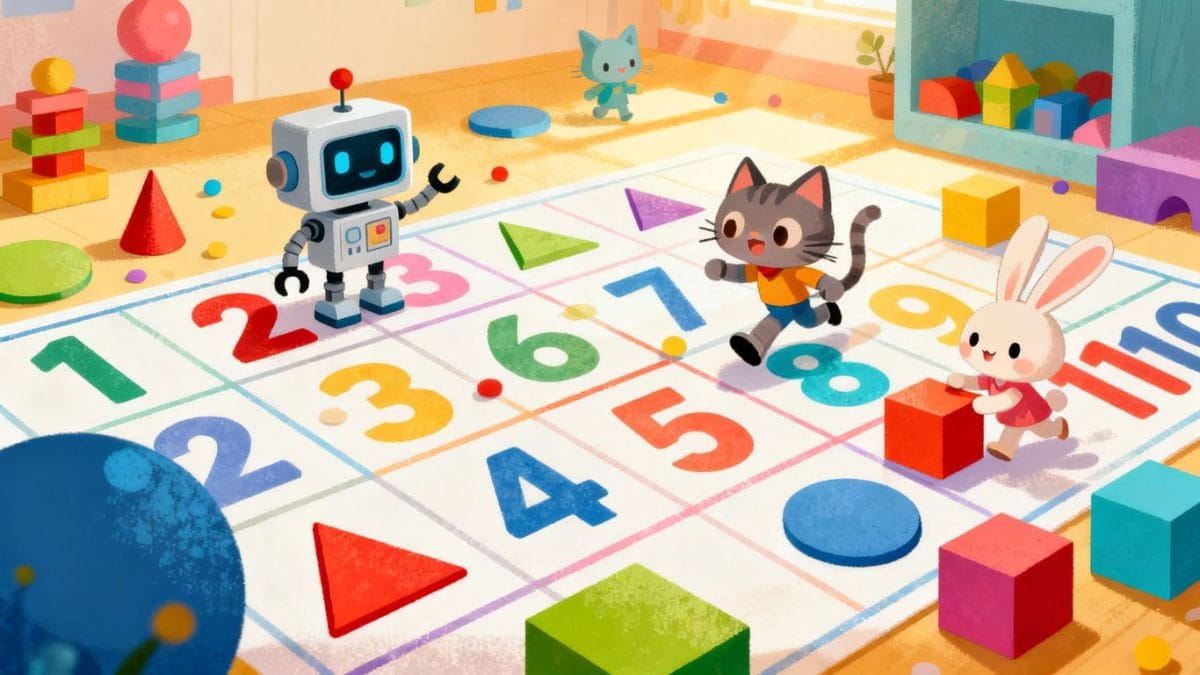
Sometimes, getting kids excited about math can feel like a puzzle itself. But what if learning numbers, shapes, and problems could be as fun as playing their favorite game? Turns out, it totally can be! We’ve looked at a bunch of ways kids can learn math through play, and it’s pretty cool how many options there are. From counting games that make numbers easy to understand, to puzzles that get their brains thinking, there’s a whole world of math game adventures waiting for young learners. It’s all about making math feel less like homework and more like an exciting challenge.
Key Takeaways
- Math games help kids learn counting, basic addition, and subtraction through fun activities.
- Exploring shapes, sizes, and patterns in games builds spatial reasoning and logic skills.
- Puzzles and sorting activities encourage problem-solving and critical thinking.
- Games that involve comparing numbers and identifying sequences boost number sense.
- Interactive math games can make learning concepts like time and place value more engaging.
Counting Games
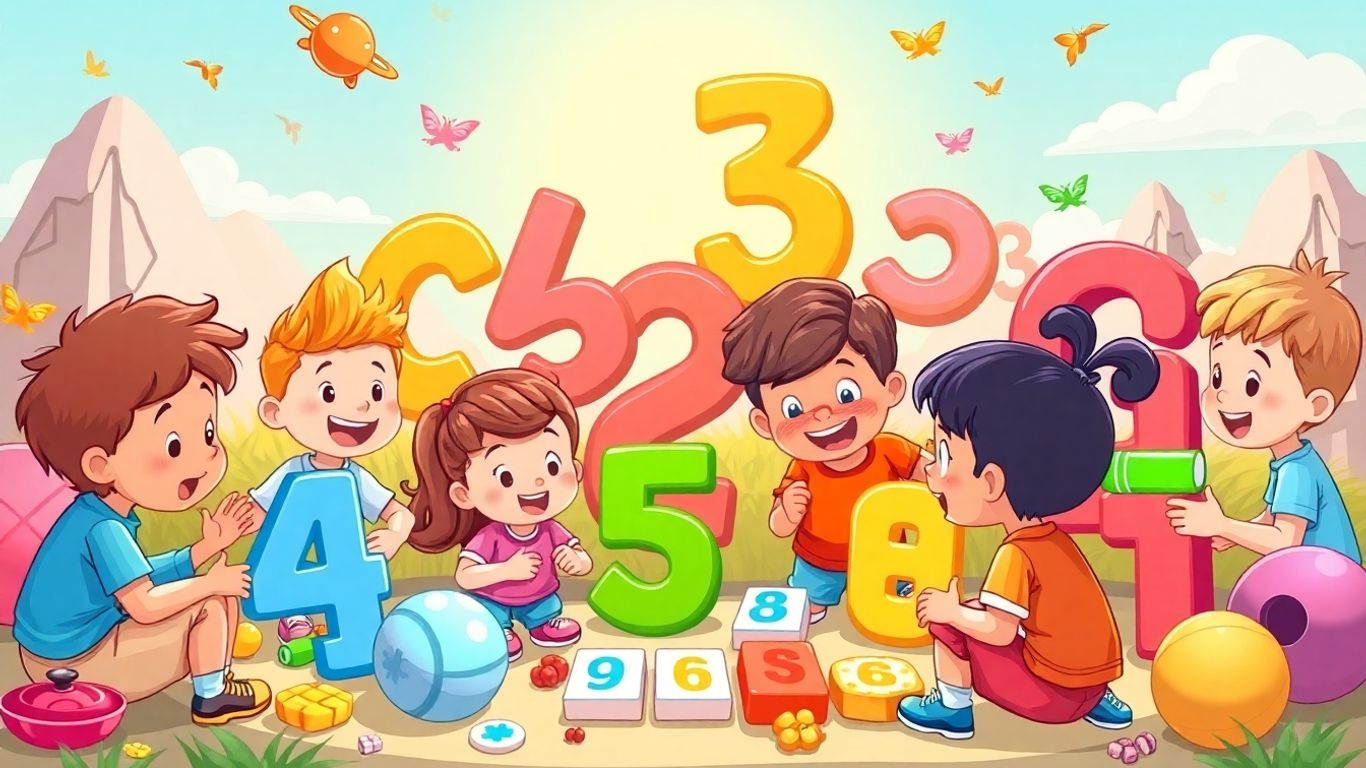
Getting a handle on numbers is the first big step in math, and games make it way more fun than just staring at a worksheet. We’re talking about games that help kids see, say, and play with numbers. Think about games where you count objects, like stars or fruits, and then match that count to a number. Some games even have kids trace numbers, which is great for little ones just learning how to write them. It’s all about building that basic number sense.
Here are a few ways games help with counting:
- Recognizing quantities: Games that show a group of items and ask how many there are, especially when kids can see the number quickly without counting each one individually (like dots on a die).
- Number order: Activities that involve putting numbers in the right sequence, whether counting up or counting down. This helps kids understand that numbers follow a pattern.
- Writing numbers: Games that guide children to trace numbers help them connect the symbol with the quantity it represents.
These early counting experiences are like building the foundation of a house. If the foundation is strong and built with engaging activities, everything that comes later in math will be much easier to put on top.
For example, a game might ask a child to count how many apples are in a basket and then pick the card with the matching number. Another might have them count backward from ten to make a character jump. These activities are designed to make counting feel like play, not work. They help kids get comfortable with numbers and build confidence from the start.
Addition And Subtraction
When young learners start to grasp numbers, addition and subtraction are the next big steps. These operations are the building blocks for more complex math. Games make learning these concepts much more enjoyable and less like a chore.
Think about it: instead of just looking at numbers on a page, kids can use objects, draw pictures, or play interactive games to figure out how many things they have when they combine groups, or how many are left when some are taken away. This hands-on approach really helps them see what’s happening with the numbers.
Here are some ways games can help with addition and subtraction:
- Visualizing Problems: Games often use pictures or objects. For example, a game might show 3 apples and then add 2 more, asking how many apples there are in total. This visual aid makes the abstract idea of adding concrete.
- Practicing Facts: Repetition is key for memorizing addition and subtraction facts. Games can turn this repetition into fun challenges, like racing against the clock to solve problems or earning points for correct answers.
- Developing Strategies: Beyond just memorizing, games can introduce different ways to solve problems. This could be counting on, using number bonds, or understanding how adding the same numbers in a different order still gives the same answer (like 2 + 3 is the same as 3 + 2).
- Building Fluency: The more kids play, the faster and more confident they become with adding and subtracting. This fluency is important for tackling bigger math problems later on.
Games that involve combining sets of objects, like blocks or counters, are great for introducing addition. For subtraction, games where children remove objects from a group help them understand the concept of ‘taking away’. These simple mechanics build a strong foundation.
Many games focus on specific skills. Some might help with adding two-digit numbers, while others focus on subtraction that requires ‘regrouping’ (sometimes called borrowing). There are even games designed to help kids master their times tables, which are closely related to addition through repeated addition.
Shapes And Sizes
Exploring shapes and sizes is a fantastic way for young learners to start understanding the world around them. It’s not just about identifying a circle or a square; it’s about noticing the attributes that make them unique and how they fit together.
Games in this category often involve visual recognition and spatial reasoning. For instance, children might play a game where they match shapes to their names or sort objects based on their form. This helps them build a vocabulary for geometric concepts.
Here are some common areas covered:
- 2D Shapes: Recognizing basic flat shapes like circles, squares, triangles, and rectangles. This includes looking at their sides and corners.
- 3D Shapes: Identifying solid shapes such as cubes, spheres, cones, and cylinders. Kids learn to distinguish these by their appearance in the real world.
- Attributes of Shapes: Understanding what makes a shape what it is – for example, a square always has four equal sides and four right angles.
- Spatial Concepts: Games might also introduce positional words like ‘above,’ ‘below,’ ‘next to,’ and ‘between,’ which are important for understanding how objects relate to each other in space.
Learning about shapes and sizes helps children develop critical thinking skills. They start to see patterns, classify objects, and solve problems by looking at visual information. This foundation is super helpful for later math topics like geometry and even basic measurement.
Many activities focus on partitioning shapes into equal parts, like halves or quarters. This introduces early fraction concepts in a very visual and concrete way. By engaging with shapes and sizes through play, children naturally develop a stronger sense of spatial awareness and geometric understanding.
Logic Tasks
Logic games are fantastic for helping young minds develop critical thinking and problem-solving skills. These activities often involve figuring out patterns, making deductions, and understanding cause and effect, all while keeping things fun and engaging. They’re not just about getting the right answer; they’re about the process of thinking through a challenge.
Think about games where kids have to arrange objects in a specific order based on clues, or where they need to identify which item doesn’t belong in a group. These kinds of tasks encourage children to look closely, compare information, and make reasoned choices. It’s like being a detective, but with numbers and shapes!
Here are a few types of logic tasks that are great for this age group:
- Pattern Recognition: Identifying and continuing sequences, whether they are visual (like colors or shapes) or numerical.
- Deductive Reasoning: Using given information to figure out a solution, like in ‘if this, then that’ scenarios.
- Spatial Reasoning: Understanding how objects fit together or move in space, which is key for many puzzles.
- Classification: Grouping items based on shared characteristics.
These games help children build a foundation for more complex mathematical concepts later on. They learn to approach problems systematically and to trust their own thinking process.
For instance, a game might present a grid with some missing pieces. The child has to figure out what goes in the empty spots based on the rules of the grid. Or, they might be shown a series of images and asked to predict what comes next. These activities build a child’s ability to think ahead and plan their moves. It’s a wonderful way to make learning feel like play.
Puzzles And Sorting
Puzzles and sorting activities are fantastic for helping young minds develop critical thinking and organizational skills. These aren’t just about putting things in order; they’re about understanding relationships, patterns, and attributes. When kids sort objects, they’re learning to identify similarities and differences, a key step in mathematical reasoning. Think about sorting toys by color, size, or type – each action builds a foundation for more complex concepts.
Here are some ways puzzles and sorting games help:
- Pattern Recognition: Many puzzles require kids to see and replicate patterns, which is a building block for understanding sequences and even early algebra.
- Attribute Identification: Sorting tasks encourage children to focus on specific characteristics of objects, like shape, color, or texture. This helps them learn to classify and categorize information.
- Problem-Solving: Figuring out how pieces fit together in a puzzle or how to arrange a set of items logically hones a child’s ability to approach problems systematically.
- Spatial Reasoning: Jigsaw puzzles, tangrams, and block-building games all contribute to a child’s understanding of how shapes and objects fit together in space.
These activities encourage children to think about how things relate to each other, making abstract concepts more concrete. For instance, a child sorting blocks by size is implicitly learning about comparative measurement. Similarly, completing a simple jigsaw puzzle helps them understand how parts make up a whole.
Engaging with puzzles and sorting games provides a hands-on way for children to explore mathematical ideas. It’s about making connections and building a mental framework for understanding the world around them through order and logic.
Comparison And Sequences
Understanding how numbers relate to each other and how they follow a pattern is a big step in math. Games that focus on comparison and sequences help young learners build this understanding. They learn to tell if one number is bigger or smaller than another, and they start to see the order in which numbers appear.
These skills are built through activities that ask children to arrange items or numbers from least to greatest, or vice versa. They also involve recognizing and continuing patterns, like counting by twos or fives. This helps them predict what comes next, a skill that’s useful way beyond math class.
Here are some ways games can help with comparison and sequences:
- Ordering Numbers: Games where kids put numbers in order, from smallest to largest or largest to smallest. This could be with number cards, on a number line, or even with collections of objects.
- Skip Counting: Practicing counting by a specific number (like 2, 5, or 10). This builds a foundation for multiplication and helps children see number patterns more clearly.
- Identifying Patterns: Activities that involve recognizing and extending visual or numerical patterns. This could be a sequence of colors, shapes, or numbers.
These activities help children develop a strong sense of number relationships and predictability.
Think about a game where kids have to sort a pile of blocks by size, from smallest to largest. They’re comparing each block to the others and putting them in a specific order. Or imagine a game where they see a sequence like 2, 4, 6, and have to figure out what number comes next. They’re not just guessing; they’re using the pattern they’ve observed.
Games that focus on comparing numbers and recognizing sequences help children build a solid foundation for more complex math concepts. They learn to think logically about quantity and order, which is a key part of mathematical thinking.
Time And Spatial Concepts
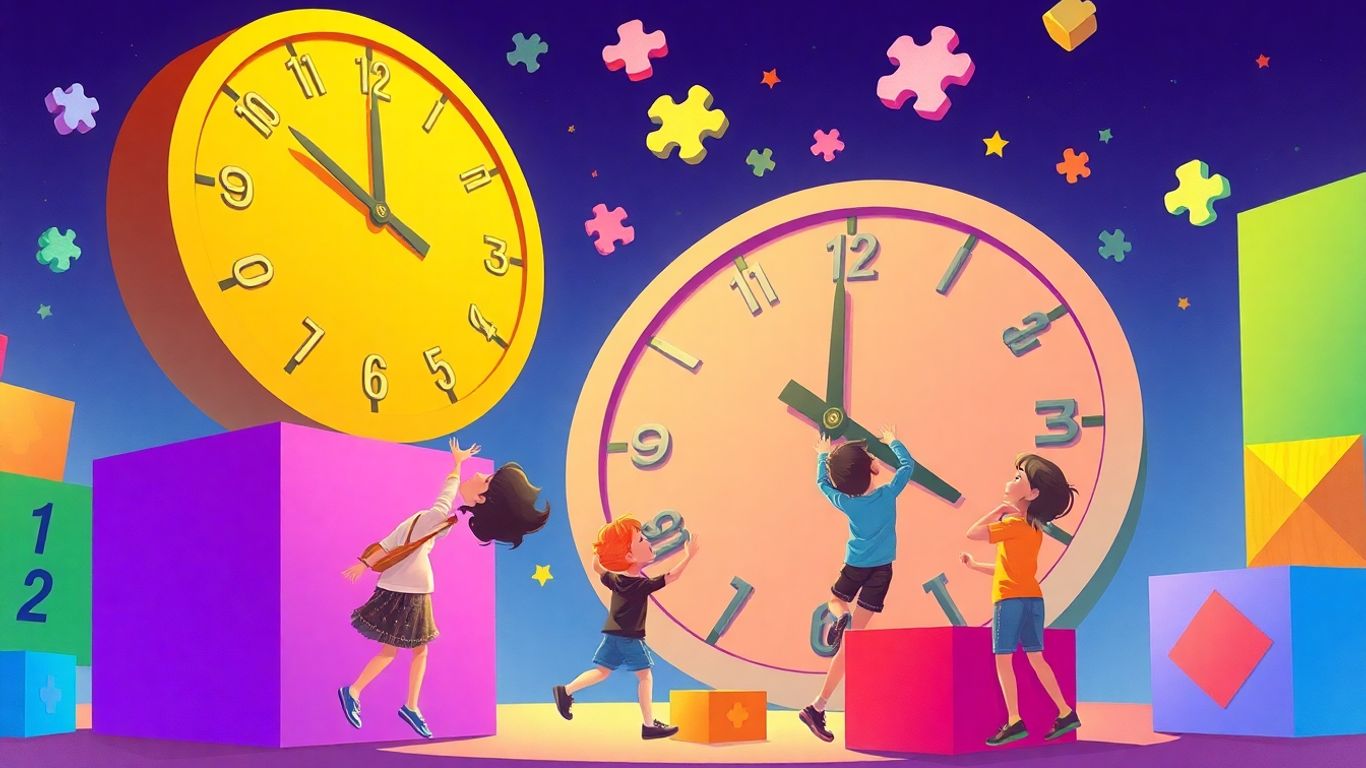
Understanding time and spatial relationships helps kids make sense of the world around them. It’s not just about telling time on a clock; it’s about sequencing events, understanding duration, and knowing where things are in relation to each other.
Games that focus on time can start with simple concepts like ‘before’ and ‘after’ or ‘morning’ and ‘night’. As children get older, they can move on to reading analog clocks, first to the hour, then half-hour, quarter-hour, and eventually to the minute. Understanding AM and PM also helps them grasp the difference between morning and evening activities.
Spatial concepts involve understanding position, direction, and distance. Games using positional words like ‘above,’ ‘below,’ ‘next to,’ and ‘behind’ are great starting points. Geometry games that explore shapes, their attributes, and how they fit together also build spatial reasoning. Thinking about how objects relate to each other in space is a key skill.
These skills are built through playful exploration and practice.
Here are some ways games can help:
- Telling Time: Games that involve setting clock hands to specific times, matching digital to analog clocks, or identifying times like ‘quarter past’ or ‘half past’ are very useful. For example, a game might ask a child to show 3:30 on an analog clock.
- Understanding Duration: Activities that ask kids to guess how long an event might take (e.g., ‘How long does it take to brush your teeth?’) or to measure elapsed time between two events help them grasp the concept of time passing.
- Spatial Awareness: Puzzles that require fitting shapes together, games that involve following directions to move a character on a grid, or activities that ask children to describe the location of objects relative to one another all build spatial skills.
Learning about time and space isn’t just about memorizing facts; it’s about developing a practical understanding of how the world works. When kids can tell time, they can plan their day. When they understand spatial relationships, they can better navigate their environment and solve problems involving physical objects.
Consider games that use visual aids like maps or simple coordinate grids to help children understand position and direction. These activities can make abstract concepts more concrete and enjoyable.
Number Sense
Number sense is all about a child’s comfort and intuition with numbers. It’s not just about memorizing facts, but about understanding what numbers mean and how they relate to each other. Games that focus on number sense help kids build a strong foundation for all future math learning.
Think about it: when kids can easily recognize numbers, count objects accurately, and understand basic comparisons like ‘more’ or ‘less’, they’re already on the right track. Activities that involve skip counting, for example, help children see patterns in numbers and prepare them for multiplication. Similarly, games that ask them to identify if a number is even or odd introduce early concepts of divisibility and number properties.
Here are some ways games can help build number sense:
- Number Recognition: Games that involve matching numerals to quantities or identifying numbers in different contexts (like on a clock or a dice) are great for this.
- Counting and Cardinality: Activities where children count objects, put them in order, or determine ‘how many’ are key.
- Comparing Numbers: Games that ask children to decide which group has more or less, or which number is larger, build this skill.
- Understanding Number Relationships: This includes concepts like number bonds (how numbers can be combined to make another number) and understanding that numbers can be represented in different ways (e.g., 10 can be 5+5 or 10 ones).
Developing a good sense of numbers early on makes tackling more complex math ideas later on much easier. It’s like learning the alphabet before you can read a book; number sense is the alphabet of mathematics.
Games like ‘Counting Along with the Stars from 1 to 5’ or ‘Identifying Embedded Numbers’ are fantastic for this. They make learning about number sequences and basic number composition fun and interactive. These playful experiences help children develop a flexible and confident approach to numbers.
Place Value Games
Understanding place value is a big deal in math. It’s how we know that the ‘2’ in 20 is worth much more than the ‘2’ in 0.02. Games make this concept click for young learners.
Think about it: numbers are built on a system where each digit’s position matters. Games can help kids see this clearly. They might involve matching number cards to their expanded form, like seeing ‘300 + 40 + 5’ and knowing it’s ‘345’. Or perhaps they’ll use manipulatives, like blocks or beads, to represent tens and ones, making the abstract idea of ‘ten ones make one ten’ very concrete.
Here are some ways place value games can help:
- Building Numbers: Games where kids draw digit cards and arrange them to make the largest or smallest possible number. This directly shows how position affects value.
- Comparing Numbers: Activities that involve comparing two numbers, focusing on which digit is in the tens place, hundreds place, and so on. This helps them understand ‘greater than’ and ‘less than’ in a meaningful way.
- Rounding Practice: Games that use number lines or charts to help children round numbers to the nearest ten or hundred. This reinforces the idea of which place value is most important for rounding.
Many games focus on breaking down numbers into their parts – ones, tens, hundreds, and even thousands. This helps children build a strong foundation for more complex math later on, like addition and subtraction with larger numbers, or understanding decimals.
For instance, a game might ask players to identify how many tens are in a number like 70. Is it seven tens, or seventy ones? Games that involve counting by tens, fives, or even hundreds also build this foundational understanding. They’re not just rote memorization; they’re about seeing the patterns and relationships within our number system. This makes math feel less like a set of rules and more like a puzzle to be solved.
Algebra Games
Algebra might sound like a big word, but it’s really about patterns and figuring out the unknown. Think of it like a detective game for numbers! Kids can start exploring algebraic thinking early on by looking for missing numbers in sequences or figuring out if two math sentences are the same, even if they look different.
These games help children understand that math isn’t just about solving problems one way. They learn that different combinations of numbers can lead to the same answer, which is a core idea in algebra. It’s all about building that foundation for more complex math later on.
Here are some ways kids can get started with algebra through games:
- Identifying Patterns: Games that ask kids to fill in the next number in a series (like 2, 4, 6, __) help them see how numbers relate to each other.
- Balancing Equations: Simple games where kids have to make both sides of an equals sign equal (like 3 + 2 = __ + 1) introduce the concept of variables and equality.
- Using Symbols: Some games use symbols to represent unknown numbers or quantities, making the abstract idea of algebra more concrete.
Playing these kinds of games early on helps children develop flexible thinking about numbers. They start to see math as a puzzle to be solved, rather than just a set of rules to memorize. This approach makes learning algebra feel less intimidating and more like an exciting challenge.
These activities are great for developing logical reasoning and problem-solving skills. They encourage kids to think critically about mathematical relationships and to experiment with different solutions. It’s a fun way to prepare them for the algebraic concepts they’ll encounter as they get older.
Putting the Fun Back into Math
So, we’ve looked at how games can really help young learners get comfortable with math. It’s not just about memorizing facts; it’s about playing, exploring, and figuring things out. Whether it’s counting, adding, or understanding shapes, there are tons of fun games out there that make learning feel less like a chore and more like an adventure. These digital tools can be a great way for kids to build confidence and a positive attitude towards numbers, setting them up for success down the road. Giving kids these playful experiences can make a big difference in how they see math.
Frequently Asked Questions
What kind of math skills do kids learn from these games?
These games are designed to help kids with all sorts of math skills! They can learn to count, figure out basic addition and subtraction, recognize shapes, and even start thinking logically by spotting patterns. It’s a fun way to build a strong math foundation without it feeling like homework.
Are these games suitable for all ages?
Yes, the games are usually made to grow with your child. Many apps and websites offer different levels or games that focus on specific age groups, starting from simple counting for preschoolers all the way up to more complex problems for older elementary students.
How do math games help kids who find math difficult?
Math games make learning enjoyable! Instead of feeling stressed, kids can explore numbers and problems in a playful way. This can boost their confidence and make them more willing to try, even if they usually struggle with traditional math lessons. Visuals and interactive elements also make concepts easier to grasp.
Can my child play these math games on different devices?
Absolutely! Most online math games and apps are designed to be played on various devices, like tablets, laptops, and even phones. This means kids can practice their math skills wherever they are, whether at home or on the go.
Do these games help with more than just basic math?
Definitely! Beyond counting and adding, many games focus on developing critical thinking and problem-solving abilities. Kids learn to think logically, figure out sequences, understand spatial concepts (like shapes and positions), and even get a head start on skills like coding through puzzles and challenges.
How can I track my child’s progress in these math games?
Many math apps and platforms offer a ‘Parent Connect’ feature. This allows parents to see how their child is doing, what skills they’ve mastered, and where they might need a little more practice. It’s a great way to stay involved in their learning journey.