
Entertainment
The PC Gaming Renaissance (1980-2000)
25 Jul 2025

How a beige box became a billion-dollar revolution, why Doom nearly broke corporate networks worldwide? The PC gaming renaissance (1980-2000) didn’t just create games it birthed new industries, from esports to virtual economies.
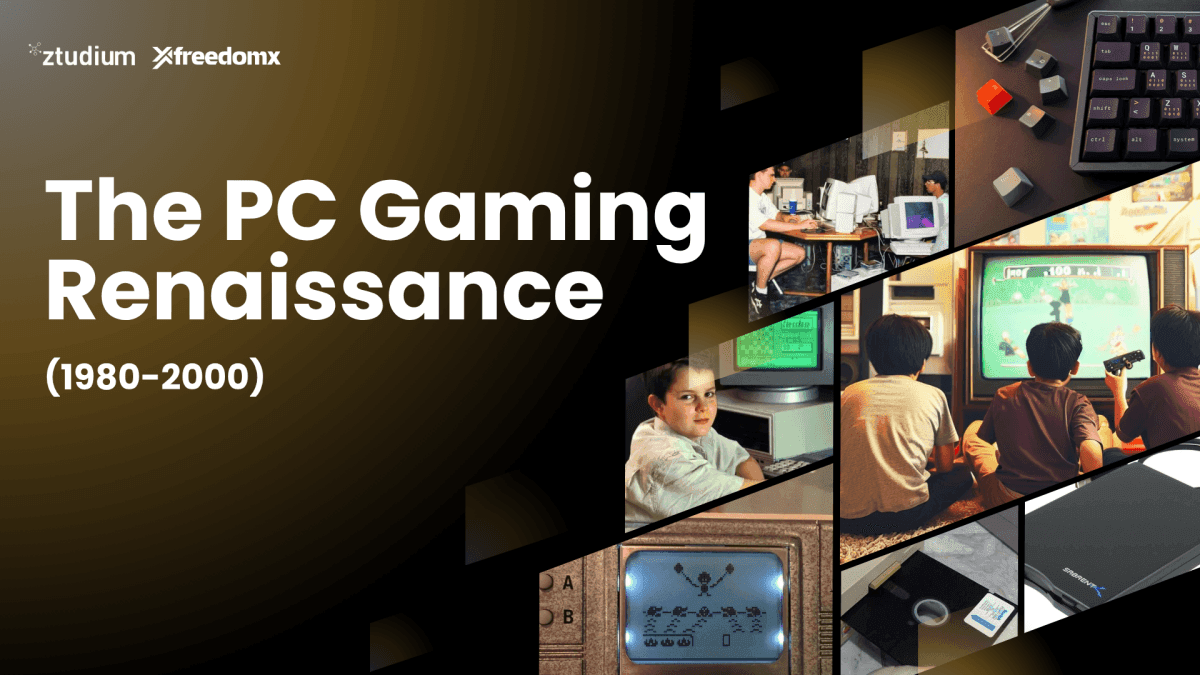
PC Gaming Renaissance, Infographic by Dinis Guarda
If you remember from the ‘80s and ‘90s the clatter of keyboards, the hum of floppy drives, and the sheer magic of watching games – it evolved from simple text adventures to sprawling 3D worlds.
This wasn’t just a shift in technology; but a full-blown revolution. And it all happened because a bunch of clever, passionate folks looked at their bulky beige computers and thought:
“Why not make something amazing?”
As the great Alan Kay once envisioned: “The personal computer is not just a tool; it is the extension of human intellect, the democratisation of computational power, and the canvas upon which we paint our digital dreams.” And oh, did those dreamers paint!
Take Richard Garriott, the bloke behind the Ultima series, who put it perfectly: “We didn’t just make games for computers. We made computers worth owning through games.”
And he wasn’t wrong.
Before PCs became household essentials, it was gaming that convinced people to shell out their hard-earned cash. Who needed spreadsheets when you could slay dragons, build cities, or explore galaxies?
From Geeky Pastime to Global Phenomenon: How PC Gaming Took Over the World
In the early days, PC gaming was about as mainstream as a calculus textbook at a disco. While your mates were happily bashing away on their Ataris and Nintendos, PC gamers were hunched over clunky keyboards, squinting at green text on black screens, and loving every minute of it.
But here’s the brilliant bit – that nerdy little hobby was about to change everything.
The personal computer revolution wasn’t just about boring spreadsheets and writing letters to Aunt Mabel (though let’s face it, WordPerfect was life-changing for homework). No, the real magic happened when people realised these beige boxes could do something extraordinary – they could bring entire worlds to life.
While consoles offered slick, polished experiences that worked straight out the box, PC gaming was like the wild west of digital entertainment.
No rules, no limits – just pure, unfiltered creativity. If you could dream it and code it, you could play it. This was the era when:
- A university student could create the next gaming sensation from their dorm room
- Players weren’t just consumers – they were modders, level designers, and sometimes even full-blown developers
- Entire new genres were being invented pretty much every other week
From text adventures that fired up your imagination to fully 3D worlds that blew your actual mind, PC gaming didn’t just evolve – it went through a full-blown metamorphosis.
And the best part?
This wasn’t some corporate-controlled revolution. This was proper people power – bedroom coders becoming industry legends, shareware spreading like wildfire, and online communities forming in the digital equivalent of smoky backrooms.
The consoles had their shiny cartridges and plug-and-play simplicity, but PCs? PCs had freedom. The freedom to tinker, to modify, to create. Before long, what started as a niche hobby for techy types had become a cultural force to be reckoned with – proving once and for all that given the right tools, gamers would always push boundaries further than anyone thought possible.
The Personal Computer Revolution
Before PCs could become gaming powerhouses, they had to become household staples. The journey from room-sized mainframes to desktop machines was nothing short of revolutionary.
The democratisation of computing power
In the early 1980s, computers were expensive, complex, and rare.
But visionaries like Steve Jobs, Steve Wozniak, and Commodore’s Jack Tramiel believed that computing power should belong to everyone, not just corporations.
Their efforts led to machines like the Apple II, the Commodore 64, and the IBM PC – each playing a crucial role in bringing gaming to the masses.
Personal computer adoption timeline:
| Year | Households with PCs | Average Price | Computing Power (MIPS) | Gaming Capability |
| 1980 | 0.2% | £3,500 | 0.3 | Text-based only |
| 1985 | 8.2% | £2,200 | 1.2 | Simple graphics |
| 1990 | 15.0% | £1,800 | 5.5 | VGA colour |
| 1995 | 36.4% | £1,200 | 75.0 | 3D acceleration |
| 2000 | 51.0% | £800 | 1,200.0 | Photorealistic |
(Source: Computer Industry Almanac, IDC Historical Database)
This shift meant that more people than ever had access to machines capable of running games. But unlike consoles, which were designed purely for entertainment, PCs were versatile. They could be used for work, creativity, and communication—but it was gaming that often justified their purchase.
The platform wars: Setting the stage
The early PC landscape was fragmented. Different systems had different strengths, and developers had to choose which platforms to support.
Major PC Gaming Platforms (1980-1990):
- Apple II – Educational and adventure games
- Commodore 64 – Europe’s gaming powerhouse
- IBM PC Compatible – Business-focused but growing in gaming
- Atari ST – Strong in Europe, especially for music and gaming
- Amiga – Superior graphics and sound
This diversity forced developers to innovate.
Some games were exclusive to certain platforms, creating fierce loyalty among fans. But by the mid-1990s, IBM-compatible PCs had won the war, unifying the market around open standards.
Early PC gaming pioneers
The first wave of PC game developers weren’t corporate teams – they were hobbyists, students, and self-taught programmers working from their bedrooms. These pioneers didn’t just make games; they defined entire genres.
Richard Garriott: The digital dungeon master
Richard Garriott, better known as Lord British, created the Ultima series—games that didn’t just simulate fantasy worlds but gave them depth, morality, and consequence.
“I wanted to create not just games but worlds – places where players could explore not just geography but philosophy, where every choice had meaning and consequence.” Richard Garriott
Ultima Innovations:
- Moral systems – Player actions affected character alignment
- Open worlds – Non-linear exploration
- Player housing – Customisable homes in-game
- Economic simulation – Complex trade systems
Roberta Williams: The queen of adventure
Roberta Williams, co-founder of Sierra On-Line, revolutionised storytelling in games with the King’s Quest series. Her work proved that games could be as rich and engaging as books or films.
King’s Quest Technical Evolution:
| Game | Year | Graphics | Innovation |
| King’s Quest I | 1984 | 16-colour EGA | First graphic adventure |
| King’s Quest IV | 1988 | 16-colour EGA | Female protagonist |
| King’s Quest V | 1990 | 256-colour VGA | Point-and-click interface |
| King’s Quest VII | 1994 | SVGA | Full voice acting |
Sid Meier & Will Wright:
Sid Meier’s Civilization and Will Wright’s SimCity showed that games could be intellectually stimulating, teaching players about history, economics, and urban planning.
“A game is a series of interesting choices.” – Sid Meier
SimCity had no win condition yet players spent countless hours building, destroying, and rebuilding their virtual metropolises.
The First-Person Shooter Revolution
Blimey, just when we thought PC gaming couldn’t get any more revolutionary, along came the first-person shooter to properly ruin everyone’s productivity. While some gamers were happily building cities or solving point-and-click puzzles, a couple of absolute mad lads at id Software were about to change everything with guns, gore, and more polygons than your dad’s office PC could handle.
Doom
When John Carmack and John Romero unleashed Doom in 1993, it wasn’t just a game – it was a full-blown cultural earthquake. Offices everywhere suddenly found their networks mysteriously slowing down as colleagues blasted demons instead of spreadsheets.
“We don’t just make games. We make the tools that enable an entire industry to make better games.” – John Carmack
And weren’t they right?
Doom didn’t just give us excitement and more excitement – it invented:
- The shareware model (first hit’s free, like digital crack)
- LAN parties (the original esports, just with more pizza stains)
- Modding culture (because why should devs have all the fun?)
Quake:
Just when we’d recovered from Doom, along came Quake in 1996 to melt our graphics cards with:
- Proper 3D worlds (goodbye sprites, hello motion sickness)
- Online multiplayer (dial-up screaming matches included free)
- The birth of esports (before we called it that)
It was like Doom had eaten its Wheaties and done a computing degree. Suddenly every PC gamer needed a 3D accelerator card and a very understanding bank manager.
MMORPGs:
Just when we thought gaming couldn’t get more addictive, along came Ultima Online and EverQuest to properly ruin relationships.
Richard Garriott wasn’t wrong when he said:
“We didn’t just create a game world. We created a society with its own economics, politics, and culture. The players became the content.”
These weren’t games – they were alternate realities where:
- People got properly married (with better housing than real life)
- Virtual economies crashed harder than the stock market
- Guild drama made EastEnders look tame
And let’s not forget the legendary EverQuest addicts who forgot to eat, sleep, or occasionally blink. The term “grinding” took on whole new meaning – both in-game and for worried parents.
The legacy of the PC gaming renaissance
By 2000, PC gaming had established itself as the most innovative platform in history. It wasn’t just about better graphics or faster processors – it was about giving players the tools to create, share, and redefine gaming itself.
From modding communities to digital distribution, from esports to virtual economies, the innovations of this era shaped everything that followed.
The PC gaming renaissance proved that when technology meets creativity, the possibilities are endless.
And as John Carmack once said: “We didn’t just write games. We wrote the future. Every line of code, every shared engine, every community forum was building toward a world where creation and play would merge into something entirely new.”


