
Entertainment
AI, Music and the Creative Economy: The 404 Million Awakening
15 May 2026

“It is no measure of health to be well adjusted to a profoundly sick society.” — J. Krishnamurti
“The illiterate of the 21st century will not be those who cannot read and write, but those who cannot learn, unlearn, and relearn.” — Alvin Toffler
The Reboot, From Tool to Creator-Architect
Somewhere between the ochre etchings of Blombos Cave 73,000 years ago and the 60,000 tracks now uploaded to Spotify every twenty-four hours, the human creator has been quietly rewritten. The species that once carved rhythm into bone flutes is now negotiating co-authorship with machines that compose, mix, master and distribute at the speed of thought. This is not a tool change. It is a redefinition of the creative act itself.
According to the Stanford HAI 2026 AI Index, generative AI reached 53% population adoption within three years, faster than the PC or the internet, with U.S. consumer surplus from these tools hitting an estimated $172 billion annually by early 2026 and the median value per user tripling between 2025 and 2026. Organisational adoption has surged to 88%, while generative AI is now used in at least one business function at 70% of organisations. The Harvest Phase has arrived. Stanford
As we speak the distinction between “human-made” and “AI-assisted” has blurred, giving rise to three distinct personas within the 404 million ecosystem:
- The Music Creator (The Hybrid Architect): As defined by Berkeley’s CNMAT, the 2026 music creator is no longer just a performer but a “Sonic Architect.” With over 60,000 tracks uploaded daily to Spotify, the role has shifted from manual composition to high-level orchestration. Creators now use “Explicable AI” to manipulate timbre and harmony at a granular level, treating the AI as a hyper-competent session musician rather than a replacement.
- The Digital Influencer/Creator (The Context Engine): In the AI economy, “content” has become a commodity. Research from Berkeley Haas suggests that the 2026 influencer’s value lies in “contextual authenticity”. While AI can generate the visuals and text, the creator provides the “Human-First” premium—the verified life experience and community trust that algorithms cannot simulate.
- The Creative Entrepreneur (The Micro-Multinational): Stanford’s Digital Economy Lab identifies this group as the fastest-growing segment. Leveraging Agentic AI, a single entrepreneur now manages the creative output, marketing, and legal compliance that previously required a 10-person agency.
For the 404 million-strong creative ecosystem – musicians, designers, writers, developers, influencers, sonic architects, micro-entrepreneurs, this acceleration is neither salvation nor extinction. It is a forced evolution. Each of them is, in their own minor key, the entire history of human expression compressed into a username. Every creator carries the cave painter, the troubadour, the studio engineer and the algorithmic composer within them. The whole of humanity moves through every individual hand that touches a digital audio workstation.
The 404 Million Creator Class — Anatomy of a New Class
The “404 million” figure is not a slogan. It is a synthesis of the world’s most rigorously tracked labour data:
- The professional creator core — over 207 million people globally identify as digital content creators, with roughly 45 million earning meaningful income.
- The freelance and gig substrate — the World Bank estimates between 154 and 435 million gig workers worldwide, representing between 4.4% and 12.5% of the global labour force.
- The hybrid edge — millions of teachers, coders, marketers and consultants whose work is now creator-adjacent through AI-augmented production.
Three distinct personas have crystallised inside this ecosystem:
- The Sonic Architect — the musician redefined. Rather than composing every note, they orchestrate, curate, conduct. CNMAT’s incoming director Carmine-Emanuele Cella identifies three focal areas for the new music research: control systems where innovative sensors and controllers generate audio; generative systems that use code to construct sounds; and explicable AI, which seeks to understand how AI models function. “Rather than replacing artists, we envision a co-evolution of humans and machines, with AI as a thoughtful partner in the musical workflow,” Cella states. BerkeleyBerkeley
- The Context Engine — the digital influencer. Content has been commoditised by generative models; what remains scarce is verified human experience, community trust and lived authenticity. Their moat is no longer production — it is presence.
- The Micro-Multinational — the creative entrepreneur. A single individual orchestrating agentic AI swarms that perform the work of a 10-person agency: A&R, legal, distribution, accounting, design, growth. As Peter Diamandis argues in Abundance and The Future Is Faster Than You Think, technology is now a resource-liberator; the bottleneck has shifted from capital to imagination.
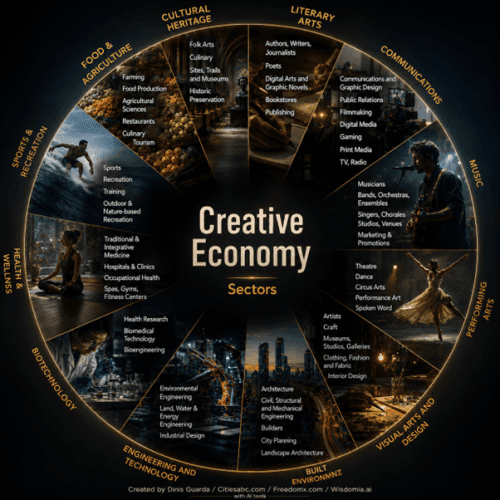
The Creator AI Paradox — Productivity Up, Income Down
Here lies the defining economic wound of 2026: a Productivity-Income Divergence so sharp it deserves its own name. Call it the 404 Million Paradox — the average creator is ten times more productive, and the average unit of creative output is ten times less valuable.
Stanford HAI‘s 2026 Economy chapter documents productivity gains of 14% to 15% in customer support, 26% in software development, and 50% in marketing output, with smaller gains in tasks requiring deeper reasoning. Employment for software developers ages 22 to 25 has fallen nearly 20% from 2024, and one-third of employers expect workforce reductions over the coming year. Stanford
UNESCO has warned that AI-generated content could erase up to 24% of human music creator revenue by 2028, with similar pressure on visual artists. Stanford’s Erik Brynjolfsson calls this the trap of “so-so automation”, replacing human tasks without creating new high-value ones, boosting corporate productivity while suppressing wages for the 404 million freelancers below.
The Berkeley Haas evidence is even more provocative. An eight-month ethnographic study by Xingqi Maggie Ye and Associate Professor Aruna Ranganathan, published in Harvard Business Review, found that generative AI didn’t free up time — it expanded what workers felt capable of, and willing, to take on. “Employees worked at a faster pace, took on a broader scope of tasks, and extended work into more hours of the day, often without being asked to do so”. The HBR title is bluntly accurate: AI Doesn’t Reduce Work — It Intensifies It. Berkeley Haas
For the creator class this means a treadmill: more output, broader scope, longer hours, narrower margins.
| Sector | Productivity Gain | Income Projection by 2028 |
| Music creators | +45% via AI stem separation, mastering, generation | −24% (UNESCO / Berger) |
| Visual artists | +60% via generative fill and ideation | −21% (UNESCO) |
| Software developers | +100% via agentic coding partners | Stable but redistributed to senior architects |
| Marketing creatives | +50% in output (Stanford HAI 2026) | Compressed agency fees |
The Music Industry — Structurally Rebuilt
Music is the leading indicator. It is the canary, the laboratory and the cathedral all at once. At UC Berkeley, music is the fastest-growing major since the pandemic, between 2020 and 2024 the number of students majoring in music grew by an astonishing 238 percent, blending Computer Science and EECS with composition. The Hybrid Creator is no longer an exception. They are the new norm. Berkeley
The numbers as of 2026:
- Global AI music generation market: $1.9 billion in 2026, projected to approach $20 billion by 2036 (Meticulous Research).
- Streaming uploads: Spotify removed more than 75 million spam tracks in the previous 12 months, while Deezer reports receiving roughly 60,000 fully AI-generated tracks daily, accounting for nearly 39% of its daily uploads. Music In Africa
- The Spotify catalogue has reached 250 million tracks. Music In Africa
- Approximately 60 million people used AI software to create music in 2024; 60% of working musicians now use AI tools in some part of their projects.
- Listener studies show that between 82% and 97% of audiences cannot reliably distinguish AI from human composition in blind tests.
- Roughly 70% of plays on fully AI-generated tracks have been flagged as potentially fraudulent or “spam” by detection systems.
- Projection: 20% of streaming platform revenue and 60% of music library revenue could be AI-generated by 2028.
AI & Music: From “Using” to “Augmenting”
AI is fundamentally restructuring the music and concert economy by driving a, according to MIDiA Research. While AI tools improve creative productivity and democratize production, they simultaneously threaten to erode artist revenue and challenge traditional copyright frameworks.
- The Creator AI Lifestyle Impact
If AI makes content infinite, then scarcity migrates upward. It moves from production to provenance, from craft to context, from making to meaning. Stanford’s Digital Economy Lab and Berkeley Haas faculty have begun using a single phrase to describe this new moat: Lifestyle Impact. The creators who endure are those who can prove they were there — physically, emotionally, biographically — in ways the model cannot fabricate.
This produces a counter-intuitive aesthetic:
- The human-made object becomes a luxury good, not because it is technically better, but because it carries irreplaceable witness.
- CNMAT pairs innovation “with critical vigilance around ethics, privacy, authorship, and accountability”. The institutional voice has shifted from celebration to stewardship. Berkeley
- Audiences impose a “reputational tax” on disclosed AI use — even when the work is objectively stronger, perceived authenticity drops.
As these 404 million individuals integrate AI, the way society lives changes:
- Personalised Everything: Music and education are now generated in real-time to fit an individual’s mood or learning style (a key focus of Berkeley’s CNMAT).
- The “Human-First” Premium: Stanford researchers note that as AI makes content “cheap,” human-made art becomes a luxury good, redefining status and value in the physical world.
- Economic Agency: With AI agents handling administrative tasks (A&R, marketing, legal), a single musician can now operate with the efficiency of a 1990s-era record label.
The music industry is moving beyond simple generative loops toward Explicable AI – the philosophy of ‘co-evolution’, where creators understand and guide the underlying models.
- The Hybrid Creator: Berkeley research highlights that music is the fastest-growing major, with a 238% increase in enrollment as students blend Computer Science with Music.
- Production Efficiency: 2026 industry data shows that AI-assisted mixing now saves engineers an average of 4 hours per track.
- The “Human-in-the-loop” Mandate: A 2026 survey of over 1,100 producers (cited by Stanford HAI affiliates) found that while 47% view AI as a “creative assistant,” 77% fear the devaluation of human-made music. The industry’s “top shelf” now prioritizes Originality over Efficiency.
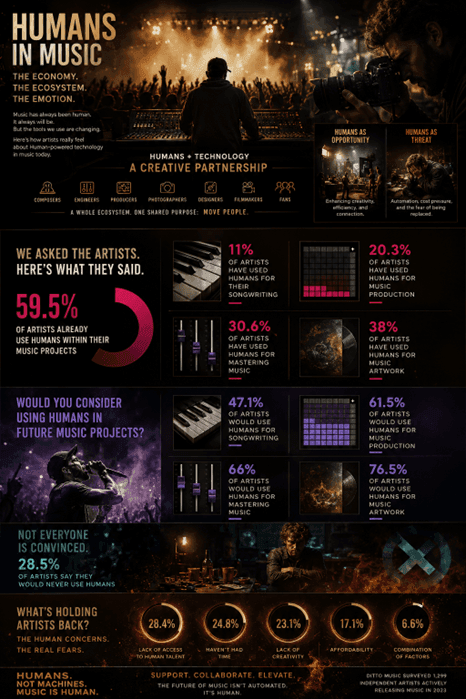
The Music AI and Live Performance Resurgence
Key trends shaping the industry as of mid-2026:
-
The Economic Shift & Revenue Impact
- Rapid Market Growth: The market for AI-generated music and audio-visual content is expanding rapidly, projected to grow from roughly €3 billion in 2024 to over €60 billion by 2028.
- Income Decline for Artists: AI-generated content is expected to cause a significant decline in revenue for human creators, with some estimates suggesting a potential 24% drop in music creator revenues, according to a UN News report citing UNESCO.
- Streaming Fraud: AI has enabled the proliferation of millions of AI-generated “fake” songs that generate fraudulent royalties, making it easier for bad actors to avoid detection, notes WIPO.
-
AI in Music Production and Content Creation
- Democratisation of Tools: Modern DAWs (Digital Audio Workstations) now integrate AI for mixing, mastering, and generating, making studio-quality production accessible, as described in this Access Creative College article.
- AI as Collaborator: Artists use AI to create whole new, original, and dynamic soundscapes.
- Ethical AI Deals: Music labels are moving towards licensing deals with “ethical” AI companies to use their catalogs for training, as reported by Music Week.
- Genre Suitability: Public opinion suggests AI works best for pop, dance, and rap, but less so for soul, blues, and folk, according to Royal Philharmonic Orchestra research.
-
Impact on the Concert Economy
- Live Performance Resurgence: Despite the rise of virtual, AI-generated artists, 78% of people believe AI will not replace human creativity in live performances, notes Royal Philharmonic Orchestra research.
- Adaptive Shows: Future concerts may feature AI-generated, real-time, adaptive music that changes based on audience, crowd, and biometric data.
- Immersive Experiences: Technologies like 3D sound environments are creating new forms of immersive listening, as in this IKLECTIK event.
-
Key Challenges and Regulatory Action
- Copyright and Licensing: The Musicians Union is fighting for, , and , to protect artists from having their work used to train AI models without compensation.
- Labels and Transparency: There is a push to mandate the labeling of AI-generated content so consumers know what they are listening to.
- Protecting Human Artists: Industry bodies like UK Music are emphasizing that human creativity should remain at the center of the industry, advocating for policies that prevent AI from being a “destroyer of creators’ livelihoods”.
Spotify’s two-track strategy. On the Q4 2025 earnings call, Co-CEO Gustav Söderström laid out a two-part AI strategy: fully original music created with generative tools, and “derivatives” of existing songs, including remixes, reinterpretations, and covers. Söderström described “derivatives, new takes on existing music” as an “untapped opportunity for artists to make money off of their existing IP”. “Right now, existing creators are largely left out of the AI opportunity altogether… That’s because the copyright problem is much more complicated to solve well, and the attribution problem of who should get paid what is much harder. But we love hard problems“, he added on the Q1 2026 call. SoundGuysMusic Business Worldwide
The tool stack of 2026. Suno leads on high-fidelity vocal synthesis and one-click full-song generation. Udio dominates audio-to-audio style transfer. ElevenLabs Music has positioned itself as the licensed, copyright-clean alternative. AIVA remains the standard for cinematic scoring with MIDI export. Logic Pro 2 ships with Smart Mixing agents. Soundverse and similar platforms let artists train AI on their own sonic identity and sell it as a blockchain-verified asset — what the industry now calls a “Licensed DNA Package.”
The music creator of 2026 is not a romantic figure with a guitar. They are an orchestrator of voices, models, agents and rights. They manage their own digital twin the way a record label of 1995 managed a single signed artist.
While the recorded music economy fragments under AI pressure, the live economy intensifies. The Royal Philharmonic Orchestra’s 2025 research found that 78% of audiences believe AI will not replace human creativity in live performance. Concert tour revenues have continued to climb. Adaptive, biometrically-responsive shows are emerging — where the music itself reshapes around the audience’s collective heart rate and movement.
The body, it turns out, is the last unfakeable medium. Sweat, breath, time, presence — these are the new premiums. The 4.5 million globally active entertainment-based gig musicians, and the 309,000 core creative roles in UK music alone, are increasingly anchored in the physical, the local, the temporally-bounded. The cave painter survives by being unrepeatable.
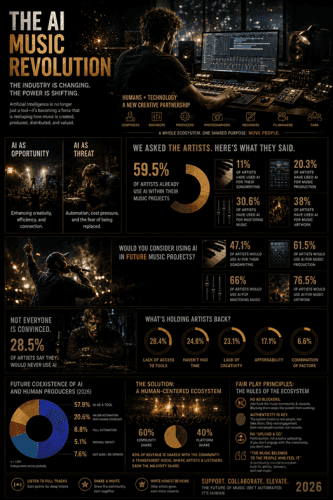
SWOT Analysis — AI and the Creator Economy in 2026
I want to summarise these concepts and ideas with a SWOT analysis that deep dive into the present challenges and opportunities the industry is facing.
STRENGTHS
- Radical productivity expansion: 14–15% in customer support, 26% in software development, 50% in marketing output, and up to +60% in visual ideation. Stanford
- Democratisation of professional-grade production — anyone with a laptop can now reach studio-quality output.
- Personalisation at planetary scale: AI DJs, agentic playlists, adaptive learning. Spotify’s adoption has pushed its catalogue to 250 million tracks and over 713 million MAUs.
- Massive consumer surplus: $172 billion in U.S. consumer value from generative AI tools annually. Stanford
- New monetisable assets — “Sonic Identity” licensing, AI derivatives, agentic micro-businesses.
- The Hybrid Creator pipeline is exploding: 238% growth in music majors at UC Berkeley between 2020 and 2024. Berkeley
WEAKNESSES
- Content saturation: 60,000 AI-generated tracks per day on a single platform; signal drowning in supply.
- Income compression: up to 24% of human music creator revenue projected to vanish by 2028.
- Reputational tax on disclosed AI use depresses pricing power.
- The 86% long-tail of streaming tracks still receive fewer than 1,000 plays.
- Loss of craft mastery: “Recent evidence raises concerns that heavy AI reliance may carry long-term learning penalties that slow skill development over time”. Stanford
- Work intensification: Berkeley Haas evidence that AI expands scope and hours rather than freeing time. Berkeley Haas
OPPORTUNITIES
- AI derivatives — Spotify’s planned framework could open an entirely new royalty class on existing IP.
- Licensed Sonic DNA — artists selling blockchain-verified vocal and stylistic identity.
- Live and immersive experiences — biometric, spatial, ambisonic concerts where human presence is the value.
- Micro-multinational entrepreneurship — single creators operating with the structural capacity of legacy agencies.
- Cultural and linguistic diversification — non-English markets (Arabic, Mandarin, Indigenous traditions) gaining first-class production capacity.
- Education and certification economy — AI literacy, prompt orchestration and ethical AI auditing as new professional categories.
THREATS
- Streaming fraud and AI slop — fraudulent royalty harvesting at industrial scale.
- Training-data opacity — unresolved questions about which artists’ work was used to build generative models.
- Concentration of platform power — Spotify, Apple, Meta, Google and TikTok as the new gatekeepers of attention and royalty distribution.
- Regulatory lag — copyright, labelling and licensing frameworks are years behind the technology.
- Carbon and energy footprint — training frontier models such as xAI’s Grok 4 can generate over 72,000 tons of CO2-equivalent emissions. IEEE Spectrum
- Geopolitical fragmentation — divergent AI rules between the U.S., EU, China and the Global South.
- Mental health and burnout — work intensification translating to higher anxiety, technostress and creator drop-out.
Conclusion — AI Music and Creator Economy: Positive, Negative, and the Civilisational Question
AI is doing to music and the creative economy what the printing press did to scripture and what electricity did to labour but in an accelerated path and with multipliers of disruption: it is collapsing the cost of production and forcing the entire ecosystem to renegotiate value, meaning and authorship.
On the positive side, the 404 million have access to capabilities that no Medici, no Motown, no major label of the 1990s could have conjured. A teenager in Lagos, Lisbon or Lima can now compose, produce, market and distribute a globally-discoverable record from a phone. Personalisation is reaching levels that border on the telepathic. New revenue classes — derivatives, sonic identity licensing, adaptive live shows — are being invented in real time. Education is democratised. The middle of the creator class is thickening, with 45% of professional creators earning between $10,000 and $100,000 annually. This is not a fad. It is the formalisation of a new economic stratum.
On the negative side, the same machinery is corroding the floor beneath those who used to make a living from the average song, the average photograph, the average article. Up to a quarter of music revenue is at risk of substitution. Work has not become lighter — Berkeley Haas’s evidence shows it has become heavier, faster, longer and lonelier. Streaming fraud is now industrial. Training-data opacity is the unresolved ethical wound of the entire field. And carbon, attention and mental-health costs are mounting at a pace policy has not begun to match.
The deeper question, however, is civilisational. From the ochre of Blombos to the algorithms of Suno, the human creative impulse has always been the species talking to itself across time. AI does not end that conversation — it changes who is speaking. Whether the next chapter is augmentation or automation depends almost entirely on what the 404 million choose to defend. If they defend only their output, they will lose to the models. If they defend their evidence — their presence, their lineage, their lived witness — they will redefine what art is worth in an age of infinite supply.
The creator of 2026 is no longer a producer. They are a custodian of meaning in a flood of signal. They are, in the most literal sense, humanity rehearsing what it wants to remain. Each individual hand on a fader, each verse written between meetings, each beat shaped at midnight, carries the whole arc of human imagination forward — from the first cave wall to the last neural network, the song is one continuous breath, and we are still inside it.
References and Sources
- Stanford HAI. The 2026 AI Index Report. Stanford Institute for Human-Centered Artificial Intelligence. https://hai.stanford.edu/ai-index/2026-ai-index-report
- Stanford HAI. Inside the AI Index: 12 Takeaways from the 2026 Report. https://hai.stanford.edu/news/inside-the-ai-index-12-takeaways-from-the-2026-report
- Stanford HAI. Economy — The 2026 AI Index Report. https://hai.stanford.edu/ai-index/2026-ai-index-report/economy
- Ye, X. M. & Ranganathan, A. (2026). AI Doesn’t Reduce Work — It Intensifies It. Harvard Business Review, February 2026. https://hbr.org/2026/02/ai-doesnt-reduce-work-it-intensifies-it
- UC Berkeley Haas Newsroom. AI promised to free up workers’ time. UC Berkeley Haas researchers found the opposite. (February 2026). https://newsroom.haas.berkeley.edu/ai-promised-to-free-up-workers-time-uc-berkeley-haas-researchers-found-the-opposite/
- UC Berkeley CNMAT. Music professors Campion and Cella steer CNMAT through the AI era. Berkeley Arts & Humanities / Letters & Science (September 2025). https://artshumanities.berkeley.edu/news/music-professors-campion-and-cella-steer-cnmat-through-ai-era
- UC Berkeley CNMAT. Center for New Music and Audio Technologies — Research. https://cnmat.berkeley.edu/research
- Music Business Worldwide. Spotify Co-CEOs outline AI ambitions on Q1 2026 earnings call. (April 2026). https://www.musicbusinessworldwide.com/spotifys-co-ceos-outline-ai-ambitions-and-more-on-q1-2026-earnings-call/
- Sound Guys. Spotify wants to let fans create AI remixes and covers, but licensing is the hurdle. (February 2026).
- Music In Africa. Spotify catalogue hits 250 million tracks amid questions over AI, recommendation strategy. (April 2026).
- Digital Music News. Spotify Song Library Contains 250 Million Tracks, Co-CEO Says. (April 2026).
- UNESCO. The Future of Cultural Work and Creative Economy in the Age of Generative AI (2026 report).
- WIPO. AI-Generated Music and Streaming Fraud — Industry Briefing (2025–26).
- Roland Berger / MIDiA Research. Music Creator Revenue Outlook 2024–2028.
- Royal Philharmonic Orchestra. Public Attitudes on AI and Live Music (2025).
- Meticulous Research. Global AI Music Generation Market Forecast (2026–2036).
- IEEE Spectrum. Stanford’s AI Index for 2026 Shows the State of AI. (April 2026). https://spectrum.ieee.org/state-of-ai-index-2026
- Diamandis, P. & Kotler, S. Abundance and The Future Is Faster Than You Think.
- Guarda, D. 4IR, The 5th Industrial Revolution, LifesDNA, Wisdomia Atlas.


